CapitalFreetown
LanguagesEnglish , Mende , Temne , and Krio
Currencyleones
Governmentpresidential republic
Bamwor Indexes
Sierra Leone — Q1 2026
IBEUBamwor Urban Scale Index
8.60%
Rank #173 of 237
View full ranking →
IBCPBamwor Population Concentration Index
14.28%
Rank #192 of 237
View full ranking →
IBDABamwor Settlement Density Index
200.74per 1K km²
Rank #74 of 241
View full ranking →
IBCXBamwor Country Complexity Index
59.10/100
Rank #122 of 234
View full ranking →
IBEEBamwor Economic Stability Index
81.35/100
Rank #178 of 220
View full ranking →
IBFMBamwor Military Strength Index
39.14/100
Rank #102 of 124
View full ranking →
IBDIBamwor Digital Infrastructure Index
26.80/100
Rank #200 of 206
View full ranking →
IBEDBamwor Education Index
25.09/100
Rank #113 of 119
View full ranking →
IBSABamwor Healthcare Index
44.00/100
Rank #208 of 218
View full ranking →
Sierra Leone Intelligence Report
Download PDF with 20+ statistics, rankings & proprietary indices
Introduction
Background
The region currently identified as Sierra Leone has been continuously inhabited for a minimum of 2,500 years and is characterized by thick jungles that historically shielded it from incursions by West African empires. The introduction of Islam to Sierra Leone was facilitated by traders, and it plays a significant role in the cultural and historical landscape of the nation. In the 17th century, the British established a trading post in the vicinity of what is now known as Freetown. Initial trade activities focused on timber and ivory, but subsequently evolved to include the trafficking of enslaved individuals. Following the American Revolution in 1787, Sierra Leone emerged as a refuge for Black British loyalists from the newly formed United States. After Britain prohibited the slave trade in 1807, numerous liberated Africans were transported to Sierra Leone aboard British vessels. Throughout the 19th century, the colony gradually expanded its territory inland.
Sierra Leone gained independence from the United Kingdom in 1961. The country held free and fair elections in 1962 and 1967; however, Siaka STEVENS, who was the second prime minister of Sierra Leone, quickly shifted towards authoritarianism, banning most political parties and maintaining power from 1967 until 1985. In 1991, soldiers from Sierra Leone initiated a civil war against STEVENS' governing party. The conflict resulted in the deaths of tens of thousands and displaced over 2 million individuals, approximately one-third of the population. A Nigerian-led coalition military force from West Africa intervened in 1998, reinstating Tejan KABBAH, who had been elected in 1996, as prime minister. In 2002, KABBAH declared the official conclusion of the civil war. Since 1998, democratic elections have been held in Sierra Leone, primarily involving the two leading political entities: the Sierra Leone People’s Party (SLPP) and the All People’s Congress (APC). Julius Maada BIO of the Sierra Leone People’s Party secured victory in the 2018 presidential election, which experienced a significant voter turnout despite some claims of voter intimidation. BIO was re-elected in June 2023, although certain irregularities raised concerns regarding the legitimacy of the election results. In October 2023, the Government of Sierra Leone and the principal opposition party, the All People’s Congress, formalized the Agreement for National Unity to enhance collaboration between political factions and initiate reforms to the nation’s electoral framework.
Geography
Area
land
71,620 sq km
water
120 sq km
total
71,740 sq km
Climate
tropical; characterized by heat and humidity; summer rainy period (May to December); dry winter period (December to April)
Terrain
mangrove swamp coastal regions, hilly wooded areas, elevated plateaus, and mountains in the eastern region
Land use
other
11% (2023 est.)
forest
34.3% (2023 est.)
agricultural land
54.7% (2023 est.)
agricultural land: arable land
arable land: 21.9% (2023 est.)
agricultural land: permanent crops
permanent crops: 2.3% (2023 est.)
agricultural land: permanent pasture
permanent pasture: 30.5% (2023 est.)
Location
Located in Western Africa, adjacent to the North Atlantic Ocean, situated between Guinea and Liberia
Coastline
402 km
Elevation
lowest point
Atlantic Ocean 0 m
highest point
Loma Mansa (Bintimani) 1,948 m
mean elevation
279 m
Irrigated land
300 sq km (2012)
Map references
Africa
Land boundaries
total
1,093 km
border countries
Guinea 794 km; Liberia 299 km
Maritime claims
contiguous zone
24 nm
territorial sea
12 nm
continental shelf
200 nm
exclusive economic zone
200 nm
Natural hazards
dry and dusty harmattan winds originating from the Sahara occur from December to February; occurrences of sandstorms and dust storms
Geography - note
coastal rainfall can attain up to 495 cm (195 in) annually, ranking it among the wettest regions in coastal western Africa
Natural resources
diamonds, titanium ore, bauxite, iron ore, gold, and chromite
Area - comparative
marginally smaller than the state of South Carolina
Geographic coordinates
8 30 N, 11 30 W
Population distribution
population is concentrated in the lower altitudes of the southern and western areas; the northern third of the nation is less densely populated, as illustrated in this population distribution map
Major watersheds (area sq km)
Atlantic Ocean drainage
Niger (2,261,741 sq km)
People & Society
Literacy
male
54.6% (2019 est.)
female
33.9% (2019 est.)
total population
43.6% (2019 est.)
Languages
English (official language, with regular use confined to a literate minority), Mende (the main vernacular in the southern region), Temne (the primary vernacular in the northern region), and Krio (an English-based Creole spoken by the descendants of liberated Jamaican slaves; serves as a first language for 10% of the populace but is comprehended by 95%)
Religions
Muslim 77.1%, Christian 22.9% (2019 est.)
Sex ratio
at birth
1.03 male(s)/female
0-14 years
1.02 male(s)/female
15-64 years
0.96 male(s)/female
total population
0.98 male(s)/female (2024 est.)
65 years and over
0.97 male(s)/female
Birth rate
30.04 births/1,000 population (2025 est.)
Death rate
8.8 deaths/1,000 population (2025 est.)
Median age
male
19 years
total
19.7 years (2025 est.)
female
19.9 years
Population
male
4,620,638
total
9,331,203 (2025 est.)
female
4,710,565
Nationality
noun
Sierra Leonean(s)
adjective
Sierra Leonean
Tobacco use
male
14.8% (2025 est.)
total
9.8% (2025 est.)
female
4.9% (2025 est.)
Urbanization
urban population
44.3% of total population (2023)
rate of urbanization
3.02% annual rate of change (2020-25 est.)
Age structure
0-14 years
40.1% (male 1,843,606/female 1,812,304)
15-64 years
57.4% (male 2,557,715/female 2,675,418)
65 years and over
2.5% (2024 est.) (male 114,405/female 117,601)
Ethnic groups
Temne 35.4%, Mende 30.8%, Limba 8.8%, Kono 4.3%, Korankoh 4%, Fullah 3.8%, Mandingo 2.8%, Loko 2%, Sherbro 1.9%, Creole 1.2% (descendants of freed Jamaican slaves who were settled in the Freetown area in the late-18th century; also known as Krio), other 5% (2019 est.)
Child marriage
men married by age 18
4.1% (2019)
women married by age 15
8.6% (2019)
women married by age 18
29.6% (2019)
Dependency ratios
total dependency ratio
72.7 (2025 est.)
youth dependency ratio
68.4 (2025 est.)
potential support ratio
22.9 (2025 est.)
elderly dependency ratio
4.4 (2025 est.)
Physician density
0.13 physicians/1,000 population (2022)
Health expenditure
Health expenditure (as % of GDP)
8.6% of GDP (2021)
Health expenditure (as % of national budget)
5.2% of national budget (2022 est.)
Net migration rate
1.13 migrant(s)/1,000 population (2025 est.)
Total fertility rate
3.52 children born/woman (2025 est.)
Drinking water source
improved: rural
rural: 54.1% of population (2022 est.)
improved: total
total: 65.3% of population (2022 est.)
improved: urban
urban: 79.8% of population (2022 est.)
unimproved: rural
rural: 45.9% of population (2022 est.)
unimproved: total
total: 34.7% of population (2022 est.)
unimproved: urban
urban: 20.2% of population (2022 est.)
Education expenditure
Education expenditure (% GDP)
2.6% of GDP (2023 est.)
Education expenditure (% national budget)
20.5% national budget (2025 est.)
Infant mortality rate
male
76 deaths/1,000 live births
total
70.1 deaths/1,000 live births (2025 est.)
female
66.2 deaths/1,000 live births
Population growth rate
2.24% (2025 est.)
Gross reproduction rate
1.73 (2025 est.)
Population distribution
population concentrations are located in the lower altitudes of the southern and western areas; the northern third of the nation is sparsely populated, as indicated on this population distribution map
Life expectancy at birth
male
57.8 years
female
61 years
total population
59.4 years (2024 est.)
Maternal mortality ratio
354 deaths/100,000 live births (2023 est.)
Sanitation facility access
improved: rural
rural: 37.9% of population (2022 est.)
improved: total
total: 57.2% of population (2022 est.)
improved: urban
urban: 81.9% of population (2022 est.)
unimproved: rural
rural: 62.1% of population (2022 est.)
unimproved: total
total: 42.8% of population (2022 est.)
unimproved: urban
urban: 18.1% of population (2022 est.)
Alcohol consumption per capita
beer
0.17 liters of pure alcohol (2019 est.)
wine
0.01 liters of pure alcohol (2019 est.)
total
3.22 liters of pure alcohol (2019 est.)
spirits
0.15 liters of pure alcohol (2019 est.)
other alcohols
2.9 liters of pure alcohol (2019 est.)
Major urban areas - population
1.309 million FREETOWN (capital) (2023)
Obesity - adult prevalence rate
8.7% (2016)
Mother's mean age at first birth
19.6 years (2019 est.)
Currently married women (ages 15-49)
61.5% (2019 est.)
Children under the age of 5 years underweight
12% (2021 est.)
Environment
Climate
tropical; characterized by high temperatures and humidity; summer precipitation period (May to December); winter dry period (December to April)
Land use
other
11% (2023 est.)
forest
34.3% (2023 est.)
agricultural land
54.7% (2023 est.)
agricultural land: arable land
arable land: 21.9% (2023 est.)
agricultural land: permanent crops
permanent crops: 2.3% (2023 est.)
agricultural land: permanent pasture
permanent pasture: 30.5% (2023 est.)
Urbanization
urban population
44.3% of total population (2023)
rate of urbanization
3.02% annual rate of change (2020-25 est.)
Waste and recycling
municipal solid waste generated annually
610,200 tons (2024 est.)
percent of municipal solid waste recycled
9.7% (2022 est.)
Environmental issues
unsustainable logging practices, growth of cattle ranching, and slash-and-burn farming leading to deforestation, soil depletion, and increased flooding; reduction in biodiversity; air contamination; water contamination; overexploitation of fish populations
Total water withdrawal
municipal
111 million cubic meters (2022 est.)
industrial
55.5 million cubic meters (2022 est.)
agricultural
45.7 million cubic meters (2022 est.)
Carbon dioxide emissions
total emissions
1.342 million metric tonnes of CO2 (2023 est.)
from petroleum and other liquids
1.342 million metric tonnes of CO2 (2023 est.)
Particulate matter emissions
45.4 micrograms per cubic meter (2019 est.)
Total renewable water resources
160 billion cubic meters (2022 est.)
International environmental agreements
party to
Biodiversity, Climate Change, Climate Change-Kyoto Protocol, Climate Change-Paris Agreement, Comprehensive Nuclear Test Ban, Desertification, Endangered Species, Hazardous Wastes, Law of the Sea, Marine Dumping-London Convention, Marine Dumping-London Protocol, Marine Life Conservation, Nuclear Test Ban, Ozone Layer Protection, Ship Pollution, Wetlands
signed, but not ratified
Environmental Modification
Government
Flag
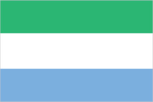
description: three equal horizontal bands of light green (top), white, and light blue
meaning: the color green symbolizes agriculture, mountains, and natural resources; white represents unity and justice; while blue denotes the sea and the natural harbor located in Freetown
Capital
name
Freetown
etymology
the term refers to the initial settlement established in 1781, which acted as a refuge for free-born and liberated African Americans
time difference
UTC 0 (5 hours ahead of Washington, DC, during Standard Time)
geographic coordinates
8 29 N, 13 14 W
Suffrage
18 years of age; universal
Citizenship
citizenship by birth
no
citizenship by descent only
at least one parent or grandparent must be a citizen of Sierra Leone
dual citizenship recognized
yes
residency requirement for naturalization
5 years
Constitution
history
several previous; latest effective 1 October 1991
amendment process
proposed by Parliament; the approval of amendments necessitates a two-thirds majority vote by Parliament in two consecutive readings and the president's assent; amendments that impact fundamental rights and freedoms, along with various other constitutional provisions, also require a referendum with participation from at least half of qualified voters and two-thirds of the votes cast
Country name
etymology
the Portuguese explorer Pedro de SINTRA is generally acknowledged as the one who named the country "Serra da Leao" (Lion Mountains) in 1462, although the Venetian explorer Alvise CA' DA MOSTO documented the name as "Serre-Lionne" in 1457, which referred to the sound of thunder echoing over the mountains
local long form
Republic of Sierra Leone
local short form
Sierra Leone
conventional long form
Republic of Sierra Leone
conventional short form
Sierra Leone
Independence
27 April 1961 (from the UK)
Legal system
a hybrid legal system combining English common law and customary law
Government type
presidential republic
Judicial branch
highest court(s)
Superior Court of Judicature (comprises the Supreme Court at its apex, including the chief justice and four additional judges, the Court of Appeal with the chief justice and seven other judges, and the High Court of Justice with the chief justice and nine other judges)
subordinate courts
magistrates' courts; District Appeals Court; local courts
judge selection and term of office
the chief justice of the Supreme Court and other judges of the Judicature are appointed by the president based on recommendations from the Judicial and Legal Service Commission, an independent body consisting of judges, presidential appointees, and the Commission chairman, subject to Parliament's approval; all judges of the Judicature serve until they reach the retirement age of 65
Executive branch
cabinet
Ministers of State are appointed by the president and require Parliament's approval; the cabinet is accountable to the president
chief of state
President Julius Maada BIO (since 27 June 2023)
election results
2023: Julius Maada BIO reelected president in first round; percent of vote - Julius Maada BIO (SLPP) 56.2%, Samura KAMARA (APC) 41.2%, other 2.6%
2018: Julius Maada BIO elected president in second round; percent of vote - Julius Maada BIO (SLPP) 51.8%, Samura KAMARA (APC) 48.2%
head of government
President Julius Maada BIO (since 27 June 2023)
most recent election date
24 June 2023
election/appointment process
the president is elected directly by securing 55% of the votes in the first round or an absolute majority in two rounds if necessary, serving a term of five years (eligible for re-election for a second term)
expected date of next election
June 2028
National holiday
Independence Day, 27 April (1961)
National color(s)
green, white, blue
National heritage
total World Heritage Sites
1 (natural)
selected World Heritage Site locales
Gola-Tiwai Complex (n)
Political parties
All People's Congress or APC
Sierra Leone People's Party or SLPP
Legislative branch
term in office
5 years
number of seats
149 (135 directly elected; 14 indirectly elected)
electoral system
proportional representation
legislature name
Parliament
scope of elections
full renewal
legislative structure
unicameral
most recent election date
6/24/2023
expected date of next election
June 2028
percentage of women in chamber
29.5%
parties elected and seats per party
Sierra Leone People's Party (SLPP) (81); All People's Congress (APC) (54)
National anthem(s)
title
"High We Exalt Thee, Realm of the Free"
history
adopted 1961
lyrics/music
Clifford Nelson FYLE/John Joseph AKA
National symbol(s)
lion
Administrative divisions
4 provinces and 1 area*; Eastern, Northern, North Western, Southern, Western*
Diplomatic representation in the US
FAX
[1] (202) 483-1793
chancery
1701 19th Street NW, Washington, DC 20009-1605
telephone
[1] (202) 939-9261
chief of mission
Ambassador Amara Sheikh Mohammed SOWA (since 24 July 2025)
email address and website
[email protected]
https://embassyofsierraleone.net/
Diplomatic representation from the US
embassy
Southridge-Hill Station, Freetown
telephone
[232] 99 105 000
mailing address
2160 Freetown Place, Washington DC 20521-2160
chief of mission
Ambassador (vacant); Chargé d'Affaires Jared M. YANCEY (since 18 September 2025)
email address and website
[email protected]
https://sl.usembassy.gov/
International organization participation
ACP, AfDB, ATMIS, AU, C, ECOWAS, EITI (compliant country), FAO, G-77, IAEA, IBRD, ICAO, ICCt, ICRM, IDA, IDB, IFAD, IFC, IFRCS, IHO (pending member), ILO, IMF, IMO, Interpol, IOC, IOM, IPU, ISO (correspondent), ITU, ITUC (NGOs), MIGA, NAM, OIC, OPCW, UN, UNAMID, UNCTAD, UNESCO, UNIDO, UNIFIL, UNISFA, UNOOSA, UNSOM, UNWTO, UPU, WCO, WFTU (NGOs), WHO, WIPO, WMO, WTO
International law organization participation
has not made an ICJ jurisdiction declaration; acknowledges ICCt jurisdiction
Economy
Budget
revenues
$740 million (2019 est.)
expenditures
$867 million (2019 est.)
Exports
Exports 2021
$928.689 million (2021 est.)
Exports 2022
$1.202 billion (2022 est.)
Exports 2023
$1.382 billion (2023 est.)
Imports
Imports 2021
$1.91 billion (2021 est.)
Imports 2022
$2.074 billion (2022 est.)
Imports 2023
$2.264 billion (2023 est.)
Industries
diamond extraction; iron ore, rutile, and bauxite extraction; small-scale production (beverages, textiles, footwear)
Labor force
2.863 million (2024 est.)
Public debt
Public debt 2016
54.9% of GDP (2016 est.)
Remittances
Remittances 2021
2.6% of GDP (2021 est.)
Remittances 2022
4.1% of GDP (2022 est.)
Remittances 2023
4.6% of GDP (2023 est.)
Exchange rates
Currency
leones (SLL) per US dollar -
Exchange rates 2019
9.01 (2019 est.)
Exchange rates 2020
9.83 (2020 est.)
Exchange rates 2021
10.439 (2021 est.)
Exchange rates 2022
14.048 (2022 est.)
Exchange rates 2023
21.305 (2023 est.)
Debt - external
Debt - external 2023
$1.451 billion (2023 est.)
Economic overview
a low-income economy in West Africa; mainly reliant on subsistence farming; significant iron and diamond mining operations are halted; gradual recovery from the civil conflict of the 1990s; pervasive corruption; high-risk indebtedness; elevated youth unemployment; rich in natural resources
Unemployment rate
Unemployment rate 2022
3.2% (2022 est.)
Unemployment rate 2023
3.2% (2023 est.)
Unemployment rate 2024
3.2% (2024 est.)
Exports - partners
China 67%, India 6%, Belgium 5%, Netherlands 4%, Ireland 3% (2023)
Imports - partners
China 32%, India 15%, UAE 5%, USA 5%, Turkey 5% (2023)
Real GDP per capita
Real GDP per capita 2022
$2,900 (2022 est.)
Real GDP per capita 2023
$3,000 (2023 est.)
Real GDP per capita 2024
$3,100 (2024 est.)
Real GDP growth rate
Real GDP growth rate 2022
5.3% (2022 est.)
Real GDP growth rate 2023
5.7% (2023 est.)
Real GDP growth rate 2024
4% (2024 est.)
Agricultural products
cassava, rice, oil palm fruit, vegetables, sweet potatoes, milk, citrus fruits, other fruits, groundnuts, sugarcane (2023)
Exports - commodities
iron ore, titanium ore, diamonds, aluminum ore, cocoa beans (2023)
Imports - commodities
rice, plastic goods, packaged pharmaceuticals, cement, automobiles (2023)
Current account balance
Current account balance 2021
-$522.815 million (2021 est.)
Current account balance 2022
-$452.094 million (2022 est.)
Current account balance 2023
-$606.358 million (2023 est.)
GDP (official exchange rate)
$7.548 billion (2024 est.)
GDP - composition, by end use
household consumption
87.6% (2024 est.)
government consumption
5.5% (2024 est.)
investment in inventories
0% (2024 est.)
investment in fixed capital
29.5% (2024 est.)
exports of goods and services
20.9% (2024 est.)
imports of goods and services
-43.5% (2024 est.)
Population below poverty line
56.8% (2018 est.)
Inflation rate (consumer prices)
Inflation rate (consumer prices) 2022
27.2% (2022 est.)
Inflation rate (consumer prices) 2023
47.6% (2023 est.)
Inflation rate (consumer prices) 2024
28.6% (2024 est.)
Industrial production growth rate
4.7% (2024 est.)
Real GDP (purchasing power parity)
Real GDP (purchasing power parity) 2022
$24.312 billion (2022 est.)
Real GDP (purchasing power parity) 2023
$25.7 billion (2023 est.)
Real GDP (purchasing power parity) 2024
$26.728 billion (2024 est.)
Youth unemployment rate (ages 15-24)
male
4.8% (2024 est.)
total
3.6% (2024 est.)
female
2.5% (2024 est.)
Reserves of foreign exchange and gold
Reserves of foreign exchange and gold 2021
$945.908 million (2021 est.)
Reserves of foreign exchange and gold 2022
$624.496 million (2022 est.)
Reserves of foreign exchange and gold 2023
$495.699 million (2023 est.)
GDP - composition, by sector of origin
industry
27.3% (2024 est.)
services
44.8% (2024 est.)
agriculture
25.4% (2024 est.)
Household income or consumption by percentage share
lowest 10%
3.4% (2018 est.)
highest 10%
29.4% (2018 est.)
Gini Index coefficient - distribution of family income
Gini Index coefficient - distribution of family income 2018
35.7 (2018 est.)
Energy
Petroleum
refined petroleum consumption
9,000 bbl/day (2023 est.)
Electricity
consumption
131.321 million kWh (2023 est.)
installed generating capacity
149,000 kW (2023 est.)
transmission/distribution losses
81.921 million kWh (2023 est.)
Electricity access
electrification - rural areas
5%
electrification - urban areas
55.3%
electrification - total population
29.4% (2022 est.)
Energy consumption per capita
Total energy consumption per capita 2023
2.301 million Btu/person (2023 est.)
Electricity generation sources
solar
9.8% of total installed capacity (2023 est.)
fossil fuels
3.4% of total installed capacity (2023 est.)
hydroelectricity
84.4% of total installed capacity (2023 est.)
biomass and waste
2.3% of total installed capacity (2023 est.)
Communications
Internet users
percent of population
21% (2023 est.)
Broadcast media
One state-operated television channel; three privately-owned television channels; one subscription-based television service; one state-owned national radio broadcaster; approximately 24 privately-owned radio stations; broadcasts from various international media outlets accessible (2019)
Internet country code
.sl
Telephones - fixed lines
total subscriptions
0 (2021 est.)
subscriptions per 100 inhabitants
(2022 est.) less than 1
Telephones - mobile cellular
total subscriptions
8.93 million (2022 est.)
subscriptions per 100 inhabitants
108 (2022 est.)
Broadband - fixed subscriptions
total
0 (2021 est.)
subscriptions per 100 inhabitants
(2021 est.) less than 1
Transportation
Ports
large
0
small
1
medium
0
key ports
Bonthe, Freetown, Pepel
very small
2
total ports
3 (2024)
ports with oil terminals
2
Airports
8 (2025)
Heliports
3 (2025)
Merchant marine
total
584 (2023)
by type
33 bulk carriers, 8 container ships, 320 general cargo vessels, 97 oil tankers, 126 others
Civil aircraft registration country code prefix
9L
Military & Security
Military - note
The primary duties of the RSLAF involve safeguarding the nation's borders and territorial seas, aiding civil authorities during domestic crises, and engaging in peacekeeping operations. Following the conclusion of the civil war in 2002, it has benefited from support provided by various foreign military forces, including those from Canada, China, France, the United Kingdom, and the United States.
The RSLAF traces its roots to the Sierra Leone Battalion of the Royal West African Frontier Force (RWAFF), a multi-regimental entity established by the British colonial administration in 1900 to garrison the West African territories of Gold Coast (Ghana), Nigeria (specifically Lagos and the protectorates of Northern and Southern Nigeria), Sierra Leone, and The Gambia. The RWAFF participated in both World Wars (2025).
Military expenditures
Military Expenditures 2020
0.3% of GDP (2020 est.)
Military Expenditures 2021
0.3% of GDP (2021 est.)
Military Expenditures 2022
0.6% of GDP (2022 est.)
Military Expenditures 2023
0.6% of GDP (2023 est.)
Military Expenditures 2024
0.5% of GDP (2024 est.)
Military and security forces
Republic of Sierra Leone Armed Forces (RSLAF): structured as a Joint Force Command comprising land, air, and naval elements.
Ministry of Internal Affairs: Sierra Leone Police (2025).
Military service age and obligation
The age range for voluntary military service is 18 to 25 for both men and women; there is no conscription (2025).
Military equipment inventories and acquisitions
The RSLAF maintains a limited inventory, consisting mainly of outdated or secondhand imported weaponry (2025).
Military and security service personnel strengths
estimated 10,000 active Armed Forces (2025)