CapitalBissau
LanguagesCreole deriving from Portuguese, Portuguese , Pular , Mandingo
CurrencyCommunaute Financiere Africaine francs
Governmentsemi-presidential republic
Bamwor Indexes
Guinea-Bissau — Q1 2026
IBEUBamwor Urban Scale Index
20.62%
Rank #80 of 237
View full ranking →
IBCPBamwor Population Concentration Index
26.06%
Rank #132 of 237
View full ranking →
IBDABamwor Settlement Density Index
118.92per 1K km²
Rank #115 of 241
View full ranking →
IBCXBamwor Country Complexity Index
56.41/100
Rank #138 of 234
View full ranking →
IBEEBamwor Economic Stability Index
81.62/100
Rank #177 of 220
View full ranking →
IBFMBamwor Military Strength Index
34.43/100
Rank #112 of 124
View full ranking →
IBDIBamwor Digital Infrastructure Index
36.01/100
Rank #189 of 206
View full ranking →
IBEDBamwor Education Index
40.84/100
Rank #104 of 119
View full ranking →
IBSABamwor Healthcare Index
51.17/100
Rank #197 of 218
View full ranking →
Guinea-Bissau Intelligence Report
Download PDF with 20+ statistics, rankings & proprietary indices
Introduction
Background
Throughout much of its past, Guinea-Bissau was governed by the Mali Empire and the Kaabu Kingdom. In the 16th century, Portugal initiated the establishment of trading posts along the coast of Guinea-Bissau. Initially, Portuguese activities were confined to the coastal areas and nearby islands. Nevertheless, the lucrative nature of the slave and gold trades attracted the interest of local African leaders, enabling the Portuguese to gradually extend their influence and control inland. Beginning in the 18th century, the Mali Empire and the Kingdom of Kaabu started to fragment into smaller local entities. By the 19th century, Portugal had fully assimilated Guinea-Bissau into its colonial empire.
Following its independence in 1974, Guinea-Bissau underwent significant political and military turmoil. A military coup in 1980 resulted in General Joao Bernardo 'Nino' VIEIRA becoming president. VIEIRA's government was known for repressing political dissent and eliminating rivals. Numerous coup attempts throughout the 1980s and early 1990s did not succeed in removing him, but a military mutiny and subsequent civil war in 1999 culminated in VIEIRA's removal from power. In 2000, a transitional authority transferred control to opposition leader Kumba YALA. However, in 2003, a bloodless military coup ousted YALA and appointed businessman Henrique ROSA as interim president. In 2005, VIEIRA was re-elected, promising to focus on economic progress and national unity; he was assassinated in 2009. Malam Bacai SANHA was subsequently elected president, but he succumbed to a prolonged illness in 2012. A military coup disrupted the second round of the election intended to replace him, but after intervention by the Economic Community of West African States, a civilian transitional government was established. In 2014, Jose Mario VAZ was elected president in a democratic election, and in 2019, he became the first president in Guinea-Bissau’s history to serve a complete term. Umaro Sissoco EMBALO was elected president in 2019, but his assumption of office was delayed until 2020 due to a lengthy dispute over the election results.
Geography
Area
land
28,120 sq km
water
8,005 sq km
total
36,125 sq km
Climate
tropical; typically hot and humid; a monsoonal rainy season occurring from June to November influenced by southwesterly winds; a dry season from December to May characterized by northeasterly harmattan winds
Terrain
predominantly a low-lying coastal plain with a highly indented estuarine coastline, transitioning to savanna in the east; features many offshore islands, including the Arquipelago Dos Bijagos, which comprises 18 primary islands and numerous smaller islets
Land use
other
0% (2023 est.)
forest
75% (2023 est.)
agricultural land
29.9% (2023 est.)
agricultural land: arable land
arable land: 14.1% (2023 est.)
agricultural land: permanent crops
permanent crops: 8.9% (2023 est.)
agricultural land: permanent pasture
permanent pasture: 6.9% (2023 est.)
Location
Located in Western Africa, it lies along the North Atlantic Ocean, situated between Guinea and Senegal
Coastline
350 km
Elevation
lowest point
Atlantic Ocean 0 m
highest point
Dongol Ronde 277 m
mean elevation
70 m
Irrigated land
250 sq km (2012)
Major aquifers
Senegalo-Mauritanian Basin
Map references
Africa
Land boundaries
total
762 km
border countries
Guinea 421 km; Senegal 341 km
Maritime claims
territorial sea
12 nm
exclusive economic zone
200 nm
Natural hazards
during the dry season, the hot, dry, and dusty harmattan haze may impair visibility; occurrences of brush fires
Geography - note
this small nation exhibits swampy terrain along its western coastline and has low-lying areas inland
Natural resources
resources include fish, timber, phosphates, bauxite, clay, granite, limestone, and untapped petroleum deposits
Area - comparative
slightly less than three times the area of Connecticut
Geographic coordinates
12 00 N, 15 00 W
Population distribution
around one fifth of the population resides in the capital city of Bissau on the Atlantic coast; the rest is spread across eight predominantly rural regions, as depicted in this population distribution map
People & Society
Literacy
male
77.3% (2022 est.)
female
52.2% (2022 est.)
total population
63.9% (2022 est.)
Languages
Creole deriving from Portuguese, Portuguese (official language; predominantly utilized as a second or third language), Pular (a language of the Fula people), Mandingo
Religions
Muslim 46.1%, folk religions 30.6%, Christian 18.9%, other or unaffiliated 4.4% (2020 estimate)
Sex ratio
at birth
1.03 male(s)/female
0-14 years
1.01 male(s)/female
15-64 years
0.93 male(s)/female
total population
0.96 male(s)/female (2024 est.)
65 years and over
0.71 male(s)/female
Birth rate
35.82 births/1,000 population (2025 est.)
Death rate
6.99 deaths/1,000 population (2025 est.)
Median age
male
17.8 years
total
18.5 years (2025 est.)
female
18.9 years
Population
male
1,042,910
total
2,132,325 (2024 est.)
female
1,089,415
Nationality
noun
Bissau-Guinean(s)
adjective
Bissau-Guinean
Tobacco use
male
13.2% (2025 est.)
total
6.7% (2025 est.)
female
0.5% (2025 est.)
Urbanization
urban population
45.5% of total population (2023)
rate of urbanization
3.22% annual rate of change (2020-25 est.)
Age structure
0-14 years
42.3% (male 453,513/female 448,514)
15-64 years
54.6% (male 561,868/female 602,280)
65 years and over
3.1% (2024 est.) (male 27,529/female 38,621)
Ethnic groups
Balanta 30%, Fulani 30%, Manjaco 14%, Mandinga 13%, Papel 7%, and other smaller ethnic groups 6% (2015 estimate)
Child marriage
men married by age 18
2.2% (2019)
women married by age 15
8.1% (2019)
women married by age 18
25.7% (2019)
Dependency ratios
total dependency ratio
83.2 (2024 est.)
youth dependency ratio
77.5 (2024 est.)
potential support ratio
17.6 (2024 est.)
elderly dependency ratio
5.7 (2024 est.)
Physician density
0.25 physicians/1,000 population (2022)
Health expenditure
Health expenditure (as % of GDP)
8.2% of GDP (2021)
Health expenditure (as % of national budget)
5.2% of national budget (2022 est.)
Net migration rate
-3.36 migrant(s)/1,000 population (2025 est.)
Total fertility rate
4.59 children born/woman (2025 est.)
Drinking water source
improved: rural
rural: 52.5% of population (2022 est.)
improved: total
total: 61.8% of population (2022 est.)
improved: urban
urban: 73.1% of population (2022 est.)
unimproved: rural
rural: 47.5% of population (2022 est.)
unimproved: total
total: 38.2% of population (2022 est.)
unimproved: urban
urban: 26.9% of population (2022 est.)
Education expenditure
2.7% of GDP (2020 est.)
Infant mortality rate
male
52 deaths/1,000 live births
total
45.1 deaths/1,000 live births (2025 est.)
female
40.6 deaths/1,000 live births
Population growth rate
2.55% (2025 est.)
Gross reproduction rate
2.26 (2025 est.)
Population distribution
around 20% of the population resides in the capital city of Bissau on the Atlantic coast; the rest are spread across the eight predominantly rural regions, as depicted in this population distribution map
Life expectancy at birth
male
62.2 years
female
66.8 years
total population
64.5 years (2024 est.)
Maternal mortality ratio
505 deaths/100,000 live births (2023 est.)
Sanitation facility access
improved: rural
rural: 23.8% of population (2022 est.)
improved: total
total: 45.6% of population (2022 est.)
improved: urban
urban: 72.2% of population (2022 est.)
unimproved: rural
rural: 76.2% of population (2022 est.)
unimproved: total
total: 54.4% of population (2022 est.)
unimproved: urban
urban: 27.8% of population (2022 est.)
Alcohol consumption per capita
beer
0.41 liters of pure alcohol (2019 est.)
wine
0.98 liters of pure alcohol (2019 est.)
total
3.21 liters of pure alcohol (2019 est.)
spirits
0.54 liters of pure alcohol (2019 est.)
other alcohols
1.28 liters of pure alcohol (2019 est.)
Major urban areas - population
664,000 BISSAU (capital) (2023)
Obesity - adult prevalence rate
9.5% (2016)
Currently married women (ages 15-49)
59% (2019 est.)
Children under the age of 5 years underweight
18.8% (2019 est.)
Environment
Climate
tropical; typically warm and moist; monsoon-like rainy period from June to November characterized by southwesterly winds; dry period from December to May influenced by northeasterly harmattan winds
Land use
other
0% (2023 est.)
forest
75% (2023 est.)
agricultural land
29.9% (2023 est.)
agricultural land: arable land
arable land: 14.1% (2023 est.)
agricultural land: permanent crops
permanent crops: 8.9% (2023 est.)
agricultural land: permanent pasture
permanent pasture: 6.9% (2023 est.)
Urbanization
urban population
45.5% of total population (2023)
rate of urbanization
3.22% annual rate of change (2020-25 est.)
Waste and recycling
municipal solid waste generated annually
289,500 tons (2024 est.)
percent of municipal solid waste recycled
10.1% (2022 est.)
Environmental issues
deforestation (excessive logging for timber and agricultural uses); soil degradation; overgrazing; overfishing
Total water withdrawal
municipal
34.1 million cubic meters (2022 est.)
industrial
11.9 million cubic meters (2022 est.)
agricultural
144 million cubic meters (2022 est.)
Carbon dioxide emissions
total emissions
366,000 metric tonnes of CO2 (2023 est.)
from coal and metallurgical coke
1 metric tonnes of CO2 (2023 est.)
from petroleum and other liquids
366,000 metric tonnes of CO2 (2023 est.)
Particulate matter emissions
42.6 micrograms per cubic meter (2019 est.)
Total renewable water resources
31.4 billion cubic meters (2022 est.)
International environmental agreements
party to
Biodiversity, Climate Change, Climate Change-Kyoto Protocol, Climate Change-Paris Agreement, Comprehensive Nuclear Test Ban, Desertification, Endangered Species, Hazardous Wastes, Law of the Sea, Nuclear Test Ban, Ozone Layer Protection, Ship Pollution, Wetlands, Whaling
signed, but not ratified
none of the selected agreements
Government
Flag
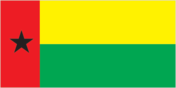
description: two equal horizontal stripes of yellow (top) and green, with a vertical red stripe on the left; a centered five-pointed black star is located within the red stripe
meaning: yellow represents the sun, green symbolizes hope, red denotes the blood shed during the fight for independence; the black star signifies African unity
history: incorporates the colors associated with the Pan-African movement; the design was significantly inspired by the flag of Ghana
Capital
name
Bissau
etymology
the name is derived from the local Bijuga people and is used to distinguish the country from neighboring Guinea
time difference
UTC 0 (5 hours ahead of Washington, DC, during Standard Time)
geographic coordinates
11 51 N, 15 35 W
Suffrage
18 years of age; universal
Citizenship
citizenship by birth
yes
citizenship by descent only
yes
dual citizenship recognized
no
residency requirement for naturalization
5 years
Constitution
history
promulgated 16 May 1984
amendment process
can be proposed by the National People's Assembly if at least one third of its members support it, by the Council of State (a presidential advisory body), or by the government; to pass, it requires a two-thirds majority vote from the Assembly; constitutional provisions related to the republican and secular nature of the government and national sovereignty are not subject to amendment
Country name
former
Portuguese Guinea
etymology
the nation is partially named after the Guinea region located in West Africa along the Gulf of Guinea; the term itself originates from the Tuareg word aginaw, which means "black people;" Bissau, the capital city's name, differentiates the country from its neighbor Guinea and is derived from the local Bijuga community
local long form
Republica da Guine-Bissau
local short form
Guine-Bissau
conventional long form
Republic of Guinea-Bissau
conventional short form
Guinea-Bissau
Independence
24 September 1973 (declared); 10 September 1974 (from Portugal)
Legal system
a mixed legal system of civil law that integrated Portuguese laws at the time of independence; is influenced by the Economic Community of West African States (ECOWAS), West African Economic and Monetary Union (UEMOA), African Francophone Public Law, and customary law
Government type
semi-presidential republic
Judicial branch
highest court(s)
Supreme Court or Supremo Tribunal de Justica (comprises 9 judges and is organized into Civil, Criminal, and Social and Administrative Disputes Chambers)
subordinate courts
Appeals Court; regional (first instance) courts; military court
judge selection and term of office
judges are appointed by the Higher Council of the Magistrate, an essential governmental body responsible for judge nominations, dismissals, and judicial discipline; judges are appointed for life by the president
Executive branch
cabinet
Cabinet appointed by the president, on the recommendation of the prime minister
chief of state
Interim President Gen. Horta Nta Na MAN (since 27 November 2025)
election results
2025: Umaro Sissoco EMBALO (Madem G15) and Fernando DIAS da Costa (PRS) both declared victory in the first round; a coup thwarted the announcement of election results after the ballots were destroyed
2019: Umaro Sissoco EMBALO won the presidency in the second round; first-round voting percentages - Domingos Simoes PEREIRA (PAIGC) 40.1%, Umaro Sissoco EMBALO (Madem G15) 27.7%, Nuno Gomez NABIAM (APU-PDGB) 13.2%, Jose Mario VAZ (independent) 12.4%, others 6.6%; second-round voting percentages - Umaro Sissoco EMBALO 53.6%, Domingos Simoes PEREIRA 46.5% (2019)
head of government
Interim Prime Minister Ilídio Vieira TE (since 28 November 2025)
most recent election date
23 November 2025
election/appointment process
the president is directly elected through an absolute-majority popular vote in up to 2 rounds, if necessary, for a maximum of 2 consecutive 5-year terms; the prime minister is appointed by the president following discussions with party leaders within the National People's Assembly
expected date of next election
2025
National holiday
Independence Day, 24 September (1973)
National color(s)
red, yellow, green, black
National heritage
total World Heritage Sites
1 (natural)
selected World Heritage Site locales
Coastal and Marine Ecosystems of the Bijagós Archipelago – Omatí Minhô (n)
Political parties
African Party for the Independence of Guinea and Cabo Verde or PAIGC
Democratic Convergence Party or PCD
Movement for Democratic Alternation Group of 15 or MADEM-G15
National People’s Assembly – Democratic Party of Guinea Bissau or APU-PDGB
New Democracy Party or PND
Party for Social Renewal or PRS
Republican Party for Independence and Development or PRID
Union for Change or UM
Legislative branch
term in office
4 years
number of seats
102 (all directly elected)
electoral system
proportional representation
legislature name
People's National Assembly (Assembleia Nacional Popular)
scope of elections
full renewal
legislative structure
unicameral
most recent election date
11/23/2025
expected date of next election
November 2029
percentage of women in chamber
9.8%
parties elected and seats per party
Inclusive Alliance Platform/Terra Coalition (54); Movement for Democratic Alternation (MADEM G.15) (29); Party for Social Renewal (PRS) (12); Bissau-Guinean Workers’ Party (6); Other (1)
National anthem(s)
title
"Esta e a Nossa Patria Bem Amada" (This is Our Beloved Country)
history
adopted in 1974; a delegation from Portuguese Guinea visited China in 1963 and experienced music by XIAO He; Amilcar Lopes CABRAL, the leader of the independence movement in Guinea-Bissau, requested the composer to create a piece that would motivate his people to strive for independence
lyrics/music
Amilcar Lopes CABRAL/XIAO He
National symbol(s)
black star
Administrative divisions
9 regions (regioes, singular - regiao); Bafata, Biombo, Bissau, Bolama/Bijagos, Cacheu, Gabu, Oio, Quinara, Tombali
Diplomatic representation in the US
FAX
[1] (202) 872-4226
chancery
918 16th Street, NW (Mezzanine Suite)
Washington DC 20006
telephone
[1] (202) 872-4222
chief of mission
Ambassador Maria Da Conceição NOBRE CABRAL (since 18 September 2024)
Diplomatic representation from the US
mailing address
2080 Bissau Place, Washington DC 20521-2080
chief of mission
Ambassador Michael RAYNOR (since 20 April 2022)
email address and website
[email protected]
https://gw.usmission.gov/
International organization participation
ACP, AfDB, AOSIS, AU, CPLP, ECOWAS, FAO, FZ, G-77, IBRD, ICAO, ICRM, IDA, IDB, IFAD, IFC, IFRCS, ILO, IMF, IMO, Interpol, IOC, IOM, IPU, ITSO, ITU, ITUC (NGOs), MIGA, MINUSMA, NAM, OIC, OIF, OPCW, UN, UNCTAD, UNESCO, UNIDO, UNWTO, UPU, WADB (regional), WAEMU, WCO, WFTU (NGOs), WHO, WIPO, WMO, WTO
International law organization participation
accepts compulsory ICJ jurisdiction; non-party state to the ICCt
Economy
Budget
revenues
$269.794 million (2023 est.)
expenditures
$450.953 million (2023 est.)
Exports
Exports 2021
$334.904 million (2021 est.)
Exports 2022
$280.065 million (2022 est.)
Exports 2023
$284.5 million (2023 est.)
Imports
Imports 2021
$518.162 million (2021 est.)
Imports 2022
$577.899 million (2022 est.)
Imports 2023
$592.095 million (2023 est.)
Industries
processing of agricultural products, beer production, non-alcoholic beverages
Labor force
845,300 (2024 est.)
Public debt
Public debt 2016
57.9% of GDP (2016 est.)
Remittances
Remittances 2021
11% of GDP (2021 est.)
Remittances 2022
10.3% of GDP (2022 est.)
Remittances 2023
9.8% of GDP (2023 est.)
Exchange rates
Currency
Communaute Financiere Africaine francs (XOF) per US dollar -
Exchange rates 2020
575.586 (2020 est.)
Exchange rates 2021
554.531 (2021 est.)
Exchange rates 2022
623.76 (2022 est.)
Exchange rates 2023
606.57 (2023 est.)
Exchange rates 2024
606.345 (2024 est.)
Debt - external
Debt - external 2023
$896.812 million (2023 est.)
Economic overview
heavily impoverished economy in West Africa; diverse ethnic labor force; rising government spending; minor inflation caused by food supply issues; significant exporter of cashews; persistent banking sector issues and corruption; susceptible to fluctuations in oil prices
Unemployment rate
Unemployment rate 2022
2.7% (2022 est.)
Unemployment rate 2023
2.7% (2023 est.)
Unemployment rate 2024
2.7% (2024 est.)
Exports - partners
India 66%, Chile 9%, Cote d'Ivoire 5%, Ghana 4%, Netherlands 3% (2023)
Imports - partners
Senegal 28%, Portugal 24%, China 11%, Gambia, The 10%, Pakistan 4% (2023)
Real GDP per capita
Real GDP per capita 2022
$2,600 (2022 est.)
Real GDP per capita 2023
$2,600 (2023 est.)
Real GDP per capita 2024
$2,700 (2024 est.)
Real GDP growth rate
Real GDP growth rate 2022
5.6% (2022 est.)
Real GDP growth rate 2023
4.5% (2023 est.)
Real GDP growth rate 2024
4.8% (2024 est.)
Agricultural products
rice, groundnuts, cashews, root vegetables, oil palm fruit, plantains, cassava, coconuts, vegetables, sweet potatoes (2023)
Exports - commodities
coconuts/brazil nuts/cashews, fish, fish oil, processed crustaceans, malt extract (2023)
Imports - commodities
refined petroleum, iron bars, rice, plastics, flavored water (2023)
Current account balance
Current account balance 2021
-$14.128 million (2021 est.)
Current account balance 2022
-$146.64 million (2022 est.)
Current account balance 2023
-$160.169 million (2023 est.)
Taxes and other revenues
8.8% (of GDP) (2023 est.)
GDP (official exchange rate)
$2.12 billion (2024 est.)
GDP - composition, by end use
household consumption
77% (2024 est.)
government consumption
17.8% (2024 est.)
investment in inventories
-1.9% (2024 est.)
investment in fixed capital
22.8% (2024 est.)
exports of goods and services
12.5% (2024 est.)
imports of goods and services
-28.2% (2024 est.)
Population below poverty line
50.5% (2021 est.)
Inflation rate (consumer prices)
Inflation rate (consumer prices) 2022
9.4% (2022 est.)
Inflation rate (consumer prices) 2023
7.1% (2023 est.)
Inflation rate (consumer prices) 2024
3.8% (2024 est.)
Industrial production growth rate
8% (2024 est.)
Real GDP (purchasing power parity)
Real GDP (purchasing power parity) 2022
$5.399 billion (2022 est.)
Real GDP (purchasing power parity) 2023
$5.64 billion (2023 est.)
Real GDP (purchasing power parity) 2024
$5.912 billion (2024 est.)
Youth unemployment rate (ages 15-24)
male
3.4% (2024 est.)
total
2.8% (2024 est.)
female
2% (2024 est.)
GDP - composition, by sector of origin
industry
16.6% (2024 est.)
services
42.1% (2024 est.)
agriculture
36.8% (2024 est.)
Household income or consumption by percentage share
lowest 10%
3.4% (2021 est.)
highest 10%
26.1% (2021 est.)
Gini Index coefficient - distribution of family income
Gini Index coefficient - distribution of family income 2021
33.4 (2021 est.)
Energy
Coal
imports
1 metric tons (2023 est.)
Petroleum
refined petroleum consumption
2,000 bbl/day (2023 est.)
Electricity
consumption
79.8 million kWh (2023 est.)
installed generating capacity
29,000 kW (2023 est.)
transmission/distribution losses
6 million kWh (2023 est.)
Electricity access
electrification - rural areas
15.8%
electrification - urban areas
61%
electrification - total population
37.4% (2022 est.)
Energy consumption per capita
Total energy consumption per capita 2023
2.351 million Btu/person (2023 est.)
Electricity generation sources
solar
3.5% of total installed capacity (2023 est.)
fossil fuels
96.5% of total installed capacity (2023 est.)
Communications
Internet users
percent of population
33% (2023 est.)
Broadcast media
There is one state-owned television network, Televisao da Guine-Bissau (TGB), along with a second channel, Radio e Televisao de Portugal (RTP) Africa, which is managed by the Portuguese public broadcaster (RTP); in addition, there is one state-owned radio station, numerous private radio outlets, and various community radio stations; a range of international broadcasters can also be accessed (2019)
Internet country code
.gw
Telephones - fixed lines
total subscriptions
0 (2022 est.)
subscriptions per 100 inhabitants
(2022 est.) less than 1
Telephones - mobile cellular
total subscriptions
2.76 million (2023 est.)
subscriptions per 100 inhabitants
126 (2022 est.)
Broadband - fixed subscriptions
total
7,000 (2023 est.)
subscriptions per 100 inhabitants
(2023 est.) less than 1
Transportation
Ports
large
0
small
0
medium
0
key ports
Bissau, Rio Cacheu
very small
2
total ports
2 (2024)
ports with oil terminals
1
Airports
7 (2025)
Merchant marine
total
20 (2023)
by type
bulk carrier 3, general cargo 12, other 5
Civil aircraft registration country code prefix
J5
Military & Security
Military - note
The Armed Forces (FARP) primarily concentrate on external security while also undertaking certain internal security responsibilities; both the FARP and the paramilitary National Guard have played significant roles in the nation’s political landscape since independence, engaging in multiple coup attempts. In the 2000s, the FARP has experienced several initiatives aimed at reforming the defense and security sectors, facilitated by the African Union, the European Union, the Economic Community of West African States (ECOWAS), and the United Nations (2025)
Military expenditures
Military Expenditures 2020
1.5% of GDP (2020 est.)
Military Expenditures 2021
1.5% of GDP (2021 est.)
Military Expenditures 2022
1.4% of GDP (2022 est.)
Military Expenditures 2023
1.2% of GDP (2023 est.)
Military Expenditures 2024
1.2% of GDP (2024 est.)
Military and security forces
People's Revolutionary Armed Force (Forcas Armadas Revolucionarias do Povo or FARP): Army, Navy, Air Force
Ministry of Internal Administration: National Guard (a gendarmerie force), Public Order Police, Border Police, Rapid Intervention Police, Maritime Police (2025)
Military service age and obligation
Selective compulsory military service is required for individuals aged 18-25, applicable to both men and women (service in the Air Force is voluntary) (2025)
Military equipment inventories and acquisitions
The FARP is primarily equipped with arms and equipment from the Soviet era (2025)
Military and security service personnel strengths
estimated 4,000 active FARP (2025)
Transnational Issues
Refugees and internally displaced persons
refugees
54 (2024 est.)