CapitalMogadishu
LanguagesSomali , Arabic , Italian, English
CurrencySomali shillings
Governmentfederal parliamentary republic
Bamwor Indexes
Somalia — Q1 2026
IBEUBamwor Urban Scale Index
12.73%
Rank #138 of 237
View full ranking →
IBCPBamwor Population Concentration Index
20.37%
Rank #160 of 237
View full ranking →
IBDABamwor Settlement Density Index
7.07per 1K km²
Rank #217 of 241
View full ranking →
IBCXBamwor Country Complexity Index
67.51/100
Rank #64 of 234
View full ranking →
IBEEBamwor Economic Stability Index
72.29/100
Rank #213 of 220
View full ranking →
IBFMBamwor Military Strength Index
55.46/100
Rank #52 of 124
View full ranking →
IBDIBamwor Digital Infrastructure Index
27.84/100
Rank #199 of 206
View full ranking →
IBEDBamwor Education Index
22.40/100
Rank #115 of 119
View full ranking →
IBSABamwor Healthcare Index
33.17/100
Rank #217 of 218
View full ranking →
Somalia Intelligence Report
Download PDF with 20+ statistics, rankings & proprietary indices
Introduction
Background
From A.D. 800 to 1100, waves of immigrant Muslim Arabs and Persians established trading posts along the coasts of the Gulf of Aden and the Indian Ocean, reinforcing the trade connections that modern Somalia maintains with the Arabian Peninsula. In the late 19th century, colonial powers including Britain, France, and Italy took control of territories in the Somali Peninsula, a situation that persisted until 1960. That year, British Somaliland achieved independence and subsequently united with Italian Somaliland to create the Republic of Somalia.
The nation operated as a parliamentary democracy until 1969, when General Mohamed SIAD Barre seized power through a coup, initiating a 22-year period of socialist dictatorship. To consolidate his authority, SIAD sought to dismantle the clan system, which was a fundamental cultural and social framework within Somali society. Opposition to SIAD’s socialist rule, which led to a swift decline in the nation’s stability, culminated in the overthrow of his regime by allied clan militias in 1991, resulting in the disintegration of the state. Following this, clashes between rival clans over resources and land overwhelmed the nation, leading to a manmade famine and necessitating international intervention. Commencing in 1993, the United Nations led a humanitarian mission, but the global community largely withdrew by 1995 after the incident known as Black Hawk Down, where two US military helicopters were downed in Mogadishu. This conflict and the ensuing rescue operations resulted in 21 fatalities and 82 injuries among international forces.
Throughout the 2000s, international peace conferences yielded several transitional governments operating from outside Somalia. Meanwhile, Somalis within the country established alternative governance systems; some regions created their own administrations, such as Somaliland and Puntland, while others formed localized institutions. Numerous local communities began relying on sharia courts, a judicial system rooted in Islamic law. In 2006, several of these courts united to form the Islamic Courts Union (ICU), which restored order to various parts of central and southern Somalia, including Mogadishu. However, military intervention by Ethiopia in 2006, in support of the Somali Transitional Federal Government (TFG), forced the ICU to retreat to rural areas or exit Somalia entirely. Less than a year later, the organization resurfaced as the Islamic insurgent and terrorist group al-Shabaab, which remains active today.
In 2007, the African Union (AU) created a peacekeeping force, assumed security responsibilities for the nation, and allowed the TFG to develop a new governmental structure for Somalia. By 2012, Somali leaders reached consensus on a provisional constitution with a loosely federated structure and established a central government in Mogadishu known as the Somali Federal Government (SFG). Since then, the nation has experienced several interim regional administrations and three presidential elections; however, significant challenges in governance and security persist due to al-Shabaab's control over substantial areas of the country.
Geography
Area
land
627,337 sq km
water
10,320 sq km
total
637,657 sq km
Climate
largely arid; characterized by the northeast monsoon (December to February) which brings moderate temperatures in the northern regions and heat in the south; the southwest monsoon (May to October) results in scorching conditions in the north and warm weather in the south, with irregular precipitation and hot, humid intervals (tangambili) occurring between the monsoon seasons.
Terrain
predominantly flat to gently rolling plateau that ascends to hilly terrain in the northern area.
Land use
other
21.7% (2023 est.)
forest
7.9% (2023 est.)
agricultural land
70.3% (2023 est.)
agricultural land: arable land
arable land: 1.8% (2023 est.)
agricultural land: permanent crops
permanent crops: 0% (2023 est.)
agricultural land: permanent pasture
permanent pasture: 68.5% (2023 est.)
Location
Located in Eastern Africa, adjacent to the Gulf of Aden and the Indian Ocean, to the east of Ethiopia.
Coastline
3,025 km
Elevation
lowest point
Indian Ocean 0 m
highest point
Mount Shimbiris 2,460 m
mean elevation
410 m
Irrigated land
2,000 sq km (2012)
Major aquifers
Ogaden-Juba Basin
Map references
Africa
Land boundaries
total
2,385 km
border countries
Djibouti 61 km; Ethiopia 1,640 km; Kenya 684 km
Maritime claims
territorial sea
200 nm; note: the US does not recognize this claim
exclusive economic zone
200 nm
Natural hazards
experiences recurrent droughts; summer is marked by frequent dust storms across the eastern plains; the rainy season can lead to flooding.
Geography - note
holds a crucial position on the Horn of Africa, along the southern routes to Bab el Mandeb as well as the pathway through the Red Sea and Suez Canal.
Natural resources
contains uranium and largely untapped reserves of iron ore, tin, gypsum, bauxite, copper, salt, natural gas, and probable oil deposits.
Area - comparative
nearly five times larger than Alabama; slightly smaller than Texas.
Geographic coordinates
10 00 N, 49 00 E
Population distribution
population distribution is highly varied across the nation; the areas with the lowest density are found in the northeast and central regions, including regions along the Kenyan border; the most densely populated regions are around the urban centers of Mogadishu, Marka, Boorama, Hargeysa, and Baidoa, as indicated on this population distribution map.
People & Society
Literacy
male
64.5% (2022 est.)
female
43.9% (2022 est.)
total population
54.1% (2022 est.)
Languages
Languages
Somali (official), Arabic (official), Italian, English
major-language sample(s)
Buugga Xaqiiqda Aduunka, waa laga maarmaanka macluumaadka assasiga. (Somali)
The World Factbook, the indispensable source for basic information.
Religions
Muslim 99.9% (Sunni Muslim 98.1%, Shia Muslim 1.2%, Islamic schismatic 0.6%), ethnic religionist 0.1% (2020 estimate)
Sex ratio
at birth
1.03 male(s)/female
0-14 years
1 male(s)/female
15-64 years
1.04 male(s)/female
total population
1.01 male(s)/female (2024 est.)
65 years and over
0.76 male(s)/female
Birth rate
46.36 births/1,000 population (2025 est.)
Death rate
11.22 deaths/1,000 population (2025 est.)
Median age
male
19.3 years
total
15.7 years (2025 est.)
female
18.9 years
Population
male
10,170,863
total
20,324,160 (2025 est.)
female
10,153,297
Nationality
noun
Somali(s)
adjective
Somali
Urbanization
urban population
47.9% of total population (2023)
rate of urbanization
4.2% annual rate of change (2020-25 est.)
Age structure
0-14 years
41.4% (male 2,689,086/female 2,694,372)
15-64 years
55.8% (male 3,699,721/female 3,568,163)
65 years and over
2.8% (2024 est.) (male 157,505/female 208,426)
Ethnic groups
mainly Somali, with smaller communities of Arabs, Bantus, and others
Dependency ratios
total dependency ratio
100.5 (2025 est.)
youth dependency ratio
97.1 (2025 est.)
potential support ratio
29.9 (2025 est.)
elderly dependency ratio
3.3 (2025 est.)
Physician density
0.05 physicians/1,000 population (2014)
Health expenditure
2.5% of national budget (2022 est.)
Net migration rate
-1.91 migrant(s)/1,000 population (2025 est.)
Hospital bed density
0.9 beds/1,000 population (2019 est.)
Total fertility rate
6.38 children born/woman (2025 est.)
Drinking water source
improved: rural
rural: 38.6% of population (2022 est.)
improved: total
total: 58.3% of population (2022 est.)
improved: urban
urban: 80.1% of population (2022 est.)
unimproved: rural
rural: 61.4% of population (2022 est.)
unimproved: total
total: 41.7% of population (2022 est.)
unimproved: urban
urban: 19.9% of population (2022 est.)
Education expenditure
Education expenditure (% GDP)
0% of GDP (2023 est.)
Education expenditure (% national budget)
8.1% national budget (2025 est.)
Infant mortality rate
male
93.2 deaths/1,000 live births
total
81.5 deaths/1,000 live births (2025 est.)
female
73.7 deaths/1,000 live births
Population growth rate
3.32% (2025 est.)
Gross reproduction rate
3.14 (2025 est.)
Population distribution
population distribution is highly variable across the nation; the northeast and central regions, as well as the areas bordering Kenya, are among the least populated; conversely, the most densely populated regions are around the cities of Mogadishu, Marka, Boorama, Hargeysa, and Baidoa, as illustrated in this population distribution map
Life expectancy at birth
male
54.1 years
female
59 years
total population
56.5 years (2024 est.)
Maternal mortality ratio
563 deaths/100,000 live births (2023 est.)
Sanitation facility access
improved: rural
rural: 34.8% of population (2022 est.)
improved: total
total: 57.6% of population (2022 est.)
improved: urban
urban: 82.9% of population (2022 est.)
unimproved: rural
rural: 65.2% of population (2022 est.)
unimproved: total
total: 42.4% of population (2022 est.)
unimproved: urban
urban: 17.1% of population (2022 est.)
Alcohol consumption per capita
beer
0 liters of pure alcohol (2019 est.)
wine
0 liters of pure alcohol (2019 est.)
total
0 liters of pure alcohol (2019 est.)
spirits
0 liters of pure alcohol (2019 est.)
other alcohols
0 liters of pure alcohol (2019 est.)
Major urban areas - population
2.610 million MOGADISHU (capital), 1.127 million Hargeysa (2023)
Obesity - adult prevalence rate
8.3% (2016)
Currently married women (ages 15-49)
62.4% (2019 est.)
Environment
Climate
primarily arid; northeast monsoon occurring from December to February, with cooler temperatures in the northern regions and elevated warmth in the southern regions; southwest monsoon spanning May to October, resulting in extreme heat in the north and warm conditions in the south, characterized by unpredictable rainfall and hot, humid intervals (tangambili) occurring between monsoon seasons
Land use
other
21.7% (2023 est.)
forest
7.9% (2023 est.)
agricultural land
70.3% (2023 est.)
agricultural land: arable land
arable land: 1.8% (2023 est.)
agricultural land: permanent crops
permanent crops: 0% (2023 est.)
agricultural land: permanent pasture
permanent pasture: 68.5% (2023 est.)
Urbanization
urban population
47.9% of total population (2023)
rate of urbanization
4.2% annual rate of change (2020-25 est.)
Waste and recycling
municipal solid waste generated annually
2.326 million tons (2024 est.)
Environmental issues
shortage of water; polluted water sources; inadequate waste management; loss of forests; deterioration of land; excessive grazing; soil degradation; advancement of desertification
Total water withdrawal
municipal
15 million cubic meters (2022 est.)
industrial
2 million cubic meters (2022 est.)
agricultural
3.281 billion cubic meters (2022 est.)
Carbon dioxide emissions
total emissions
838,000 metric tonnes of CO2 (2023 est.)
from coal and metallurgical coke
10 metric tonnes of CO2 (2023 est.)
from petroleum and other liquids
838,000 metric tonnes of CO2 (2023 est.)
Particulate matter emissions
14.3 micrograms per cubic meter (2019 est.)
Total renewable water resources
14.7 billion cubic meters (2022 est.)
International environmental agreements
party to
Biodiversity, Climate Change, Climate Change-Kyoto Protocol, Climate Change-Paris Agreement, Desertification, Endangered Species, Hazardous Wastes, Law of the Sea, Ozone Layer Protection
signed, but not ratified
Nuclear Test Ban
Government
Flag
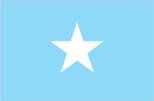
description: a light blue background featuring a prominent white five-pointed star at its center
meaning: the blue backdrop was initially inspired by the UN flag, yet it is currently interpreted as symbolizing the sky and the Indian Ocean; the five points of the star denote the areas in the Horn of Africa inhabited by the Somali people: former British Somaliland and Italian Somaliland (which together constitute Somalia), Djibouti, Ogaden (Ethiopia), and the Northeast Province (Kenya)
Capital
name
Mogadishu
etymology
the term likely originates from the Arabic word mukaddas, which translates to "holy"
time difference
UTC+3 (8 hours ahead of Washington, DC, during Standard Time)
geographic coordinates
2 04 N, 45 20 E
Suffrage
18 years of age; universal suffrage commencing with local elections on 24 June 2024
Citizenship
citizenship by birth
no
citizenship by descent only
the father must be a citizen of Somalia
dual citizenship recognized
no
residency requirement for naturalization
7 years
Constitution
history
previously established in 1961 and 1979; most recent draft was on 12 June 2012 and adopted on 1 August 2012
amendment process
proposals may be initiated by the federal government, state government members, the Federal Parliament, or through public petitions; all proposals must be examined by a joint parliamentary committee that includes public and state legislature feedback; for passage, a supermajority of at least two-thirds in both parliamentary houses is required, alongside majority approval in a referendum; certain constitutional provisions regarding Islamic principles, the federal structure, human rights and freedoms, government branch powers, and women's inclusion in national institutions are not subject to amendment
Country name
former
British Somaliland, Italian Somaliland, Somali Republic, Somali Democratic Republic
etymology
the name translates to "Land of the Somali," referring to a local ethnic group; the etymology of this group's name remains uncertain but could stem from 1) a Cushitic term meaning "dark," 2) the local expression soo mal, which translates to "go and milk" (referring to the tradition of offering milk to guests), 3) a local chief's name, or 4) the Arabic zamla, meaning "cattle"
local long form
Jamhuuriyadda Federaalka Soomaaliya (Somali)/ Jumhuriyat as Sumal al Fidiraliyah (Arabic)
local short form
Soomaaliya (Somali)/ As Sumal (Arabic)
conventional long form
Federal Republic of Somalia
conventional short form
Somalia
Independence
1 July 1960 (resulting from the unification of British Somaliland, which gained independence from the UK on 26 June 1960, and Italian Somaliland, which became independent from the Italian-administered UN trusteeship on 1 July 1960 to establish the Somali Republic)
Legal system
a hybrid system incorporating civil law, Islamic (sharia) law, and customary law (known as Xeer)
Government type
federal parliamentary republic
Judicial branch
highest court(s)
the provisional constitution mandates the formation of the Constitutional Court, which is composed of five judges, including a chief judge and a deputy chief judge
subordinate courts
federal courts; courts at the level of federal member states; military courts; sharia courts
judge selection and term of office
judges are appointed by the president based on recommendations from the Judicial Service Commission, which comprises nine members overseeing judicial and administrative matters; tenure for judges is not applicable
Executive branch
cabinet
the Cabinet is appointed by the prime minister and must receive approval from the House of the People
chief of state
President HASSAN SHEIKH Mohamud (since 23 May 2022)
election results
2022: HASSAN SHEIKH Mohamud was elected president in the third round - Federal Parliament vote percentages in the first round - Said ABDULLAHI DENI (Kaah) 20.2%, Mohamed ABDULLAHI Mohamed "Farmaajo" (TPP) 18.3%, HASSAN SHEIKH Mohamud (PDP) 16.2%, Hassan Ali KHAYRE (independent) 14.6%, others 30.7%; Federal Parliament vote percentages in the second round - HASSAN SHEIKH Mohamud 34.1%, Mohamed ABDULLAHI Mohamed "Farmaajo" 25.7%, Said ABDULLAHI DENI 21%, Hassan Ali KHAYRE 19.2%; Federal Parliament vote percentages in the third round - HASSAN SHEIKH Mohamud 66%, Mohamed ABDULLAHI Mohamed "Farmaajo" 34%
head of government
Prime Minister Hamza Abdi BARRE (since 25 June 2022)
most recent election date
15 May 2022
election/appointment process
the president is indirectly elected by the Federal Parliament through a two-thirds majority vote in up to two rounds, if necessary, for a single term of four years; the prime minister is appointed by the president and must be approved by the House of the People
expected date of next election
2026
National holiday
Foundation of the Somali Republic on 1 July (1960); note - 26 June (1960) in Somaliland
Government - note
regional and local governing bodies persist and manage various areas within the country, including the self-proclaimed Republic of Somaliland in northwestern Somalia
National color(s)
blue, white
Political parties
Cosmopolitan Democratic Party
Green Party
Himilo Qaran Party
Ilays Party
Justice and Reconciliation Party
National Progressive Party
Peace and Unity Party
Qaransoor Party
Qiimo Qaran Party
Security and Justice Party
Social Justice Party
Somali Labour Party
Somali Republic Party
Somali Social Unity Party or SSUP
Union for Peace and Development Party or PDP
Wadajir Party
Legislative branch
legislature name
Federal Parliament
legislative structure
bicameral
National anthem(s)
title
"Qolobaa Calankeed" (Every Nation Has Its Own Flag)
history
adopted 2012
lyrics/music
Abdullahi QARSHE
National symbol(s)
leopard
Administrative divisions
18 regions (gobollo, singular - gobol); Awdal, Bakool, Banaadir, Bari, Bay, Galguduud, Gedo, Hiiraan, Jubbada Dhexe (Middle Jubba), Jubbada Hoose (Lower Jubba), Mudug, Nugaal, Sanaag, Shabeellaha Dhexe (Middle Shabeelle), Shabeellaha Hoose (Lower Shabeelle), Sool, Togdheer, Woqooyi Galbeed
Legislative branch - lower chamber
chamber name
House of the People (Golaha Shacabka)
term in office
5 years
number of seats
275 (all indirectly elected)
scope of elections
full renewal
most recent election date
11/1/2021 to 5/5/2022
expected date of next election
October 2026
percentage of women in chamber
19%
Legislative branch - upper chamber
chamber name
Upper House (Aqalka Sare)
term in office
5 years
number of seats
54 (all indirectly elected)
scope of elections
full renewal
most recent election date
7/27/2021 to 11/13/2021
expected date of next election
July 2026
percentage of women in chamber
25.9%
Diplomatic representation in the US
chancery
1609 22nd Street NW, Washington, DC 20008
telephone
[1] (202) 853-9164
chief of mission
Ambassador DAHIR Hassan Abdi (since 18 September 2024)
email address and website
[email protected]
https://usa.mfa.gov.so/
Diplomatic representation from the US
embassy
Mogadishu, (reopened in October 2019 at the site of the Mogadishu Airport)
telephone
[254] 20 363-6451
mailing address
P.O. Box 606 Village Market
00621 Nairobi, Kenya
chief of mission
Ambassador Richard H. RILEY (since 20 June 2024)
email address and website
[email protected]
https://so.usembassy.gov/
International organization participation
ACP, AfDB, AFESD, AMF, AU, CAEU (candidate), EAC, FAO, G-77, IBRD, ICAO, ICRM, IDA, IDB, IFAD, IFC, IFRCS, IGAD, ILO, IMF, IMO, Interpol, IOC, IOM, IPU, ITSO, ITU, LAS, NAM, OIC, OPCW, OPCW (signatory), UN, UNCTAD, UNESCO, UNHCR, UNHRC, UNIDO, UPU, WFTU (NGOs), WHO, WIPO, WMO
International law organization participation
accepts compulsory ICJ jurisdiction with reservations; not a party state to the ICCt
Economy
Exports
Exports 2022
$1.804 billion (2022 est.)
Exports 2023
$2.164 billion (2023 est.)
Exports 2024
$2.424 billion (2024 est.)
Imports
Imports 2022
$7.456 billion (2022 est.)
Imports 2023
$8.002 billion (2023 est.)
Imports 2024
$9.002 billion (2024 est.)
Industries
light industries such as sugar refining, textiles, and wireless communication
Labor force
3.439 million (2024 est.)
Public debt
Public debt 2014
93% of GDP (2014 est.)
Remittances
Remittances 2021
18.3% of GDP (2021 est.)
Remittances 2022
17% of GDP (2022 est.)
Remittances 2023
15.8% of GDP (2023 est.)
Exchange rates
Currency
Somali shillings (SOS) per US dollar -
Exchange rates 2013
19,283.8 (2013 est.)
Exchange rates 2014
20,230.929 (2014 est.)
Exchange rates 2015
22,254.236 (2015 est.)
Exchange rates 2016
23,061.784 (2016 est.)
Exchange rates 2017
23,097.987 (2017 est.)
Debt - external
Debt - external 2023
$2.563 billion (2023 est.)
Economic overview
economy in the low-income African Horn; three decades of warfare and instability have hindered economic development; high levels of remittances for basic survival; introduction of a new fiscal federalism strategy; some unsustainable debt has been resolved; environmentally vulnerable; initiatives for urbanization driven by digital technology
Unemployment rate
Unemployment rate 2022
19.1% (2022 est.)
Unemployment rate 2023
19% (2023 est.)
Unemployment rate 2024
18.9% (2024 est.)
Exports - partners
UAE 35%, Saudi Arabia 27%, Oman 18%, Djibouti 8%, India 3% (2023)
Imports - partners
UAE 29%, China 19%, India 15%, Turkey 8%, Oman 5% (2023)
Real GDP per capita
Real GDP per capita 2022
$1,400 (2022 est.)
Real GDP per capita 2023
$1,400 (2023 est.)
Real GDP per capita 2024
$1,400 (2024 est.)
Real GDP growth rate
Real GDP growth rate 2022
2.7% (2022 est.)
Real GDP growth rate 2023
4.2% (2023 est.)
Real GDP growth rate 2024
4% (2024 est.)
Agricultural products
camel milk, milk, goat milk, sheep milk, sugarcane, fruits, sorghum, cassava, vegetables, maize (2023)
Exports - commodities
sheep and goats, gold, postage stamps/documents, other animals, cattle (2023)
Imports - commodities
raw sugar, tobacco, broadcasting equipment, rice, milk (2023)
Taxes and other revenues
0% (of GDP) (2023 est.)
GDP (official exchange rate)
$12.109 billion (2024 est.)
GDP - composition, by end use
household consumption
124% (2024 est.)
government consumption
7.6% (2024 est.)
investment in inventories
0% (2024 est.)
investment in fixed capital
22.7% (2024 est.)
exports of goods and services
20% (2024 est.)
imports of goods and services
-74.3% (2024 est.)
Population below poverty line
54.4% (2022 est.)
Inflation rate (consumer prices)
Inflation rate (consumer prices) 2020
4.3% (2020 est.)
Inflation rate (consumer prices) 2021
4.6% (2021 est.)
Inflation rate (consumer prices) 2022
6.8% (2022 est.)
Real GDP (purchasing power parity)
Real GDP (purchasing power parity) 2022
$24.706 billion (2022 est.)
Real GDP (purchasing power parity) 2023
$25.747 billion (2023 est.)
Real GDP (purchasing power parity) 2024
$26.77 billion (2024 est.)
Youth unemployment rate (ages 15-24)
male
32.1% (2024 est.)
total
33.9% (2024 est.)
female
37% (2024 est.)
Energy
Coal
imports
4 metric tons (2023 est.)
Petroleum
refined petroleum consumption
6,000 bbl/day (2023 est.)
Electricity
consumption
396.792 million kWh (2023 est.)
installed generating capacity
156,000 kW (2023 est.)
transmission/distribution losses
15.408 million kWh (2023 est.)
Natural gas
proven reserves
5.663 billion cubic meters (2021 est.)
Electricity access
electrification - rural areas
30.6%
electrification - urban areas
76.7%
electrification - total population
48.9% (2022 est.)
Energy consumption per capita
Total energy consumption per capita 2023
649,000 Btu/person (2023 est.)
Electricity generation sources
wind
1.5% of total installed capacity (2023 est.)
solar
16% of total installed capacity (2023 est.)
fossil fuels
82.5% of total installed capacity (2023 est.)
Communications
Internet users
percent of population
28% (2022 est.)
Broadcast media
Two private television channels retransmit Al-Jazeera and CNN; there is one government-run television channel along with one privately owned television station; the state-run Radio Mogadishu is in operation; additionally, there is one shortwave station and about ten private FM radio stations located in Mogadishu; numerous radio stations also exist in the central and southern areas; broadcasts from at least two international media outlets can be received (2019)
Internet country code
.so
Telephones - fixed lines
total subscriptions
91,000 (2022 est.)
subscriptions per 100 inhabitants
1 (2022 est.) less than 1
Telephones - mobile cellular
total subscriptions
9.91 million (2023 est.)
subscriptions per 100 inhabitants
54 (2023 est.)
Broadband - fixed subscriptions
total
119,000 (2022 est.)
subscriptions per 100 inhabitants
1 (2022 est.)
Transportation
Ports
large
1
small
2
medium
0
key ports
Baraawe, Berbera, Boosaaso, Kismaayo, Marka, Muqdisho
very small
3
total ports
6 (2024)
ports with oil terminals
2
Airports
40 (2025)
Merchant marine
total
4 (2023)
by type
general cargo 1, other 3
Civil aircraft registration country code prefix
6O
Military & Security
Military - note
The Somali National Army (SNA) primarily focuses on countering the al-Shabaab terrorist organization, which exerts control over significant territories in central and southern Somalia and persists in executing attacks against military and civilian targets, including military installations, governmental establishments, and civilian assemblies. The SNA receives assistance from the National Police, regional and state security forces, allied militias, and international troops. Since 2007, several African Union (AU) nations have contributed military aid to the SNA through the AU Mission in Somalia (AMISOM, 2007-2022), the AU Transition Mission in Somalia (ATMIS, 2022-2024), and the AU Support and Stabilization Mission in Somalia (AUSSOM, January 2025-present). Additionally, Turkey and the United States have rendered military support for SNA operations.
Turkey and the United States have established and trained various SNA units, including the U.S.-supported Danab ("Lightning") Brigade and the Turkish-trained Gorgor ("Eagle") brigades. Furthermore, SNA personnel have received training from nations such as Egypt, Eritrea, Ethiopia, the European Union, Uganda, the United Arab Emirates, and the United Kingdom (2025).
Military expenditures
Military Expenditures 2017
5.9% of GDP (2017 est.)
Military Expenditures 2018
6% of GDP (2018 est.)
Military Expenditures 2019
5.6% of GDP (2019 est.)
Military Expenditures 2020
6% of GDP (2020 est.)
Military Expenditures 2021
6% of GDP (2021 est.)
Military and security forces
Somali Armed Forces (SAF; also known as Somali Defense Force): Somali National Army (SNA; also referred to as Land Forces), Somali Navy, Somali Air Force.
Ministry of Internal Security: Somali National Police (SNP, which includes the Coast Guard and a commando unit) (2025).
Military service age and obligation
Individuals aged 18-22 can voluntarily enlist in the Somali Armed Forces, regardless of gender; while compulsory military service has reportedly been authorized, it is not presently enforced (2025).
Military equipment inventories and acquisitions
The SNA's arsenal comprises a combination of older and donated (usually secondhand) equipment sourced from various suppliers, including Italy, Russia, South Africa, Turkey, the United Kingdom, and the United States (2025).
Military and security service personnel strengths
estimated 20,000 active Somali Armed Forces (2025)
Terrorism
Terrorist group(s)
al-Shabaab; Islamic State of Iraq and ash-Sham – Somalia
Transnational Issues
Trafficking in persons
tier rating
Unique Instance; for additional information, please visit: https://www.state.gov/reports/2025-trafficking-in-persons-report/somalia/
Refugees and internally displaced persons
IDPs
3,869,345 (2024 est.)
refugees
41,763 (2024 est.)