CapitalNairobi
LanguagesOfficial languages include English and Kiswahili, along with a variety of indigenous languages.
CurrencyKenyan shillings
Governmenta presidential republic
Bamwor Indexes
Kenya — Q1 2026
IBEUBamwor Urban Scale Index
7.89%
Rank #181 of 237
View full ranking →
IBCPBamwor Population Concentration Index
15.31%
Rank #187 of 237
View full ranking →
IBDABamwor Settlement Density Index
11.99per 1K km²
Rank #204 of 241
View full ranking →
IBCXBamwor Country Complexity Index
74.11/100
Rank #22 of 234
View full ranking →
IBEEBamwor Economic Stability Index
83.66/100
Rank #159 of 220
View full ranking →
IBFMBamwor Military Strength Index
55.62/100
Rank #51 of 124
View full ranking →
IBDIBamwor Digital Infrastructure Index
47.04/100
Rank #174 of 206
View full ranking →
IBSABamwor Healthcare Index
63.03/100
Rank #150 of 218
View full ranking →
Kenya Intelligence Report
Download PDF with 20+ statistics, rankings & proprietary indices
Introduction
Background
Trade hubs such as Mombasa have been present along the coastal regions of Kenya and Tanzania, historically referred to as the Land of Zanj, since at least the 2nd century. These hubs engaged in commerce with distant lands, including China, India, Indonesia, the Middle East, North Africa, and Persia. By approximately the 9th century, the diverse population of Africans, Arabs, and Persians residing and trading in these areas became recognized as Swahili ("people of the coast"), characterized by a unique language (KiSwahili) and cultural practices. The Portuguese made their entrance in the 1490s and, utilizing Mombasa as a strategic location, aimed to dominate trade throughout the Indian Ocean. However, they were expelled in the late 1600s by the united forces of Oman and Pate, an island situated off the coast. In 1890, the territory was partitioned between Germany and the United Kingdom, with the UK securing the northern section while the Germans acquired the southern part, which includes modern-day Tanzania, Burundi, and Rwanda. The British established the East Africa Protectorate in 1895, which was later transformed into a colony in 1920 and named Kenya in honor of its tallest mountain. A series of political conflicts between the colony and the UK culminated in the violent Mau Mau Uprising that began in 1952, ultimately leading to independence in 1963.
Jomo KENYATTA, recognized as the founding president and a symbol of the liberation movement, governed Kenya from its independence in 1963 until his demise in 1978, at which point Vice President Daniel Arap MOI ascended to power through constitutional succession. From 1969 until 1982, the nation effectively functioned as a one-party state, after which the ruling Kenya African National Union (KANU) amended the constitution to establish itself as the only legal political entity. Under mounting internal and external demands for political reforms, MOI relented in 1991; however, the fragmented opposition was unable to unseat KANU in the 1992 and 1997 elections, both of which were tainted by violence and electoral fraud. MOI resigned in 2002 following fair and peaceful elections. Mwai KIBAKI, the candidate from the multiethnic united opposition coalition known as the National Rainbow Coalition (NARC), triumphed over KANU candidate Uhuru KENYATTA, the son of the founding president, and took office with a campaign focused on anticorruption initiatives.In 2007, opposition candidate Raila ODINGA contended KIBAKI's reelection, citing extensive vote manipulation, which triggered two months of ethnic conflict resulting in over 1,100 fatalities and the displacement of countless individuals. Mediation efforts led by the African Union produced a power-sharing agreement that included ODINGA in the government as prime minister and set forth a reform agenda. In 2010, Kenyans overwhelmingly approved a new constitution that abolished the position of prime minister, instituted additional checks and balances on executive authority, and decentralized power and resources to 47 newly established counties. Uhuru KENYATTA emerged victorious in the inaugural presidential election conducted under the new constitution in 2013. He secured a second and final term in 2017 following a contentious repeat election. In 2022, William RUTO narrowly won the presidential election; he took office the following month after the Kenyan Supreme Court confirmed his victory.
Geography
Area
land
569,140 sq km
water
11,227 sq km
total
580,367 sq km
Climate
ranges from tropical near the coastline to arid in the inland regions
Terrain
low plains elevate to central highlands separated by the Great Rift Valley; a fertile plateau is located in the western region
Land use
other
44% (2023 est.)
forest
6.5% (2023 est.)
agricultural land
49.5% (2023 est.)
agricultural land: arable land
arable land: 11.4% (2023 est.)
agricultural land: permanent crops
permanent crops: 1.4% (2023 est.)
agricultural land: permanent pasture
permanent pasture: 36.7% (2023 est.)
Location
Eastern Africa, situated along the Indian Ocean, between Somalia and Tanzania
Coastline
536 km
Elevation
lowest point
Indian Ocean 0 m
highest point
Mount Kenya 5,199 m
mean elevation
762 m
Irrigated land
1,030 sq km (2012)
Major aquifers
Ogaden-Juba Basin
Map references
Africa
Land boundaries
total
3,457 km
border countries
Ethiopia 867 km; Somalia 684 km; South Sudan 317 km; Tanzania 775 km; Uganda 814 km
Maritime claims
territorial sea
12 nm
continental shelf
200-m depth or to the depth of exploitation
exclusive economic zone
200 nm
Natural hazards
periodic droughts; flooding occurs during the rainy seasons
volcanism: minimal volcanic activity; the Barrier (1,032 m) last erupted in 1921; South Island represents the only other historically active volcano
Geography - note
the Kenyan Highlands are among the most productive agricultural regions in Africa; glaciers are present on Mount Kenya, which is the continent's second-highest peak; the distinctive physiography fosters a diverse and abundant wildlife population of both scientific and economic significance; Lake Victoria, the largest tropical lake globally and the second-largest freshwater lake, is shared by three nations: Kenya, Tanzania, and Uganda
Natural resources
limestone, soda ash, salt, gemstones, fluorspar, zinc, diatomite, gypsum, wildlife, hydropower
Area - comparative
five times larger than Ohio; just over double the size of Nevada
Geographic coordinates
1 00 N, 38 00 E
Population distribution
the population is predominantly situated in the western region along the shores of Lake Victoria; additional densely populated areas include the capital city of Nairobi and the southeastern region along the Indian Ocean coast, as illustrated in this population distribution map
Major lakes (area sq km)
salt water lake(s)
Lake Turkana (shared with Ethiopia) - 6,400 sq km
fresh water lake(s)
Lake Victoria (shared with Tanzania and Uganda) - 62,940 sq km
Major watersheds (area sq km)
Atlantic Ocean drainage
(Mediterranean Sea) Nile (3,254,853 sq km)
People & Society
Languages
Languages
Official languages include English and Kiswahili, along with a variety of indigenous languages.
major-language sample(s)
The World Factbook, the indispensable source for basic information. (English)
The World Factbook, Chanzo cha Lazima Kuhusu Habari ya Msingi. (Kiswahili)
Religions
Christianity accounts for 85.5% of the population (Protestant 33.4%, Catholic 20.6%, Evangelical 20.4%, African Instituted Churches 7%, other Christian 4.1%), Muslims constitute 10.9%, other religions make up 1.8%, those with no religion are 1.6%, and individuals who do not know or did not answer comprise 0.2% (2019 estimate).
Sex ratio
at birth
1.02 male(s)/female
0-14 years
1.01 male(s)/female
15-64 years
1 male(s)/female
total population
1 male(s)/female (2024 est.)
65 years and over
0.84 male(s)/female
Birth rate
25.93 births/1,000 population (2025 est.)
Death rate
4.72 deaths/1,000 population (2025 est.)
Median age
male
21.1 years
total
21.5 years (2025 est.)
female
21.4 years
Population
male
27,857,519
total
55,751,717 (2025 est.)
female
27,894,198
Nationality
noun
Kenyan(s)
adjective
Kenyan
Tobacco use
male
15.5% (2025 est.)
total
8.6% (2025 est.)
female
1.9% (2025 est.)
Urbanization
urban population
29.5% of total population (2023)
rate of urbanization
4.09% annual rate of change (2020-25 est.)
Age structure
0-14 years
35.8% (male 10,464,384/female 10,366,997)
15-64 years
60.9% (male 17,731,068/female 17,723,012)
65 years and over
3.4% (2024 est.) (male 896,348/female 1,064,569)
Ethnic groups
Kikuyu 17.1%, Luhya 14.3%, Kalenjin 13.4%, Luo 10.7%, Kamba 9.8%, Somali 5.8%, Kisii 5.7%, Mijikenda 5.2%, Meru 4.2%, Maasai 2.5%, Turkana 2.1%, non-Kenyan 1%, other 8.2% (2019 est.)
Child marriage
men married by age 18
1.8% (2022)
women married by age 15
2.2% (2022)
women married by age 18
12.5% (2022)
Dependency ratios
total dependency ratio
64 (2025 est.)
youth dependency ratio
58.5 (2025 est.)
potential support ratio
18.2 (2025 est.)
elderly dependency ratio
5.5 (2025 est.)
Physician density
0.29 physicians/1,000 population (2023)
Health expenditure
Health expenditure (as % of GDP)
4.5% of GDP (2021)
Health expenditure (as % of national budget)
8.7% of national budget (2022 est.)
Net migration rate
0.26 migrant(s)/1,000 population (2025 est.)
Hospital bed density
1.3 beds/1,000 population (2019 est.)
Total fertility rate
3.09 children born/woman (2025 est.)
Drinking water source
improved: rural
rural: 53.3% of population (2022 est.)
improved: total
total: 62.9% of population (2022 est.)
improved: urban
urban: 86.4% of population (2022 est.)
unimproved: rural
rural: 46.7% of population (2022 est.)
unimproved: total
total: 37.1% of population (2022 est.)
unimproved: urban
urban: 13.6% of population (2022 est.)
Education expenditure
Education expenditure (% GDP)
4% of GDP (2024 est.)
Education expenditure (% national budget)
28.5% national budget (2025 est.)
Infant mortality rate
male
29 deaths/1,000 live births
total
26.8 deaths/1,000 live births (2025 est.)
female
23.1 deaths/1,000 live births
Population growth rate
2.15% (2025 est.)
Gross reproduction rate
1.53 (2025 est.)
Population distribution
The population is predominantly located in the western region adjacent to Lake Victoria; notable areas of high population density also include Nairobi, the capital city, and the southeastern region along the Indian Ocean coast, as depicted in the accompanying population distribution map.
Life expectancy at birth
male
68.6 years
female
72.2 years
total population
70.4 years (2024 est.)
Maternal mortality ratio
379 deaths/100,000 live births (2023 est.)
Sanitation facility access
improved: rural
rural: 51.1% of population (2022 est.)
improved: total
total: 60.9% of population (2022 est.)
improved: urban
urban: 84.7% of population (2022 est.)
unimproved: rural
rural: 48.9% of population (2022 est.)
unimproved: total
total: 39.1% of population (2022 est.)
unimproved: urban
urban: 15.3% of population (2022 est.)
Alcohol consumption per capita
beer
0.81 liters of pure alcohol (2019 est.)
wine
0.04 liters of pure alcohol (2019 est.)
total
1.68 liters of pure alcohol (2019 est.)
spirits
0.81 liters of pure alcohol (2019 est.)
other alcohols
0.03 liters of pure alcohol (2019 est.)
Major urban areas - population
5.325 million NAIROBI (capital), 1.440 million Mombassa (2023)
Obesity - adult prevalence rate
7.1% (2016)
Mother's mean age at first birth
20.3 years (2014 est.)
Currently married women (ages 15-49)
53.2% (2022 est.)
Children under the age of 5 years underweight
9.8% (2022 est.)
Environment
Climate
ranges from tropical along the coastline to arid in the inland regions
Land use
other
44% (2023 est.)
forest
6.5% (2023 est.)
agricultural land
49.5% (2023 est.)
agricultural land: arable land
arable land: 11.4% (2023 est.)
agricultural land: permanent crops
permanent crops: 1.4% (2023 est.)
agricultural land: permanent pasture
permanent pasture: 36.7% (2023 est.)
Urbanization
urban population
29.5% of total population (2023)
rate of urbanization
4.09% annual rate of change (2020-25 est.)
Methane emissions
other
32.8 kt (2019-2021 est.)
waste
127.1 kt (2019-2021 est.)
energy
334.4 kt (2022-2024 est.)
agriculture
1,241 kt (2019-2021 est.)
Waste and recycling
municipal solid waste generated annually
5.595 million tons (2024 est.)
percent of municipal solid waste recycled
19.9% (2022 est.)
Environmental issues
water contamination stemming from urban and industrial discharges and from the application of pesticides and fertilizers; flooding; proliferation of water hyacinth in Lake Victoria; deforestation; soil degradation; desertification; illegal hunting
Total water withdrawal
municipal
495 million cubic meters (2022 est.)
industrial
303 million cubic meters (2022 est.)
agricultural
3.234 billion cubic meters (2022 est.)
Carbon dioxide emissions
total emissions
19.023 million metric tonnes of CO2 (2023 est.)
from coal and metallurgical coke
3.316 million metric tonnes of CO2 (2023 est.)
from petroleum and other liquids
15.707 million metric tonnes of CO2 (2023 est.)
Particulate matter emissions
12.7 micrograms per cubic meter (2019 est.)
Total renewable water resources
30.7 billion cubic meters (2022 est.)
International environmental agreements
party to
Biodiversity, Climate Change, Climate Change-Kyoto Protocol, Climate Change-Paris Agreement, Comprehensive Nuclear Test Ban, Desertification, Endangered Species, Hazardous Wastes, Law of the Sea, Marine Dumping-London Convention, Marine Dumping-London Protocol, Marine Life Conservation, Nuclear Test Ban, Ozone Layer Protection, Ship Pollution, Wetlands, Whaling
signed, but not ratified
none of the selected agreements
Government
Flag
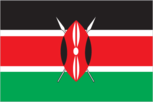
description: consists of three horizontal stripes of equal width in black (top), red, and green; the red stripe is bordered in white; centrally placed is a large Maasai warrior's shield with crossed spears
meaning: black represents the majority population, red signifies the blood shed during the fight for freedom, green denotes natural wealth, and white symbolizes peace; the shield and crossed spears illustrate the defense of freedom
Capital
name
Nairobi
etymology
the name originates from the Maasai phrase that translates to "cool waters," which referred to a nearby water source, Enkare Nairobi
time difference
UTC+3 (8 hours ahead of Washington, DC during Standard Time)
geographic coordinates
1 17 S, 36 49 E
Suffrage
18 years of age; universal
Citizenship
citizenship by birth
no
citizenship by descent only
at least one parent must be a citizen of Kenya
dual citizenship recognized
yes
residency requirement for naturalization
4 out of the previous 7 years
Constitution
history
current constitution passed by referendum on 4 August 2010
amendment process
amendments may be proposed by either chamber of Parliament or by a petition signed by at least one million qualified voters; for Parliament to pass amendments, a two-thirds majority vote is required from both houses in two readings, followed by a majority approval in a referendum from at least 20% of eligible voters in no fewer than half of Kenya’s counties, and finally, the president's approval; amendments introduced via petition necessitate the majority approval of county assemblies, a majority vote from both houses, and the president's consent
Country name
former
British East Africa
etymology
named after Mount Kenya; the mountain's name may stem from the Kikuyu term kere nyaga, translating to "white mountain"
local long form
Republic of Kenya (English)/ Jamhuri ya Kenya (Swahili)
local short form
Kenya
conventional long form
Republic of Kenya
conventional short form
Kenya
Independence
12 December 1963 (from the UK)
Legal system
a mixed legal system incorporating English common law, Islamic law, and customary law; the Supreme Court is responsible for reviewing legislation
Government type
a presidential republic
Judicial branch
highest court(s)
Supreme Court (consists of chief and deputy chief justices and 5 judges)
subordinate courts
High Court; Court of Appeal; military tribunals; magistrates' courts; religious tribunals
judge selection and term of office
the chief justice and deputy chief justice are nominated by the Judicial Service Commission (JSC) and appointed by the president with the National Assembly's consent; other judges are also nominated by the JSC and appointed by the president; the chief justice holds a nonrenewable term of ten years or until reaching the age of 70, whichever occurs first; other judges serve until the age of 70
Executive branch
cabinet
the Cabinet is appointed by the president, pending confirmation by the National Assembly
chief of state
President William RUTO (since 13 September 2022)
election results
2022: William RUTO was elected president in the first round; vote percentages - William RUTO (UDA) 50.5%, Raila ODINGA (ODM) 48.9%, others 0.6%
head of government
President William RUTO (since 13 September 2022)
most recent election date
9 August 2022
election/appointment process
the president and deputy president are directly elected on a single ballot through a nationwide majority vote, requiring at least 25% of the votes in no fewer than 24 of the 47 counties; if these thresholds are not met, a runoff is conducted between the two leading candidates
expected date of next election
10 August 2027
National holiday
Jamhuri Day (Independence Day), 12 December (1963)
National color(s)
black, red, green, white
National heritage
total World Heritage Sites
8(5 cultural, 3 natural)
selected World Heritage Site locales
Lake Turkana National Parks (n); Mount Kenya National Park/Natural Forest (n); Lamu Old Town (c); Sacred Mijikenda Kaya Forests (c); Fort Jesus, Mombasa (c); Kenya Lake System in the Great Rift Valley (n); Thimlich Ohinga Archaeological Site (c); The Historic Town and Archaeological Site of Gedi (c)
Political parties
Azimio La Umoja–One Kenya Coalition Party
Amani National Congress or ANC
Chama Cha Kazi or CCK
Democratic Action Party or DAP-K
Democratic Party or DP
Forum for the Restoration of Democracy–Kenya or FORD-Kenya
Grand Dream Development Party or GDDP
Jubilee Party or JP
Kenya African National Union or KANU
Kenya Kwanza coalition
Kenya Union Party or KUP
Maendeleo Chap Chap Party or MCC
Movement for Democracy and Growth or MDG
National Agenda Party or NAP-K
National Ordinary People Empowerment Union or NOPEU
Orange Democratic Movement or ODM
Pamoja African Alliance or PAA]
The Service Party or TSP
United Democratic Alliance or UDA
United Democratic Movement or UDM
United Democratic Party or UDP
United Party of Independent Alliance or UPIA
United Progressive Alliance or UPA
Wiper Democratic Movement-Kenya or WDM-K
Legislative branch
legislature name
Parliament of Kenya
legislative structure
bicameral
National anthem(s)
title
"Ee Mungu Nguvu Yetu" (O God of All Creation)
history
adopted in 1963; inspired by a traditional Kenyan folk melody
lyrics/music
Graham HYSLOP, Thomas KALUME, Peter KIBUKOSYA, Washington OMONDI, and George W. SENOGA-ZAKE/traditional, adapted by Graham HYSLOP, Thomas KALUME, Peter KIBUKOSYA, Washington OMONDI, and George W. SENOGA-ZAKE
National symbol(s)
lion
National coat of arms
the two lions represent protection, holding a traditional East African shield and spears to defend freedom and unity; the shield incorporates national colors: black for the people, green for agriculture and natural resources, red for the fight for freedom, and white for unity and peace; a rooster on the shield heralds the new day, while the axe symbolizes both authority and the Kenya Africa National Union (KANU) that led the nation to independence; Mount Kenya, Africa’s second-highest peak, is depicted at the shield's base; the scroll features the Swahili term Harambee, which means “all for one” or “pulling together”
Administrative divisions
47 counties; Baringo, Bomet, Bungoma, Busia, Elgeyo/Marakwet, Embu, Garissa, Homa Bay, Isiolo, Kajiado, Kakamega, Kericho, Kiambu, Kilifi, Kirinyaga, Kisii, Kisumu, Kitui, Kwale, Laikipia, Lamu, Machakos, Makueni, Mandera, Marsabit, Meru, Migori, Mombasa, Murang'a, Nairobi City, Nakuru, Nandi, Narok, Nyamira, Nyandarua, Nyeri, Samburu, Siaya, Taita/Taveta, Tana River, Tharaka-Nithi, Trans Nzoia, Turkana, Uasin Gishu, Vihiga, Wajir, West Pokot
Legislative branch - lower chamber
chamber name
National Assembly
term in office
5 years
number of seats
350 (all directly elected)
electoral system
plurality/majority
scope of elections
full renewal
most recent election date
8/9/2022
expected date of next election
August 2027
percentage of women in chamber
23.4%
parties elected and seats per party
United Democratic Alliance (UDA) (145); Orange Democratic Movement (ODM) (86); Jubilee Party (JP) (28); Wiper Democratic Movement-Kenya (WDM-K) (26); Others (19); Other (45)
Legislative branch - upper chamber
chamber name
Senate
term in office
5 years
number of seats
68 (all directly elected)
electoral system
plurality/majority
scope of elections
full renewal
most recent election date
8/9/2022
expected date of next election
August 2027
percentage of women in chamber
31.3%
parties elected and seats per party
Kenya Kwanza Alliance (33); Azimio la Umoja - One Kenya Coalition Party (32); Other (1)
Diplomatic representation in the US
FAX
[1] (202) 462-3829
chancery
2249 R St NW, Washington, DC 20008
telephone
[1] (202) 387-6101
consulate(s)
New York
chief of mission
Ambassador David Kipkorir Kiplagat KERICH (since 18 September 2024)
email address and website
[email protected]
https://kenyaembassydc.org/#
Diplomatic representation from the US
FAX
[254] (20) 363-6157
embassy
P.O. Box 606 Village Market, 00621 Nairobi
telephone
[254] (20) 363-6000
mailing address
8900 Nairobi Place, Washington, DC 20521-8900
chief of mission
Ambassador (vacant); Chargé d’Affaires Susan M. BURNS (since 25 August 2025)
email address and website
[email protected]
https://ke.usembassy.gov/
International organization participation
ACP, AfDB, ATMIS, AU, C, CD, COMESA, EAC, EADB, FAO, G-15, G-77, IAEA, IBRD, ICAO, ICCT, ICRM, IDA, IFAD, IFC, IFRCS, IGAD, ILO, IMF, IMO, IMSO, Interpol, IOC, IOM, IPU, ISO, ITSO, ITU, ITUC (NGOs), MIGA, MONUSCO, NAM, OPCW, PCA, UN, UNAMID, UNCTAD, UNESCO, UNHCR, UNIDO, UNIFIL, UNISFA, UNMIL, UNMISS, UNOOSA, UNSOM, UNWTO, UPU, WCO, WHO, WMO, WTO
International law organization participation
accepts compulsory ICJ jurisdiction with reservations; accepts ICCt jurisdiction
Economy
Budget
revenues
$20.202 billion (2023 est.)
expenditures
$30.924 billion (2023 est.)
Exports
Exports 2021
$11.815 billion (2021 est.)
Exports 2022
$13.954 billion (2022 est.)
Exports 2023
$12.626 billion (2023 est.)
Imports
Imports 2021
$22.001 billion (2021 est.)
Imports 2022
$24.606 billion (2022 est.)
Imports 2023
$22.046 billion (2023 est.)
Industries
agriculture, transportation, services, manufacturing, construction, telecommunications, tourism, retail
Labor force
23.781 million (2024 est.)
Public debt
Public debt 2016
53.2% of GDP (2016 est.)
Remittances
Remittances 2021
3.4% of GDP (2021 est.)
Remittances 2022
3.5% of GDP (2022 est.)
Remittances 2023
3.9% of GDP (2023 est.)
Exchange rates
Currency
Kenyan shillings (KES) per US dollar -
Exchange rates 2020
106.451 (2020 est.)
Exchange rates 2021
109.638 (2021 est.)
Exchange rates 2022
117.866 (2022 est.)
Exchange rates 2023
139.846 (2023 est.)
Exchange rates 2024
134.822 (2024 est.)
Debt - external
Debt - external 2023
$31.451 billion (2023 est.)
Economic overview
rapidly expanding, third-largest economy in Sub-Saharan Africa; robust agricultural sector complemented by growing services and tourism industries; IMF program to tackle current account and debt service issues; business-friendly regulations promote infrastructure investment, digital innovation, and public-private partnerships; susceptible to droughts caused by climate change
Unemployment rate
Unemployment rate 2022
5.8% (2022 est.)
Unemployment rate 2023
5.6% (2023 est.)
Unemployment rate 2024
5.5% (2024 est.)
Exports - partners
Uganda 10%, USA 10%, UAE 8%, Netherlands 8%, Pakistan 6% (2023)
Imports - partners
China 22%, UAE 14%, India 10%, Saudi Arabia 5%, Malaysia 4% (2023)
Real GDP per capita
Real GDP per capita 2022
$5,500 (2022 est.)
Real GDP per capita 2023
$5,700 (2023 est.)
Real GDP per capita 2024
$5,800 (2024 est.)
Real GDP growth rate
Real GDP growth rate 2022
4.9% (2022 est.)
Real GDP growth rate 2023
5.6% (2023 est.)
Real GDP growth rate 2024
4.5% (2024 est.)
Agricultural products
sugarcane, milk, maize, bananas, tea, potatoes, cassava, cabbages, camel milk, mangoes/guavas (2023)
Exports - commodities
tea, cut flowers, garments, gold, tropical fruits (2023)
Imports - commodities
refined petroleum, palm oil, wheat, plastics, garments (2023)
Current account balance
Current account balance 2021
-$5.597 billion (2021 est.)
Current account balance 2022
-$5.889 billion (2022 est.)
Current account balance 2023
-$4.317 billion (2023 est.)
Taxes and other revenues
14% (of GDP) (2023 est.)
GDP (official exchange rate)
$124.499 billion (2024 est.)
GDP - composition, by end use
household consumption
75.5% (2024 est.)
government consumption
11.5% (2024 est.)
investment in inventories
-0.9% (2024 est.)
investment in fixed capital
17.7% (2024 est.)
exports of goods and services
11.1% (2024 est.)
imports of goods and services
-19.2% (2024 est.)
Population below poverty line
38.6% (2021 est.)
Average household expenditures
on food
42.1% of household expenditures (2023 est.)
on alcohol and tobacco
3.5% of household expenditures (2023 est.)
Inflation rate (consumer prices)
Inflation rate (consumer prices) 2022
7.7% (2022 est.)
Inflation rate (consumer prices) 2023
7.7% (2023 est.)
Inflation rate (consumer prices) 2024
4.5% (2024 est.)
Industrial production growth rate
0.2% (2024 est.)
Real GDP (purchasing power parity)
Real GDP (purchasing power parity) 2022
$297.938 billion (2022 est.)
Real GDP (purchasing power parity) 2023
$314.491 billion (2023 est.)
Real GDP (purchasing power parity) 2024
$328.632 billion (2024 est.)
Youth unemployment rate (ages 15-24)
male
8.3% (2024 est.)
total
11.9% (2024 est.)
female
16% (2024 est.)
Reserves of foreign exchange and gold
Reserves of foreign exchange and gold 2022
$7.969 billion (2022 est.)
Reserves of foreign exchange and gold 2023
$7.342 billion (2023 est.)
Reserves of foreign exchange and gold 2024
$10.067 billion (2024 est.)
GDP - composition, by sector of origin
industry
16.1% (2024 est.)
services
55.9% (2024 est.)
agriculture
21.3% (2024 est.)
Household income or consumption by percentage share
lowest 10%
2.9% (2021 est.)
highest 10%
31.8% (2021 est.)
Gini Index coefficient - distribution of family income
Gini Index coefficient - distribution of family income 2021
38.7 (2021 est.)
Energy
Coal
exports
30 metric tons (2023 est.)
imports
1.453 million metric tons (2023 est.)
consumption
1.453 million metric tons (2023 est.)
Petroleum
refined petroleum consumption
113,000 bbl/day (2023 est.)
Electricity
exports
34 million kWh (2023 est.)
imports
316 million kWh (2023 est.)
consumption
10.002 billion kWh (2023 est.)
installed generating capacity
3.824 million kW (2023 est.)
transmission/distribution losses
3.069 billion kWh (2023 est.)
Electricity access
electrification - rural areas
65.6%
electrification - urban areas
98%
electrification - total population
76% (2022 est.)
Energy consumption per capita
Total energy consumption per capita 2023
5.486 million Btu/person (2023 est.)
Electricity generation sources
wind
15.7% of total installed capacity (2023 est.)
solar
4.5% of total installed capacity (2023 est.)
geothermal
47.2% of total installed capacity (2023 est.)
fossil fuels
10.2% of total installed capacity (2023 est.)
hydroelectricity
20.9% of total installed capacity (2023 est.)
biomass and waste
1.6% of total installed capacity (2023 est.)
Communications
Internet users
percent of population
35% (2023 est.)
Broadcast media
Approximately six major, privately-held media corporations, which own television and radio stations, along with a government-operated television broadcaster, deliver services across the country; there are subscription services available for satellite and cable television; the state-owned radio broadcaster manages two national radio channels and offers regional and local radio programming in various languages; numerous private radio stations transmit nationally, with more than 100 private and non-profit regional stations airing in local languages; broadcasts from all significant international networks are accessible, primarily through subscription services (2019)
Internet country code
.ke
Telephones - fixed lines
total subscriptions
68,000 (2023 est.)
subscriptions per 100 inhabitants
(2023 est.) less than 1
Telephones - mobile cellular
total subscriptions
71.4 million (2024 est.)
subscriptions per 100 inhabitants
126 (2024 est.)
Broadband - fixed subscriptions
total
1.32 million (2023 est.)
subscriptions per 100 inhabitants
2 (2023 est.)
Transportation
Ports
large
0
small
2
medium
1
key ports
Kilifi, Lamu, Malindi, Mombasa
very small
1
total ports
4 (2024)
ports with oil terminals
1
Airports
368 (2025)
Railways
total
3,819 km (2018)
narrow gauge
3,334 km (2018) 1.000-m gauge
standard gauge
485 km (2018) 1.435-m gauge
Merchant marine
total
26 (2023)
by type
oil tanker 4, other 22
Civil aircraft registration country code prefix
5Y
Military & Security
Military - note
The Kenya Defense Forces (KDF) are tasked with safeguarding the nation's sovereignty and territorial integrity, as well as aiding civil authorities during emergencies, disasters, or instances of political unrest upon request. The primary security challenges faced by the KDF include regional conflicts and instability, maritime crime and piracy, and the threats from the al-Shabaab terrorist organization based in Somalia, which has carried out attacks within Kenya. Since 2011, the KDF has been engaged in operations in Somalia and has participated in various regional peacekeeping and security initiatives. The KDF is a prominent member of the Africa Standby Force and is involved in multinational training exercises, maintaining relationships with foreign military forces, including those from France, the United Kingdom, and the United States.
The Kenya Military Forces were established after the nation gained independence in 1963. The current structure of the KDF was defined in the 2010 constitution, and it operates under the provisions of the Kenya Defense Forces Act of 2012. The Army's lineage can be traced back to the Kings African Rifles (KAR), a British colonial regiment formed from Britain's East African territories, active from 1902 until the 1960s. The KAR undertook military and internal security roles within the colonial regions and was deployed outside these territories during both World Wars (2025).
Military deployments
400 personnel for the Democratic Republic of the Congo (MONUSCO); approximately 1,400 personnel for Somalia (African Union Support and Stabilization Mission in Somalia or AUSSOM) (2025).
Military expenditures
Military Expenditures 2020
1.2% of GDP (2020 est.)
Military Expenditures 2021
1.2% of GDP (2021 est.)
Military Expenditures 2022
1.1% of GDP (2022 est.)
Military Expenditures 2023
1.1% of GDP (2023 est.)
Military Expenditures 2024
1.1% of GDP (2024 est.)
Military and security forces
Kenya Defense Forces (KDF): Kenya Army, Kenya Navy, Kenya Air Force.
Ministry of Interior: National Police Service, Kenya Coast Guard (2025).
Military service age and obligation
Individuals between the ages of 18 to 26 may enlist voluntarily, with those under 18 allowed to join with parental consent; specialists, tradesmen, or women possessing a diploma may serve until the age of 30; and chaplains/imams may serve up to 39 years of age. The service obligations range from 7 to 9 years (2026).
Military equipment inventories and acquisitions
The KDF's arsenal comprises a combination of older, donated, secondhand, and modern weapon systems sourced from various suppliers. Notable providers include China, France, South Africa, Türkiye, the United Kingdom, and the United States. In 2023, the Kenyan Government announced a five-year defense expenditure plan aimed at enhancing military capabilities, which includes updates to military equipment such as aerial surveillance drones, tactical vehicles, and air defense systems (2025).
Military and security service personnel strengths
Around 25,000 active members of the Kenya Defense Forces (2025).
Terrorism
Terrorist group(s)
al-Shabaab
Transnational Issues
Refugees and internally displaced persons
IDPs
284,886 (2024 est.)
refugees
823,904 (2024 est.)
stateless persons
9,800 (2024 est.)
Space
Space launch site(s)
The Luigi Broglio Space Center, also known as the Malindi Space Center, Malindi Station, and San Marco Satellite Launching and Tracking Station, is located in Kilifi County. Between 1967 and 1989, the facility was responsible for the launch of more than 20 sounding rockets and nine satellites. In 2020, Kenya entered into a new agreement with Italy to resume rocket launches from this site in the future, specifically targeting the year 2025.
Space agency/agencies
Kenya Space Agency (KSA; established 2017) (2025)
Space program overview
The national space strategy emphasizes the acquisition and application of space technologies for various sectors, including agriculture, communications, disaster and resource management, security, urban planning, and weather monitoring. It also involves collaborative development and construction of nanosatellites with international partners, the operation of satellites, and the research and development of satellite payloads and capabilities for analyzing imagery data. Furthermore, it has engaged in cooperative space initiatives with countries such as China, Japan, India, Italy, and the United States, along with several African partners. It is also a member of the African Space Agency as of 2025.
Key space-program milestones
1970 - first satellite (US-made Uhura) launched from Kenya
2008 - established country's first satellite ground station
2018 - first remote-sensing (RS)/technology-demonstrator cube nanosatellite (1KUNS-PF) produced jointly with Japan and Italy and deployed from the International Space Station
2023 - first domestically designed RS satellite (TAIFA-1) built by Bulgaria and launched by US