CapitalSingapore
LanguagesEnglish, Mandarin, other Chinese dialects, Malay, Tamil, others
CurrencySingapore dollars
Governmentparliamentary republic
Bamwor Indexes
Singapore — Q1 2026
IBEUBamwor Urban Scale Index
92.73%
Rank #7 of 237
View full ranking →
IBCPBamwor Population Concentration Index
110.53%
Rank #13 of 237
View full ranking →
IBDABamwor Settlement Density Index
538.25per 1K km²
Rank #33 of 241
View full ranking →
IBCXBamwor Country Complexity Index
37.15/100
Rank #196 of 234
View full ranking →
IBEEBamwor Economic Stability Index
87.94/100
Rank #93 of 220
View full ranking →
IBFMBamwor Military Strength Index
58.72/100
Rank #38 of 124
View full ranking →
IBDIBamwor Digital Infrastructure Index
92.10/100
Rank #6 of 206
View full ranking →
IBEDBamwor Education Index
99.35/100
Rank #1 of 119
View full ranking →
IBSABamwor Healthcare Index
91.69/100
Rank #1 of 218
View full ranking →
Singapore Intelligence Report
Download PDF with 20+ statistics, rankings & proprietary indices
Introduction
Background
By the 14th century, a Malay trading port referred to as Temasek was established on the island of Singapore. Over the following centuries, the settlement changed ownership multiple times and was ultimately destroyed by fire in the 17th century, leading to its decline into obscurity. In 1819, the British established contemporary Singapore as a trading colony at the same location and, in 1959, provided it with complete internal self-governance, excluding matters of defense and foreign policy. In 1963, Singapore became a member of the Malaysian Federation but was expelled two years later, achieving independence. Following this, Singapore evolved into one of the most affluent nations globally, boasting robust international trade connections and a per capita GDP that ranks among the highest worldwide. Since the conclusion of the British colonial period, the People’s Action Party has secured victory in every general election in Singapore, supported by its ability to maintain steady economic growth, along with the disjointed nature of the opposition and electoral systems that heavily favor the ruling party.
Geography
Area
land
709.2 sq km
water
10 sq km
total
719 sq km
Climate
tropical climate characterized by heat, humidity, and rainfall; features two main monsoon periods - the northeastern monsoon from December to March and the southwestern monsoon from June to September; inter-monsoon periods experience frequent thunderstorms in the afternoons and early evenings
Terrain
a central plateau that is low-lying and gently rolling
Land use
other
77.1% (2023 est.)
forest
22% (2023 est.)
agricultural land
0.9% (2023 est.)
agricultural land: arable land
arable land: 0.8% (2023 est.)
agricultural land: permanent crops
permanent crops: 0.1% (2023 est.)
agricultural land: permanent pasture
permanent pasture: 0% (2022 est.)
Location
Southeast Asia, located on the islands between Malaysia and Indonesia
Coastline
193 km
Elevation
lowest point
Singapore Strait 0 m
highest point
Bukit Timah 166 m
Irrigated land
0 sq km (2022)
Map references
Southeast Asia
Land boundaries
total
0 km
Maritime claims
territorial sea
3 nm
exclusive fishing zone
both within and outside of the territorial sea as established by agreements and customary practices
Natural hazards
sudden flooding events
Geography - note
a crucial hub for maritime routes in Southeast Asia; comprises approximately 60 islands, with Pulau Ujong being the largest; land reclamation efforts have eliminated numerous former islands and resulted in the formation of several new ones
Natural resources
marine life and deep-water harbors
Area - comparative
a size that is slightly over 3.5 times greater than that of Washington, D.C.
Geographic coordinates
1 22 N, 103 48 E
Population distribution
most urban development is concentrated along the southern coastline, with relatively dense population centers situated in the central regions
People & Society
Literacy
male
98.9% (2021 est.)
female
96.4% (2021 est.)
total population
97.7% (2021 est.)
Languages
Languages
English (official) 48.3%, Mandarin (official) 29.9%, other Chinese dialects (which include Hokkien, Cantonese, Teochew, Hakka) 8.7%, Malay (official) 9.2%, Tamil (official) 2.5%, others 1.4% (2020 est.)
major-language sample(s)
The World Factbook, the indispensable source for basic information. (English)
世界概況 – 不可缺少的基本消息來源 (Mandarin)
Religions
Buddhist 31.1%, Christian 18.9%, Muslim 15.6%, Taoist 8.8%, Hindu 5%, other 0.6%, none 20% (2020 est.)
Sex ratio
at birth
1.05 male(s)/female
0-14 years
1.07 male(s)/female
15-64 years
1.01 male(s)/female
total population
1 male(s)/female (2024 est.)
65 years and over
0.87 male(s)/female
Birth rate
8.77 births/1,000 population (2025 est.)
Death rate
4.38 deaths/1,000 population (2025 est.)
Median age
male
38 years
total
39.8 years (2025 est.)
female
40.6 years
Population
male
3,040,862
total
6,080,545 (2025 est.)
female
3,039,683
Nationality
noun
Singaporean(s)
adjective
Singapore
Tobacco use
male
27.6% (2025 est.)
total
16.2% (2025 est.)
female
3.8% (2025 est.)
Urbanization
urban population
100% of total population (2023)
rate of urbanization
0.74% annual rate of change (2020-25 est.)
Age structure
0-14 years
14.6% (male 455,536/female 424,969)
15-64 years
71.1% (male 2,157,441/female 2,126,799)
65 years and over
14.3% (2024 est.) (male 400,653/female 463,061)
Ethnic groups
Chinese 74.2%, Malay 13.7%, Indian 8.9%, other 3.2% (2021 est.)
Child marriage
women married by age 15
0% (2023)
women married by age 18
0.1% (2023)
Dependency ratios
total dependency ratio
41.6 (2025 est.)
youth dependency ratio
20.5 (2025 est.)
potential support ratio
4.7 (2025 est.)
elderly dependency ratio
21.2 (2025 est.)
Physician density
2.83 physicians/1,000 population (2022)
Health expenditure
Health expenditure (as % of GDP)
5.6% of GDP (2021)
Health expenditure (as % of national budget)
18.1% of national budget (2022 est.)
Net migration rate
4.11 migrant(s)/1,000 population (2025 est.)
Hospital bed density
2.6 beds/1,000 population (2021 est.)
Total fertility rate
1.18 children born/woman (2025 est.)
Drinking water source
improved: total
total: 100% of population (2022 est.)
improved: urban
urban: 100% of population (2022 est.)
unimproved: total
total: 0% of population (2022 est.)
unimproved: urban
urban: 0% of population (2022 est.)
Education expenditure
Education expenditure (% GDP)
2.2% of GDP (2024 est.)
Education expenditure (% national budget)
12% national budget (2025 est.)
Infant mortality rate
male
1.7 deaths/1,000 live births
total
1.5 deaths/1,000 live births (2025 est.)
female
1.4 deaths/1,000 live births
Population growth rate
0.85% (2025 est.)
Gross reproduction rate
0.58 (2025 est.)
Population distribution
the majority of urban development occurs along the southern coastline, with relatively concentrated population centers found in the central regions
Life expectancy at birth
male
84 years
female
89.5 years
total population
86.7 years (2024 est.)
Maternal mortality ratio
6 deaths/100,000 live births (2023 est.)
Sanitation facility access
improved: total
total: 100% of population (2022 est.)
improved: urban
urban: 100% of population (2022 est.)
unimproved: total
total: 0% of population (2022 est.)
unimproved: urban
urban: 0% of population (2022 est.)
Alcohol consumption per capita
beer
1.26 liters of pure alcohol (2019 est.)
wine
0.27 liters of pure alcohol (2019 est.)
total
1.81 liters of pure alcohol (2019 est.)
spirits
0.24 liters of pure alcohol (2019 est.)
other alcohols
0.04 liters of pure alcohol (2019 est.)
Major urban areas - population
6.081 million SINGAPORE (capital) (2023)
Obesity - adult prevalence rate
6.1% (2016)
Mother's mean age at first birth
30.5 years (2015 est.)
Currently married women (ages 15-49)
43.8% (2020 est.)
School life expectancy (primary to tertiary education)
male
17 years (2022 est.)
total
17 years (2022 est.)
female
17 years (2022 est.)
Environment
Climate
tropical; characterized by hot, humid, and rainy conditions; features two primary monsoon periods - the northeastern monsoon occurring from December to March and the southwestern monsoon from June to September; inter-monsoon periods are marked by frequent thunderstorms in the afternoons and early evenings
Land use
other
77.1% (2023 est.)
forest
22% (2023 est.)
agricultural land
0.9% (2023 est.)
agricultural land: arable land
arable land: 0.8% (2023 est.)
agricultural land: permanent crops
permanent crops: 0.1% (2023 est.)
agricultural land: permanent pasture
permanent pasture: 0% (2022 est.)
Urbanization
urban population
100% of total population (2023)
rate of urbanization
0.74% annual rate of change (2020-25 est.)
Waste and recycling
municipal solid waste generated annually
1.87 million tons (2024 est.)
percent of municipal solid waste recycled
51.7% (2022 est.)
Environmental issues
water contamination; pollution from industrial activities; scarce freshwater supplies; challenges in waste disposal due to restricted land space; air quality degradation; deforestation; seasonal smoke and haze resulting from forest fires in Indonesia
Total water withdrawal
municipal
198.207 million cubic meters (2022)
industrial
162.624 million cubic meters (2022)
agricultural
0 cubic meters (2022)
Carbon dioxide emissions
total emissions
238.962 million metric tonnes of CO2 (2023 est.)
from consumed natural gas
25.765 million metric tonnes of CO2 (2023 est.)
from coal and metallurgical coke
2.338 million metric tonnes of CO2 (2023 est.)
from petroleum and other liquids
210.859 million metric tonnes of CO2 (2023 est.)
Particulate matter emissions
10 micrograms per cubic meter (2019 est.)
Total renewable water resources
600 million cubic meters (2022)
International environmental agreements
party to
Biodiversity, Climate Change, Climate Change-Kyoto Protocol, Climate Change-Paris Agreement, Comprehensive Nuclear Test Ban, Desertification, Endangered Species, Hazardous Wastes, Law of the Sea, Nuclear Test Ban, Ozone Layer Protection, Ship Pollution
signed, but not ratified
none of the selected agreements
Government
Flag
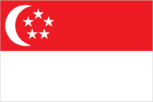
description: features two equal horizontal stripes, one red at the top and one white below; on the left side of the red band, a vertical white crescent is present, accompanied by a circle of five five-pointed white stars to the right of the crescent
meaning: red symbolizes brotherhood and equality, while white denotes purity and virtue; the waxing crescent moon represents a young nation in a phase of growth; the stars embody the national principles of democracy, peace, progress, justice, and equality
Capital
name
Singapore
etymology
the name originates from the Sanskrit terms simha (lion) and pur (city); as per Malayan folklore, an Indian prince traveled to Singapore in the 7th century and confused the first creature he encountered for a lion, which is not indigenous to the region
time difference
UTC+8 (13 hours ahead of Washington, DC, during Standard Time)
geographic coordinates
1 17 N, 103 51 E
Suffrage
21 years of age; universal and compulsory
Citizenship
citizenship by birth
no
citizenship by descent only
at least one parent must be a citizen of Singapore
dual citizenship recognized
no
residency requirement for naturalization
10 years
Constitution
history
several previous; latest adopted 22 December 1965
amendment process
proposed by the Parliament; to be enacted, a two-thirds majority vote in the second and third readings by the elected members of Parliament is required, along with the approval of the president of the republic; amendments impacting sovereignty or oversight of the Police Force or Armed Forces necessitate at least a two-thirds majority in a referendum
Country name
etymology
the name originates from the Sanskrit terms simha (lion) and pur (city); as per Malayan folklore, an Indian prince traveled to Singapore in the 7th century and confused the first creature he encountered for a lion, which is not indigenous to the region
local long form
Republic of Singapore
local short form
Singapore
conventional long form
Republic of Singapore
conventional short form
Singapore
Independence
9 August 1965 (from Malaysian Federation)
Legal system
based on English common law
Government type
parliamentary republic
Judicial branch
highest court(s)
Supreme Court (the number of judges can vary, consisting of judicial commissioners, judges of appeal, and international judges); the court is structured into an upper-tier Appeal Court and a lower-tier High Court
subordinate courts
district, magistrates', juvenile, family, community, and coroners' courts; small claims tribunals; employment claims tribunals
judge selection and term of office
judges are appointed by the president from a list of candidates put forward by the prime minister after consulting with the chief justice; judges typically serve until reaching the retirement age of 65, although terms can be extended
Executive branch
cabinet
the Cabinet is appointed by the president based on the prime minister's advice; it is accountable to Parliament
chief of state
President THARMAN Shanmugaratnam (since 14 September 2023)
election results
2023: THARMAN Shanmugaratnam was elected president; vote percentage - THARMAN Shanmugaratnam (independent) 70.4%, NG Kok Song (independent) 15.7%, TAN Kin Lian (independent) 13.9%
2017: HALIMAH Yacob was declared president on 13 September 2017, being the sole eligible candidate
head of government
Prime Minister Lawrence WONG (since 15 May 2024)
most recent election date
1 September 2023
election/appointment process
the president is directly elected through a simple-majority popular vote for a term of 6 years (there are no term limits); post-legislative elections, the president designates the leader of the majority party or coalition as prime minister; deputy prime ministers are also appointed by the president
expected date of next election
2029
National holiday
National Day, 9 August (1965)
National color(s)
red, white
National heritage
total World Heritage Sites
1 (cultural)
selected World Heritage Site locales
Singapore Botanic Gardens
Political parties
People's Action Party or PAP
Workers' Party or WPS
there are 13 additional active political parties in Singapore
Legislative branch
term in office
5 years
number of seats
108 (97 directly elected; 9 appointed)
electoral system
plurality/majority
legislature name
Parliament
scope of elections
full renewal
legislative structure
unicameral
most recent election date
5/3/2025
expected date of next election
May 2030
percentage of women in chamber
32.3%
parties elected and seats per party
People's Action Party (PAP) (87); Workers' Party (WPS) (12)
National anthem(s)
title
"Majulah Singapura" (Onward, Singapore)
history
adopted in 1959; the anthem is performed exclusively in Malay; the first four lines of the melody serve as a presidential salute
lyrics/music
Zubir SAID
National symbol(s)
lion, merlion (a mythical creature that is half-lion and half-fish), orchid
Administrative divisions
there are no first-order administrative divisions; five community development councils exist: Central Singapore Development Council, North East Development Council, North West Development Council, South East Development Council, South West Development Council (2019)
Diplomatic representation in the US
FAX
[1] (202) 537-0876
chancery
3501 International Place NW, Washington, DC 20008
telephone
[1] (202) 537-3100
consulate(s)
New York
chief of mission
Ambassador LUI Tuck Yew (since 30 June 2023)
consulate(s) general
San Francisco
email address and website
[email protected]
https://www.mfa.gov.sg/washington/
Diplomatic representation from the US
FAX
[65] 6476-9340
embassy
27 Napier Road, Singapore 258508
telephone
[65] 6476-9100
mailing address
4280 Singapore Place, Washington DC 20521-4280
chief of mission
Ambassador Anjani K. SINHA (since 17 November 2025)
email address and website
[email protected]
https://sg.usembassy.gov/
International organization participation
ADB, AOSIS, APEC, Arctic Council (observer), ARF, ASEAN, BIS, C, CP, EAS, FAO, FATF, G-77, IAEA, IBRD, ICAO, ICC (national committees), ICCt, ICRM, IDA, IFC, IFRCS, IHO, ILO, IMF, IMO, IMSO, Interpol, IOC, IPU, ISO, ITSO, ITU, ITUC (NGOs), MIGA, NAM, OPCW, Pacific Alliance (observer), PCA, UN, UNCTAD, UNESCO, UNHCR, UNOOSA, UPU, WCO, WHO, WIPO, WMO, WTO
International law organization participation
has not issued a declaration of jurisdiction to the ICJ; a non-party state to the ICCt
Economy
Budget
revenues
$80.836 billion (2022 est.)
expenditures
$73.144 billion (2022 est.)
Exports
Exports 2022
$947.355 billion (2022 est.)
Exports 2023
$917.683 billion (2023 est.)
Exports 2024
$978.597 billion (2024 est.)
Imports
Imports 2022
$744.364 billion (2022 est.)
Imports 2023
$728.5 billion (2023 est.)
Imports 2024
$786.02 billion (2024 est.)
Industries
electronics, chemicals, financial services, oil drilling equipment, petroleum refining, biomedical products, scientific instruments, telecommunication equipment, processed food and beverages, ship repair, offshore platform construction, entrepot trade
Labor force
3.722 million (2024 est.)
Public debt
Public debt 2023
175.6% of GDP (2023 est.)
Remittances
Remittances 2021
0% of GDP (2021 est.)
Remittances 2022
0% of GDP (2022 est.)
Remittances 2023
0% of GDP (2023 est.)
Exchange rates
Currency
Singapore dollars (SGD) per US dollar -
Exchange rates 2020
1.38 (2020 est.)
Exchange rates 2021
1.343 (2021 est.)
Exchange rates 2022
1.379 (2022 est.)
Exchange rates 2023
1.343 (2023 est.)
Exchange rates 2024
1.336 (2024 est.)
Economic overview
characterized as a high-income, service-oriented economy; a global financial center; promotes business-friendly policies and is favorable for investment and trade; inflation is decreasing yet remains persistent in the service sector; public sector investments focus on education, healthcare, and infrastructure; strong development of human capital is confronted by an aging population
Unemployment rate
Unemployment rate 2022
3.6% (2022 est.)
Unemployment rate 2023
3.5% (2023 est.)
Unemployment rate 2024
3.2% (2024 est.)
Exports - partners
Hong Kong 13%, China 11%, USA 10%, Malaysia 9%, S. Korea 6% (2023)
Imports - partners
China 15%, Malaysia 11%, Taiwan 11%, USA 10%, S. Korea 6% (2023)
Real GDP per capita
Real GDP per capita 2022
$133,600 (2022 est.)
Real GDP per capita 2023
$129,600 (2023 est.)
Real GDP per capita 2024
$132,600 (2024 est.)
Real GDP growth rate
Real GDP growth rate 2022
4.1% (2022 est.)
Real GDP growth rate 2023
1.8% (2023 est.)
Real GDP growth rate 2024
4.4% (2024 est.)
Agricultural products
chicken, eggs, vegetables, pork, duck, spinach, lettuce, pork offal, cabbages, pork fat (2023)
Exports - commodities
integrated circuits, refined petroleum, machinery, vaccines, gold (2023)
Imports - commodities
integrated circuits, refined petroleum, crude petroleum, gold, gas turbines (2023)
Current account balance
Current account balance 2022
$93.771 billion (2022 est.)
Current account balance 2023
$89.403 billion (2023 est.)
Current account balance 2024
$96.015 billion (2024 est.)
Taxes and other revenues
13.9% (of GDP) (2023 est.)
GDP (official exchange rate)
$547.387 billion (2024 est.)
GDP - composition, by end use
household consumption
31.5% (2024 est.)
government consumption
10.6% (2024 est.)
investment in inventories
0.3% (2024 est.)
investment in fixed capital
21.9% (2024 est.)
exports of goods and services
178.8% (2024 est.)
imports of goods and services
-143.6% (2024 est.)
Average household expenditures
on food
7% of household expenditures (2023 est.)
on alcohol and tobacco
1.7% of household expenditures (2023 est.)
Inflation rate (consumer prices)
Inflation rate (consumer prices) 2022
6.1% (2022 est.)
Inflation rate (consumer prices) 2023
4.8% (2023 est.)
Inflation rate (consumer prices) 2024
2.4% (2024 est.)
Industrial production growth rate
4.2% (2024 est.)
Real GDP (purchasing power parity)
Real GDP (purchasing power parity) 2022
$752.948 billion (2022 est.)
Real GDP (purchasing power parity) 2023
$766.662 billion (2023 est.)
Real GDP (purchasing power parity) 2024
$800.304 billion (2024 est.)
Youth unemployment rate (ages 15-24)
male
5.6% (2024 est.)
total
7.8% (2024 est.)
female
10.8% (2024 est.)
Reserves of foreign exchange and gold
Reserves of foreign exchange and gold 2022
$296.629 billion (2022 est.)
Reserves of foreign exchange and gold 2023
$359.835 billion (2023 est.)
Reserves of foreign exchange and gold 2024
$383.946 billion (2024 est.)
GDP - composition, by sector of origin
industry
21.4% (2024 est.)
services
73% (2024 est.)
agriculture
0% (2024 est.)
Gini Index coefficient - distribution of family income
Gini Index coefficient - distribution of family income 2016
45.8 (2016)
Energy
Coal
exports
97 metric tons (2023 est.)
imports
1.326 million metric tons (2023 est.)
consumption
1.153 million metric tons (2023 est.)
Petroleum
refined petroleum consumption
1.514 million bbl/day (2023 est.)
Electricity
consumption
56.672 billion kWh (2023 est.)
installed generating capacity
13.134 million kW (2023 est.)
transmission/distribution losses
169.447 million kWh (2023 est.)
Natural gas
exports
399.452 million cubic meters (2023 est.)
imports
13.973 billion cubic meters (2023 est.)
consumption
13.134 billion cubic meters (2023 est.)
Electricity access
electrification - total population
100% (2022 est.)
Energy consumption per capita
Total energy consumption per capita 2023
643.259 million Btu/person (2023 est.)
Electricity generation sources
solar
2% of total installed capacity (2023 est.)
fossil fuels
94.8% of total installed capacity (2023 est.)
biomass and waste
3.1% of total installed capacity (2023 est.)
Communications
Internet users
percent of population
94% (2023 est.)
Broadcast media
Media outlets under government control; six television channels managed by the state-owned MediaCorp; reception of broadcasts from Malaysian and Indonesian networks permitted; prohibition on satellite dishes; availability of multi-channel cable television services; a total of 19 radio stations exists, comprising 11 operated by MediaCorp, 5 associated with the state-linked Singapore Press Holdings, 2 linked to the Singapore Armed Forces Reservists Association, and 1 affiliated with BBC Radio; access to Malaysian and Indonesian radio stations is also available (2019)
Internet country code
.sg
Telephones - fixed lines
total subscriptions
1.912 million (2023 est.)
subscriptions per 100 inhabitants
33 (2023 est.)
Telephones - mobile cellular
total subscriptions
9.96 million (2024 est.)
subscriptions per 100 inhabitants
171 (2024 est.)
Broadband - fixed subscriptions
total
1.57 million (2023 est.)
subscriptions per 100 inhabitants
27 (2023 est.)
Transportation
Ports
large
2
small
1
medium
1
key ports
Jurong Island, Keppel - (Eastern Singapore), Pulau Bukom, Pulau Sebarok
very small
1
total ports
5 (2024)
ports with oil terminals
3
Airports
9 (2025)
Heliports
1 (2025)
Merchant marine
total
3,202 (2023)
by type
bulk carriers 591, container vessels 604, general cargo ships 107, oil tankers 600, others 1,300
Civil aircraft registration country code prefix
9V
Military & Security
Military - note
The primary duty of the Singapore Armed Forces (SAF) is to ensure external defense, with a particular emphasis on maritime security. Additionally, it prepares for certain domestic security functions, such as conducting joint deterrence patrols with law enforcement during periods of increased terrorism threats. The Army encompasses a 'people's defense force,' which operates as a divisional headquarters tasked with homeland security and counterterrorism efforts. Regularly, the SAF engages in both bilateral and multilateral training exercises.
Singapore is a participant in the Five Powers Defense Arrangements (FPDA), a framework of mutual assistance agreements established in 1971 that includes Australia, Malaysia, New Zealand, Singapore, and the United Kingdom. The FPDA obligates its members to consult each other in the event of an armed attack or threat against any member, allowing them to collectively determine the necessary actions to be taken, whether jointly or individually. Furthermore, Singapore maintains close security collaborations with the United States, which include granting access to military bases, overflight rights, and other privileges.
The origins of the SAF can be traced back to 1854 with the establishment of the Singapore Volunteer Rifle Corps under colonial authority. The First Singapore Infantry Regiment, which was the first battalion of regular soldiers, was formed in 1957. The contemporary SAF was founded in 1965 (2025).
Military deployments
The SAF operates permanent training detachments stationed in Australia, France, and the United States (2025).
Military expenditures
Military Expenditures 2020
3% of GDP (2020 est.)
Military Expenditures 2021
3% of GDP (2021 est.)
Military Expenditures 2022
3% of GDP (2022 est.)
Military Expenditures 2023
3% of GDP (2023 est.)
Military Expenditures 2024
3% of GDP (2024 est.)
Military and security forces
Singapore Armed Forces (SAF; also known as Singapore Defense Force): comprises the Singapore Army, Republic of Singapore Navy, Republic of Singapore Air Force (which includes air defense), and the Digital and Intelligence Service.
Ministry of Home Affairs: includes the Singapore Police Force (SPF; which consists of the Police Coast Guard and the Gurkha Contingent) (2025).
Military service age and obligation
The age for voluntary enlistment for both men and women is set at 18 years (or 16.5 years for early enlistment with parental consent); compulsory military service for men is required between the ages of 18 and 21; the service obligation for conscripts lasts 24 months (2026).
Military equipment inventories and acquisitions
The SAF incorporates a varied and contemporary array of both domestically manufactured and imported Western weaponry from suppliers including France, Germany, and the United States. Singapore possesses a compact yet advanced defense industry that produces military equipment such as armored vehicles and naval warships (2025).
Military and security service personnel strengths
While the exact figures may vary, approximately 55,000 personnel are active-duty members of the Armed Forces (40,000 from the Army; 7,000 from the Navy; 8,000 from the Air Force) (2025).
Terrorism
Transnational Issues
Refugees and internally displaced persons
stateless persons
1,109 (2024 est.)