CapitalPhnom Penh
LanguagesKhmer, minority languages, Chinese, Vietnamese, other
Currencyriels
Governmentparliamentary constitutional monarchy
Bamwor Indexes
Cambodia — Q1 2026
IBEUBamwor Urban Scale Index
9.13%
Rank #166 of 237
View full ranking →
IBCPBamwor Population Concentration Index
16.11%
Rank #178 of 237
View full ranking →
IBDABamwor Settlement Density Index
61.99per 1K km²
Rank #149 of 241
View full ranking →
IBCXBamwor Country Complexity Index
68.50/100
Rank #57 of 234
View full ranking →
IBEEBamwor Economic Stability Index
85.81/100
Rank #127 of 220
View full ranking →
IBDIBamwor Digital Infrastructure Index
62.23/100
Rank #146 of 206
View full ranking →
IBEDBamwor Education Index
57.64/100
Rank #81 of 119
View full ranking →
IBSABamwor Healthcare Index
63.90/100
Rank #147 of 218
View full ranking →
Cambodia Intelligence Report
Download PDF with 20+ statistics, rankings & proprietary indices
Introduction
Background
Most Cambodians consider themselves to be Khmers, descendants of the Angkor Empire that extended over much of Southeast Asia and reached its zenith between the 10th and 13th centuries. Attacks by the Thai and Cham (from present-day Vietnam) weakened the empire, ushering in a long period of decline. The king placed the country under French protection in 1863, and it became part of French Indochina in 1887. Following Japanese occupation in World War II, Cambodia gained full independence from France in 1953. In 1975, after a seven-year struggle, communist Khmer Rouge forces captured Phnom Penh and evacuated all cities and towns. At least 1.5 million Cambodians died from execution, forced hardships, or starvation during the Khmer Rouge regime under POL POT. A 1978 Vietnamese invasion drove the Khmer Rouge into the countryside, began a 10-year Vietnamese occupation, and touched off 13 years of internecine warfare in which a coalition of Khmer Rouge, Cambodian nationalists, and royalist insurgents, with assistance from China, fought the Vietnamese-backed People’s Republic of Kampuchea (PRK).
The 1991 Paris Agreements ended the country’s civil war and mandated democratic elections, which took place in 1993 and ushered in a period of multi-party democracy with a constitutional monarchy. King Norodom SIHANOUK was reinstated as head of state, and the Cambodian People's Party (CPP) and the royalist FUNCINPEC party formed a coalition government. Nevertheless, the power-sharing arrangement proved fractious and fragile, and in 1997, a coup led by CPP leader and former PRK prime minister HUN SEN dissolved the coalition and sidelined FUNCINPEC. Despite further attempts at coalition governance, the CPP has since remained in power through elections criticized for lacking fairness, political and judicial corruption, media control, and influence over labor unions, all of which have been enforced with violence and intimidation. HUN SEN remained as prime minister until 2023, when he transferred power to his son, HUN MANET. HUN SEN has subsequently maintained considerable influence as the leader of the CPP and the Senate. The CPP has also placed limits on civil society, press freedom, and freedom of expression. Despite some economic growth and considerable investment from China over the past decade, Cambodia remains one of East Asia's poorest countries.
The remaining elements of the Khmer Rouge surrendered in 1999. A UN-backed special tribunal established in Cambodia in 1997 tried some of the surviving Khmer Rouge leaders for crimes against humanity and genocide. The tribunal concluded in 2022 with three convictions.
Geography
Area
land
176,515 sq km
water
4,520 sq km
total
181,035 sq km
Climate
tropical climate characterized by a rainy monsoon period from May to November and a dry season from December to April, with minimal seasonal temperature fluctuations
Terrain
predominantly flat and low plains, with mountainous regions situated in the southwest and north
Land use
other
25.8% (2023 est.)
forest
39.4% (2023 est.)
agricultural land
34.9% (2023 est.)
agricultural land: arable land
arable land: 23.3% (2023 est.)
agricultural land: permanent crops
permanent crops: 3% (2023 est.)
agricultural land: permanent pasture
permanent pasture: 8.5% (2023 est.)
Location
Located in Southeast Asia, adjacent to the Gulf of Thailand and bordered by Thailand, Vietnam, and Laos
Coastline
443 km
Elevation
lowest point
Gulf of Thailand 0 m
highest point
Phnum Aoral 1,810 m
mean elevation
126 m
Irrigated land
3,540 sq km (2012)
Map references
Southeast Asia
Land boundaries
total
2,530 km
border countries
Laos 555 km; Thailand 817 km; Vietnam 1158 km
Maritime claims
contiguous zone
24 nm
territorial sea
12 nm
continental shelf
200 nm
exclusive economic zone
200 nm
Natural hazards
Experiences monsoonal precipitation from June to November, leading to flooding and occasional droughts
Geography - note
A nation characterized by rice paddies and forests, primarily influenced by the Mekong River and Tonle Sap, which is the largest freshwater lake in Southeast Asia
Natural resources
Natural resources include oil and gas, timber, gemstones, iron ore, manganese, phosphates, potential for hydropower, and cultivable land
Area - comparative
Approximately 1.5 times larger than Pennsylvania and slightly smaller than Oklahoma
Geographic coordinates
13 00 N, 105 00 E
Population distribution
The majority of the population is situated in the southeastern region, especially around the capital, Phnom Penh; population distribution is closely associated with the Mekong and Tonle Sap Rivers
Major lakes (area sq km)
fresh water lake(s)
Tonle Sap - 2,700-16,000 sq km
Major watersheds (area sq km)
Pacific Ocean drainage
Mekong (805,604 sq km)
Major rivers (by length in km)
Mekong River (shared with China [s], Burma, Thailand, Laos, and Vietnam [m]) - 4,350 km
note: [s] indicates the river's source country; [m] indicates the river's mouth country
People & Society
Literacy
male
81.5% (2021 est.)
female
63.6% (2021 est.)
total population
71.9% (2021 est.)
Languages
Languages
Khmer (official) 95.8%, minority languages 2.9%, Chinese 0.6%, Vietnamese 0.5%, other 0.2% (2019 estimate)
major-language sample(s)
សៀវភៅហេតុការណនៅលើពិភពលោក។ ទីតាំងពត៏មានមូលដានគ្រឹះយាងសំខាន់។. (Khmer)
The World Factbook, the indispensable source for basic information.
Religions
Buddhist (official) 97.1%, Muslim 2%, Christian 0.3%, other 0.5% (2019 estimate)
Sex ratio
at birth
1.04 male(s)/female
0-14 years
1.02 male(s)/female
15-64 years
0.95 male(s)/female
total population
0.94 male(s)/female (2024 est.)
65 years and over
0.55 male(s)/female
Birth rate
17.74 births/1,000 population (2025 est.)
Death rate
5.62 deaths/1,000 population (2025 est.)
Median age
male
26.9 years
total
28.3 years (2025 est.)
female
28.9 years
Population
male
8,362,224
total
17,230,333 (2025 est.)
female
8,868,109
Nationality
noun
Cambodian(s)
adjective
Cambodian
Tobacco use
male
24.9% (2025 est.)
total
14.5% (2025 est.)
female
4.7% (2025 est.)
Urbanization
urban population
25.6% of total population (2023)
rate of urbanization
3.06% annual rate of change (2020-25 est.)
Age structure
0-14 years
28.9% (male 2,497,056/female 2,436,618)
15-64 years
65.8% (male 5,456,941/female 5,765,206)
65 years and over
5.3% (2024 est.) (male 323,591/female 584,257)
Ethnic groups
Khmer 95.4%, Cham 2.4%, Chinese 1.5%, other 0.7% (2019-20 estimate)
Child marriage
men married by age 18
3.3% (2022)
women married by age 15
1.9% (2022)
women married by age 18
17.9% (2022)
Dependency ratios
total dependency ratio
51.2 (2025 est.)
youth dependency ratio
42.9 (2025 est.)
potential support ratio
11.9 (2025 est.)
elderly dependency ratio
8.4 (2025 est.)
Physician density
0.21 physicians/1,000 population (2019)
Health expenditure
Health expenditure (as % of GDP)
7.5% of GDP (2021)
Health expenditure (as % of national budget)
7% of national budget (2022 est.)
Net migration rate
-2.62 migrant(s)/1,000 population (2025 est.)
Hospital bed density
0.7 beds/1,000 population (2018 est.)
Total fertility rate
2.14 children born/woman (2025 est.)
Drinking water source
improved: rural
rural: 72.8% of population (2022 est.)
improved: total
total: 78% of population (2022 est.)
improved: urban
urban: 93.6% of population (2022 est.)
unimproved: rural
rural: 27.2% of population (2022 est.)
unimproved: total
total: 22% of population (2022 est.)
unimproved: urban
urban: 6.4% of population (2022 est.)
Education expenditure
Education expenditure (% GDP)
2.2% of GDP (2023 est.)
Education expenditure (% national budget)
11.6% national budget (2025 est.)
Infant mortality rate
male
31.3 deaths/1,000 live births
total
27.2 deaths/1,000 live births (2025 est.)
female
24.4 deaths/1,000 live births
Population growth rate
0.95% (2025 est.)
Gross reproduction rate
1.05 (2025 est.)
Population distribution
the population is primarily located in the southeast, especially in and around the capital city of Phnom Penh; additional distribution is closely associated with the Tonle Sap and Mekong Rivers
Life expectancy at birth
male
69.6 years
female
73.3 years
total population
71.4 years (2024 est.)
Maternal mortality ratio
137 deaths/100,000 live births (2023 est.)
Sanitation facility access
improved: rural
rural: 79.6% of population (2022 est.)
improved: total
total: 84.7% of population (2022 est.)
improved: urban
urban: 100% of population (2022 est.)
unimproved: rural
rural: 20.4% of population (2022 est.)
unimproved: total
total: 15.3% of population (2022 est.)
unimproved: urban
urban: 0% of population (2022 est.)
Alcohol consumption per capita
beer
4.12 liters of pure alcohol (2019 est.)
wine
0.03 liters of pure alcohol (2019 est.)
total
4.56 liters of pure alcohol (2019 est.)
spirits
0.41 liters of pure alcohol (2019 est.)
other alcohols
0 liters of pure alcohol (2019 est.)
Major urban areas - population
2.281 million PHNOM PENH (capital) (2023)
Obesity - adult prevalence rate
3.9% (2016)
Mother's mean age at first birth
23.3 years (2021-22 est.)
Currently married women (ages 15-49)
67.2% (2022 est.)
Children under the age of 5 years underweight
16.3% (2021 est.)
School life expectancy (primary to tertiary education)
male
11 years (2023 est.)
total
11 years (2023 est.)
female
11 years (2023 est.)
Environment
Climate
tropical; characterized by a rainy monsoon period (from May to November); a dry season (from December to April); minimal seasonal temperature fluctuations
Land use
other
25.8% (2023 est.)
forest
39.4% (2023 est.)
agricultural land
34.9% (2023 est.)
agricultural land: arable land
arable land: 23.3% (2023 est.)
agricultural land: permanent crops
permanent crops: 3% (2023 est.)
agricultural land: permanent pasture
permanent pasture: 8.5% (2023 est.)
Urbanization
urban population
25.6% of total population (2023)
rate of urbanization
3.06% annual rate of change (2020-25 est.)
Waste and recycling
municipal solid waste generated annually
1.089 million tons (2024 est.)
percent of municipal solid waste recycled
12.4% (2022 est.)
Environmental issues
loss of habitat and biodiversity due to unlawful logging and strip mining activities; degradation of mangrove wetlands; soil degradation; restricted access to clean drinking water in rural regions; unlawful fishing practices and overfishing; deforestation resulting in sediment accumulation within coastal ecosystems
Total water withdrawal
municipal
98 million cubic meters (2022 est.)
industrial
33 million cubic meters (2022 est.)
agricultural
2.053 billion cubic meters (2022 est.)
Carbon dioxide emissions
total emissions
18.779 million metric tonnes of CO2 (2023 est.)
from coal and metallurgical coke
8.026 million metric tonnes of CO2 (2023 est.)
from petroleum and other liquids
10.753 million metric tonnes of CO2 (2023 est.)
Particulate matter emissions
18.4 micrograms per cubic meter (2019 est.)
Total renewable water resources
476.1 billion cubic meters (2022 est.)
International environmental agreements
party to
Biodiversity, Climate Change, Climate Change-Kyoto Protocol, Climate Change-Paris Agreement, Comprehensive Nuclear Test Ban, Desertification, Endangered Species, Hazardous Wastes, Marine Life Conservation, Ozone Layer Protection, Ship Pollution, Tropical Timber 2006, Wetlands, Whaling
signed, but not ratified
Law of the Sea
Government
Flag
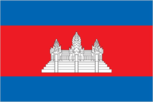
description: consists of three horizontal stripes: blue (top), red (double-width), and blue; at the center of the red band is a three-towered, stylized white temple outlined in black, symbolizing Angkor Wat
meaning: red and blue are colors traditionally associated with Cambodia
Capital
name
Phnom Penh
etymology
the term translates to "mountain of plenty," originating from the Cambodian words phnom (mountain or hill) and penh (full)
time difference
UTC+7 (12 hours ahead of Washington, DC, during Standard Time)
geographic coordinates
11 33 N, 104 55 E
Suffrage
18 years of age; universal
Citizenship
citizenship by birth
no
citizenship by descent only
at least one parent must be a citizen of Cambodia
dual citizenship recognized
yes
residency requirement for naturalization
7 years
Constitution
history
previously established in 1947; most recently promulgated on 21 September 1993
amendment process
introduced by the monarch, the prime minister, or the president of the National Assembly, provided it has the backing of one-fourth of the Assembly members; a two-thirds majority of the Assembly members is required for passage; amendments to constitutional articles regarding the multiparty democratic system and the monarchy are prohibited
Country name
former
Khmer Republic, Democratic Kampuchea, People's Republic of Kampuchea, State of Cambodia
etymology
the name originates from Kambu, a mythical progenitor of the Cambodian populace
local long form
Preahreacheanachakr Kampuchea (phonetic transliteration)
local short form
Kampuchea
conventional long form
Kingdom of Cambodia
conventional short form
Cambodia
Independence
9 November 1953 (from France)
Legal system
legal system based on civil law (influenced by the UN Transitional Authority in Cambodia), customary law, Communist legal theory, and common law
Government type
parliamentary constitutional monarchy
Judicial branch
highest court(s)
Supreme Council (organized into panels of 5 and 9 judges, including a court chief and deputy chief); Constitutional Court (comprising 9 members)
subordinate courts
Appellate Court; provincial and municipal courts; Military Court
judge selection and term of office
candidates for the Supreme Court and Constitutional Council are recommended by the Supreme Council of Magistracy, a 17-member body led by the monarch and including other senior judicial officials; judges for both courts are appointed by the monarch; Supreme Court judges serve for life; Constitutional Council judges serve for 9-year terms, with one-third of the court renewed every 3 years
Executive branch
cabinet
Council of Ministers named by the prime minister and appointed by the monarch
chief of state
King Norodom SIHAMONI (since 29 October 2004)
head of government
Prime Minister HUN MANET (since 22 August 2023)
election/appointment process
the monarch is selected by the 9-member Royal Council of the Throne from among all eligible males of royal lineage; following legislative elections, the leader of the majority party or coalition is appointed prime minister by the Chairman of the National Assembly and confirmed by the monarch
National holiday
Independence Day, 9 November (1953)
National color(s)
red, blue
National heritage
total World Heritage Sites
5 (all cultural)
selected World Heritage Site locales
Angkor; Temple of Preah Vihear; Sambor Prei Kuk; Koh Ker: Archaeological Site of Ancient Lingapora or Chok Gargyar; Cambodian Memorial Sites: From centres of repression to places of peace and reflection (c)
Political parties
Cambodian People's Party (CPP)
United National Front for an Independent, Neutral, Peaceful and Co-operative Cambodia (FUNCINPEC)
Legislative branch
legislature name
Parliament
legislative structure
bicameral
National anthem(s)
title
"Nokoreach" (Royal Kingdom)
history
adopted in 1941, restored in 1993; the anthem, based on a Cambodian folk melody, was reinstated following the fall of the Communist regime
lyrics/music
CHUON NAT/F. PERRUCHOT and J. JEKYLL
National symbol(s)
Angkor Wat temple, kouprey (wild ox)
National coat of arms
Cambodia’s coat of arms also serves as the Royal Arms of Cambodia; the lions represent strength, bravery, and the divine safeguarding of the monarchs; the lion on the left is a gajasingha (a lion with an elephant’s trunk), while the lion on the right is a rajasingha (royal lion); both lions hold five-tiered umbrellas symbolizing the king and queen, positioned on a blue ribbon inscribed with “Preah Chao Krung Kampuche” (King of the Kingdom of Cambodia); between the lions is a crown featuring the Unalome, a Buddhist and Hindu emblem representing the spiritual journey to enlightenment, with a ray of light above
Administrative divisions
24 provinces (khett, both singular and plural) and 1 municipality (krong, both singular and plural)
provinces: Banteay Meanchey, Battambang, Kampong Cham, Kampong Chhnang, Kampong Speu, Kampong Thom, Kampot, Kandal, Kep, Koh Kong, Kratie, Mondolkiri, Oddar Meanchey, Pailin, Preah Sihanouk, Preah Vihear, Prey Veng, Pursat, Ratanakiri, Siem Reap, Stung Treng, Svay Rieng, Takeo, Tbong Khmum
municipalities: Phnom Penh (Phnum Penh)
Legislative branch - lower chamber
chamber name
National Assembly (Radhsphea Ney Preah Recheanachakr Kampuchea)
term in office
5 years
number of seats
125 (all directly elected)
electoral system
proportional representation
scope of elections
full renewal
most recent election date
7/23/2023
expected date of next election
July 2028
percentage of women in chamber
13.6%
parties elected and seats per party
Cambodian People's Party (CPP) (120); United National Front for an Independent, Neutral, Peaceful and Co-operative Cambodia (FUNCINPEC) (5)
Legislative branch - upper chamber
chamber name
Senate
term in office
6 years
number of seats
62 (60 indirectly elected; 2 appointed)
scope of elections
full renewal
most recent election date
2/25/2024
expected date of next election
February 2030
percentage of women in chamber
19.4%
Diplomatic representation in the US
FAX
[1] (202) 726-8381
chancery
4530 16th Street NW, Washington, DC 20011
telephone
[1] (202) 726-7742
chief of mission
Ambassador Koy KUONG (since 11 June 2025)
email address and website
[email protected]
https://www.embassyofcambodiadc.org/
Diplomatic representation from the US
FAX
[855] (23) 728-700
embassy
#1, Street 96, Sangkat Wat Phnom, Khan Daun Penh, Phnom Penh
telephone
[855] (23) 728-000
mailing address
4540 Phnom Penh Place, Washington DC 20521-4540
chief of mission
Ambassador (vacant); Chargé d’Affaires Bridgette L. WALKER (since August 2024)
email address and website
[email protected]
https://kh.usembassy.gov/
International organization participation
ADB, ARF, ASEAN, CICA, EAS, FAO, G-77, IAEA, IBRD, ICAO, ICRM, IDA, IFAD, IFC, IFRCS, ILO, IMF, IMO, Interpol, IOC, IOM, IPU, ISO (correspondent), ITU, MIGA, NAM, OIF, OPCW, PCA, UN, UNAMID, UNCTAD, UNESCO, UNIDO, UNIFIL, UNISFA, UNMISS, UNWTO, UPU, WCO, WFTU (NGOs), WHO, WIPO, WMO, WTO
International law organization participation
accepts compulsory ICJ jurisdiction with reservations; accepts ICCt jurisdiction
Economy
Budget
revenues
$7.076 billion (2023 est.)
expenditures
$8.285 billion (2023 est.)
Exports
Exports 2022
$25.497 billion (2022 est.)
Exports 2023
$27.753 billion (2023 est.)
Exports 2024
$31.712 billion (2024 est.)
Imports
Imports 2022
$34.759 billion (2022 est.)
Imports 2023
$29.421 billion (2023 est.)
Imports 2024
$34.329 billion (2024 est.)
Industries
sectors including tourism, garments, construction, rice milling, fishing, wood and wood products, rubber, cement, gem mining, and textiles
Labor force
9.904 million (2024 est.)
Public debt
Public debt 2023
50.3% of GDP (2023 est.)
Remittances
Remittances 2022
6.5% of GDP (2022 est.)
Remittances 2023
6.6% of GDP (2023 est.)
Remittances 2024
6.1% of GDP (2024 est.)
Exchange rates
Currency
riels (KHR) per US dollar -
Exchange rates 2020
4,092.783 (2020 est.)
Exchange rates 2021
4,098.723 (2021 est.)
Exchange rates 2022
4,102.038 (2022 est.)
Exchange rates 2023
4,110.653 (2023 est.)
Exchange rates 2024
4,072.397 (2024 est.)
Debt - external
Debt - external 2023
$8.019 billion (2023 est.)
Economic overview
recognized as one of the rapidly growing economies in Southeast Asia; recovering tourism and apparel exports; notable manufacturing and construction industries; new trade agreements that enhance agricultural markets; considerable public debt; investments directed towards new ports and infrastructure
Unemployment rate
Unemployment rate 2022
0.3% (2022 est.)
Unemployment rate 2023
0.3% (2023 est.)
Unemployment rate 2024
0.3% (2024 est.)
Exports - partners
USA 36%, Germany 6%, China 6%, Japan 6%, Thailand 5% (2023)
Imports - partners
China 39%, Thailand 20%, Vietnam 12%, Singapore 6%, Indonesia 3% (2023)
Real GDP per capita
Real GDP per capita 2022
$6,500 (2022 est.)
Real GDP per capita 2023
$6,700 (2023 est.)
Real GDP per capita 2024
$7,000 (2024 est.)
Real GDP growth rate
Real GDP growth rate 2022
5.1% (2022 est.)
Real GDP growth rate 2023
5% (2023 est.)
Real GDP growth rate 2024
6% (2024 est.)
Agricultural products
cassava, rice, maize, sugarcane, vegetables, oil palm fruit, rubber, bananas, jute, pork (2023)
Exports - commodities
garments, semiconductors, trunks and cases, footwear, gold (2023)
Imports - commodities
refined petroleum, fabric, gold, plastic products, synthetic fabric (2023)
Current account balance
Current account balance 2022
-$7.582 billion (2022 est.)
Current account balance 2023
$552.346 million (2023 est.)
Current account balance 2024
$222.108 million (2024 est.)
Taxes and other revenues
12.2% (of GDP) (2023 est.)
GDP (official exchange rate)
$46.353 billion (2024 est.)
GDP - composition, by end use
household consumption
59.8% (2024 est.)
government consumption
5.8% (2024 est.)
investment in inventories
0.6% (2024 est.)
investment in fixed capital
31.6% (2024 est.)
exports of goods and services
71.4% (2024 est.)
imports of goods and services
-72.1% (2024 est.)
Average household expenditures
on food
40.7% of household expenditures (2023 est.)
on alcohol and tobacco
1.9% of household expenditures (2023 est.)
Inflation rate (consumer prices)
Inflation rate (consumer prices) 2021
2.9% (2021 est.)
Inflation rate (consumer prices) 2022
5.3% (2022 est.)
Inflation rate (consumer prices) 2023
2.1% (2023 est.)
Industrial production growth rate
9.5% (2024 est.)
Real GDP (purchasing power parity)
Real GDP (purchasing power parity) 2022
$111.095 billion (2022 est.)
Real GDP (purchasing power parity) 2023
$116.658 billion (2023 est.)
Real GDP (purchasing power parity) 2024
$123.676 billion (2024 est.)
Youth unemployment rate (ages 15-24)
male
0.7% (2024 est.)
total
0.8% (2024 est.)
female
0.9% (2024 est.)
Reserves of foreign exchange and gold
Reserves of foreign exchange and gold 2022
$17.801 billion (2022 est.)
Reserves of foreign exchange and gold 2023
$19.984 billion (2023 est.)
Reserves of foreign exchange and gold 2024
$22.506 billion (2024 est.)
GDP - composition, by sector of origin
industry
41.8% (2024 est.)
services
35.6% (2024 est.)
agriculture
16.6% (2024 est.)
Energy
Coal
imports
4.36 million metric tons (2023 est.)
production
27,000 metric tons (2023 est.)
consumption
4.39 million metric tons (2023 est.)
Petroleum
refined petroleum consumption
77,000 bbl/day (2023 est.)
Electricity
imports
5.096 billion kWh (2023 est.)
consumption
16.998 billion kWh (2023 est.)
installed generating capacity
3.673 million kW (2023 est.)
transmission/distribution losses
1.882 billion kWh (2023 est.)
Electricity access
electrification - rural areas
88%
electrification - urban areas
99%
electrification - total population
92.3% (2022 est.)
Energy consumption per capita
Total energy consumption per capita 2023
15.664 million Btu/person (2023 est.)
Electricity generation sources
solar
5.8% of total installed capacity (2023 est.)
fossil fuels
55.5% of total installed capacity (2023 est.)
hydroelectricity
38.6% of total installed capacity (2023 est.)
biomass and waste
0.1% of total installed capacity (2023 est.)
Communications
Internet users
percent of population
61% (2023 est.)
Broadcast media
A combination of state-run, joint public-private, and privately owned broadcasting entities; 27 television stations, the majority of which operate on several channels, encompassing 1 state-run station with various locations and 11 stations that are either co-managed or privately owned, some of which have multiple sites; multi-channel cable and satellite services; 84 radio stations, featuring 1 state-run broadcaster with numerous stations alongside a blend of public and private broadcasters; one international broadcasting service is accessible, in addition to a television station that operates in collaboration with China and the Ministry of Interior; several television and radio services are available exclusively online (often through Facebook) (2019)
Internet country code
.kh
Telephones - fixed lines
total subscriptions
29,100 (2024 est.)
subscriptions per 100 inhabitants
(2024 est.) less than 1
Telephones - mobile cellular
total subscriptions
20.5 million (2024 est.)
subscriptions per 100 inhabitants
116 (2024 est.)
Broadband - fixed subscriptions
total
510,000 (2022 est.) Gradually increasing as the emphasis shifts towards mobile internet
subscriptions per 100 inhabitants
3 (2022 est.)
Transportation
Ports
large
0
small
0
medium
1
key ports
Kampong Saom, Phsar Ream
very small
1
total ports
2 (2024)
ports with oil terminals
1
Airports
12 (2025)
Railways
total
642 km (2014)
narrow gauge
642 km (2014) 1.000-m gauge
Heliports
1 (2025)
Merchant marine
total
195 (2023)
by type
container vessel 2, general cargo 123, petroleum tanker 18, miscellaneous 52
Civil aircraft registration country code prefix
XU
Military & Security
Military - note
The Royal Cambodian Armed Forces (RCAF) primarily oversee border, coastal, and internal security operations; key allies in security matters include China and Vietnam. In July 2025, amid escalating tensions, clashes occurred between the RCAF and Thailand's military across several sites along their contentious border. Each side accused the other of inciting the five-day conflict, which featured cross-border artillery bombardments and aerial assaults by RTARF fighter jets and drones.
The RCAF was established anew in 1993 during the initial coalition government, resulting from the amalgamation of the military forces of the Cambodian Government (Cambodian People’s Armed Forces) and two non-communist resistance groups (Sihanoukist National Army, also known as the National Army for Khmer Independence, and the Khmer People's National Liberation Armed Forces). By 1994, thousands of Khmer Rouge fighters began to surrender due to a government amnesty initiative, with the final remnants of the Khmer Rouge forces (National Army of Democratic Kampuchea) being disbanded or integrated into the RCAF by 1999 (2025).
Military deployments
340 Central African Republic (MINUSCA); 180 Lebanon (UNIFIL) (2025)
Military expenditures
Military Expenditures 2020
2.3% of GDP (2020 est.)
Military Expenditures 2021
2.3% of GDP (2021 est.)
Military Expenditures 2022
2.1% of GDP (2022 est.)
Military Expenditures 2023
1.5% of GDP (2023 est.)
Military Expenditures 2024
1.5% of GDP (2024 est.)
Military and security forces
Royal Cambodian Armed Forces (RCAF): Royal Cambodian Army, Royal Khmer Navy, Royal Cambodian Air Force, Royal Gendarmerie (Military Police); National Committee for Maritime Security (2025)
Military service age and obligation
The legal minimum age for military service is 18 for both men and women (2025).
Military equipment inventories and acquisitions
The RCAF primarily utilizes older weaponry of Chinese and Russian/Soviet design; in recent years, it has acquired a limited number of more contemporary arms from various suppliers, notably China (2025).
Military and security service personnel strengths
Estimates vary; the Armed Forces are approximated to comprise 200,000 personnel, including the Gendarmerie (2025).
Transnational Issues
Trafficking in persons
tier rating
Tier 3 — Cambodia fails to completely satisfy the minimum criteria for eradicating trafficking and is not making notable efforts in this regard, thus, Cambodia continues to be classified as Tier 3; for further information, visit: https://www.state.gov/reports/2025-trafficking-in-persons-report/cambodia/
Refugees and internally displaced persons
IDPs
2,526 (2024 est.)
refugees
28 (2024 est.)
stateless persons
75,000 (2024 est.)