CapitalMalé
LanguagesDhivehi , English
Currencyrufiyaa
Governmentpresidential republic
Bamwor Indexes
Maldives — Q1 2026
IBEUBamwor Urban Scale Index
26.67%
Rank #52 of 237
View full ranking →
IBCPBamwor Population Concentration Index
36.17%
Rank #91 of 237
View full ranking →
IBDABamwor Settlement Density Index
389.26per 1K km²
Rank #45 of 241
View full ranking →
IBCXBamwor Country Complexity Index
43.55/100
Rank #175 of 234
View full ranking →
IBEEBamwor Economic Stability Index
88.52/100
Rank #88 of 220
View full ranking →
IBDIBamwor Digital Infrastructure Index
75.87/100
Rank #93 of 206
View full ranking →
IBEDBamwor Education Index
80.06/100
Rank #22 of 119
View full ranking →
IBSABamwor Healthcare Index
76.20/100
Rank #52 of 218
View full ranking →
Maldives Intelligence Report
Download PDF with 20+ statistics, rankings & proprietary indices
Introduction
Background
The Maldives, which has been a sultanate since the 12th century, became a British protectorate in 1887 and transitioned to a republic in 1968, three years following its independence. President Maumoon Abdul GAYOOM was a formidable presence in the political landscape of the Maldives for three decades, having been elected for six consecutive terms through single-party referendums. In response to political protests in the capital, Male, in 2003, GAYOOM and his administration committed to initiating a series of liberalization and democratic reforms aimed at creating a more representative political framework and increasing political liberties. The legalization of political parties occurred in 2005.
A constituent assembly, known as the "Special Majlis," completed a new constitution in 2008, which was ratified by GAYOOM. That same year marked the first presidential elections conducted under a multi-candidate, multi-party system. GAYOOM was defeated in a runoff by Mohamed NASHEED, a political activist who had previously been imprisoned by the regime. In 2012, following weeks of protests triggered by the arrest of a senior judge, NASHEED resigned from the presidency, transferring power to Vice President Mohammed WAHEED Hassan Maniku. A Commission of National Inquiry, appointed by the government, determined that there was no evidence of a coup; however, NASHEED alleged that he was coerced into resigning by police and military forces. In the 2013 elections, NASHEED, WAHEED, and Abdulla YAMEEN Abdul Gayoom competed, with YAMEEN ultimately securing the presidency after three rounds of voting. In 2018, YAMEEN lost his reelection attempt to parliament member Ibrahim Mohamed SOLIH. In 2022, he was arrested and imprisoned on charges of corruption. The Maldives held its fourth democratic election in September 2023, where the victor, Male City Mayor Dr. Mohamed MUIZZU, campaigned with a focus on Maldivian sovereignty, pledging to expel Indian military personnel from the nation. MUIZZU is affiliated with a coalition of the Progressive Party of Maldives and the People's National Congress (PPM/PNC).
Geography
Area
land
298 sq km
water
0 sq km
total
298 sq km
Climate
tropical climate; characterized by hot and humid conditions; influenced by a dry northeast monsoon from November to March and a rainy southwest monsoon from June to August
Terrain
flat coral atolls featuring white sandy beaches; located on the underwater volcanic Chagos-Laccadive Ridge
Land use
other
67.7% (2023 est.)
forest
12.5% (2023 est.)
agricultural land
19.8% (2023 est.)
agricultural land: arable land
arable land: 13.4% (2023 est.)
agricultural land: permanent crops
permanent crops: 3% (2023 est.)
agricultural land: permanent pasture
permanent pasture: 3.4% (2023 est.)
Location
Located in Southern Asia, this is a collection of atolls situated in the Indian Ocean, to the south-southwest of India
Coastline
644 km
Elevation
lowest point
Indian Ocean 0 m
highest point
8th tee, golf course, Villingi Island 5 m
mean elevation
2 m
Irrigated land
0 sq km (2012)
Map references
Asia
Land boundaries
total
0 km
Maritime claims
contiguous zone
24 nm
territorial sea
12 nm
exclusive economic zone
200 nm
Natural hazards
vulnerable to tsunamis; the islands' low elevation makes them particularly susceptible to rising sea levels
Geography - note
the smallest country in Asia; an archipelago consisting of 1,190 coral islands organized into 26 atolls (200 of which are inhabited, alongside 80 designated for tourist resorts); it holds a strategic position along key maritime routes in the Indian Ocean
Natural resources
fish
Area - comparative
approximately 1.7 times larger than Washington, D.C.
Geographic coordinates
3 15 N, 73 00 E
Population distribution
around one-third of the population resides in the capital city of Male, with nearly one-tenth living in southern Addu City; the rest of the inhabitants are distributed across the roughly 200 populated islands of the archipelago
People & Society
Literacy
male
98.2% (2019 est.)
female
98.3% (2019 est.)
total population
98.2% (2019 est.)
Languages
Dhivehi (official language, closely related to Sinhala, with a script that has Arabic origins), English (commonly spoken by the majority of government officials)
Religions
Sunni Muslim (official)
Sex ratio
at birth
1.05 male(s)/female
0-14 years
1.04 male(s)/female
15-64 years
1.06 male(s)/female
total population
1.04 male(s)/female (2024 est.)
65 years and over
0.77 male(s)/female
Birth rate
14.77 births/1,000 population (2025 est.)
Death rate
4.3 deaths/1,000 population (2025 est.)
Median age
male
31.3 years
total
32.4 years (2025 est.)
female
32.4 years
Population
male
197,739
total
388,858 (2024 est.)
female
191,119
Nationality
noun
Maldivian(s)
adjective
Maldivian
Tobacco use
male
41.5% (2025 est.)
total
28% (2025 est.)
female
9.2% (2025 est.)
Urbanization
urban population
42% of total population (2023)
rate of urbanization
2.34% annual rate of change (2020-25 est.)
Age structure
0-14 years
22.4% (male 44,321/female 42,626)
15-64 years
71.5% (male 143,021/female 135,044)
65 years and over
6.1% (2024 est.) (male 10,397/female 13,449)
Ethnic groups
a homogeneous blend of Sinhalese, Dravidian, Arab, Australasian, and African influences resulting from historical shifts in regional dominance over maritime trade routes
Child marriage
men married by age 18
2.2% (2017)
women married by age 15
0% (2017)
women married by age 18
2.2% (2017)
Dependency ratios
total dependency ratio
39.8 (2024 est.)
youth dependency ratio
31.3 (2024 est.)
potential support ratio
11.7 (2024 est.)
elderly dependency ratio
8.6 (2024 est.)
Physician density
2.24 physicians/1,000 population (2019)
Health expenditure
Health expenditure (as % of GDP)
10% of GDP (2021)
Health expenditure (as % of national budget)
18.2% of national budget (2022 est.)
Net migration rate
-12.85 migrant(s)/1,000 population (2025 est.)
Hospital bed density
5 beds/1,000 population (2020 est.)
Total fertility rate
1.7 children born/woman (2025 est.)
Drinking water source
improved: rural
rural: 99.9% of population (2022 est.)
improved: total
total: 99.6% of population (2022 est.)
improved: urban
urban: 99.1% of population (2022 est.)
unimproved: rural
rural: 0.1% of population (2022 est.)
unimproved: total
total: 0.4% of population (2022 est.)
unimproved: urban
urban: 0.9% of population (2022 est.)
Education expenditure
Education expenditure (% GDP)
5.2% of GDP (2023 est.)
Education expenditure (% national budget)
9.6% national budget (2025 est.)
Infant mortality rate
male
27.3 deaths/1,000 live births
total
23.7 deaths/1,000 live births (2025 est.)
female
21.3 deaths/1,000 live births
Population growth rate
-0.24% (2025 est.)
Gross reproduction rate
0.83 (2025 est.)
Population distribution
approximately one-third of the population resides in the centrally situated capital city of Male, while nearly one-tenth is found in southern Addu City; the remainder is distributed across the roughly 200 inhabited islands of the archipelago
Life expectancy at birth
male
75.1 years
female
79.9 years
total population
77.4 years (2024 est.)
Maternal mortality ratio
32 deaths/100,000 live births (2023 est.)
Sanitation facility access
improved: rural
rural: 100% of population (2022 est.)
improved: total
total: 100% of population (2022 est.)
improved: urban
urban: 100% of population (2022 est.)
unimproved: rural
rural: 0% of population (2022 est.)
unimproved: total
total: 0% of population (2022 est.)
unimproved: urban
urban: 0% of population (2022 est.)
Alcohol consumption per capita
beer
0.33 liters of pure alcohol (2019 est.)
wine
0.59 liters of pure alcohol (2019 est.)
total
1.38 liters of pure alcohol (2019 est.)
spirits
0.45 liters of pure alcohol (2019 est.)
other alcohols
0 liters of pure alcohol (2019 est.)
Major urban areas - population
177,000 MALE (capital) (2018)
Obesity - adult prevalence rate
8.6% (2016)
Mother's mean age at first birth
23.2 years (2016/17 est.)
Currently married women (ages 15-49)
68.4% (2022 est.)
Children under the age of 5 years underweight
14.8% (2017 est.)
School life expectancy (primary to tertiary education)
male
11 years (2022 est.)
total
13 years (2022 est.)
female
15 years (2022 est.)
Environment
Climate
tropical climate; characterized by high temperatures and humidity; dry conditions during the northeast monsoon season (November to March); rainy season during the southwest monsoon (June to August)
Land use
other
67.7% (2023 est.)
forest
12.5% (2023 est.)
agricultural land
19.8% (2023 est.)
agricultural land: arable land
arable land: 13.4% (2023 est.)
agricultural land: permanent crops
permanent crops: 3% (2023 est.)
agricultural land: permanent pasture
permanent pasture: 3.4% (2023 est.)
Urbanization
urban population
42% of total population (2023)
rate of urbanization
2.34% annual rate of change (2020-25 est.)
Waste and recycling
municipal solid waste generated annually
211,500 tons (2024 est.)
percent of municipal solid waste recycled
20.9% (2022 est.)
Environmental issues
increasing sea levels; reduction of freshwater aquifers; insufficient sewage treatment; coral reef bleaching
Total water withdrawal
municipal
5.6 million cubic meters (2022 est.)
industrial
300,000 cubic meters (2022 est.)
agricultural
268,194 cubic meters (2022 est.)
Carbon dioxide emissions
total emissions
1.908 million metric tonnes of CO2 (2023 est.)
from petroleum and other liquids
1.908 million metric tonnes of CO2 (2023 est.)
Particulate matter emissions
12.3 micrograms per cubic meter (2019 est.)
Total renewable water resources
30 million cubic meters (2022 est.)
International environmental agreements
party to
Biodiversity, Climate Change, Climate Change-Kyoto Protocol, Climate Change-Paris Agreement, Comprehensive Nuclear Test Ban, Desertification, Endangered Species, Hazardous Wastes, Law of the Sea, Ozone Layer Protection, Ship Pollution
signed, but not ratified
none of the selected agreements
Government
Flag
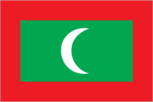
description: a red field featuring a prominent green rectangle at its center, adorned with a vertical white crescent moon that is centrally positioned on the rectangle
meaning: the red symbolizes the sacrifices of those who have given their lives for the nation, the green represents peace and prosperity, while the white crescent signifies Islam.
Capital
name
Malé
etymology
the name is believed to be derived from the Sanskrit term mala, which translates to "garland."
time difference
UTC+5 (10 hours ahead of Washington, DC, during Standard Time)
geographic coordinates
4 10 N, 73 30 E
Suffrage
18 years of age; universal
Citizenship
citizenship by birth
no
citizenship by descent only
at least one parent must be a citizen of Maldives
dual citizenship recognized
yes
residency requirement for naturalization
unknown
Constitution
history
many previous; latest ratified 7 August 2008
amendment process
proposed by Parliament; its approval necessitates a three-quarters majority vote from its members and the president's signature; alterations to constitutional articles related to rights, freedoms, and the terms of office for both Parliament and the president also demand a majority vote in a referendum.
Country name
etymology
the name's origin is uncertain but may originate from the Sanskrit word maladvipa, meaning "garland of islands;" the local designation, Dhivehi Raajje, translates to "land of the Dhivehi people" in the native language.
local long form
Dhivehi Raajjeyge Jumhooriyyaa
local short form
Dhivehi Raajje
conventional long form
Republic of Maldives
conventional short form
Maldives
Independence
26 July 1965 (from the UK)
Legal system
Islamic (sharia) legal framework infused with elements of English common law, predominantly in commercial areas.
Government type
presidential republic
Judicial branch
highest court(s)
Supreme Court (consists of the chief justice and 6 justices)
subordinate courts
High Court; Criminal, Civil, Family, Juvenile, and Drug Courts; Magistrate Courts (located on each inhabited island)
judge selection and term of office
Supreme Court judges are appointed by the president in collaboration with the Judicial Service Commission, a body consisting of 10 selected senior officials and public representatives, and are confirmed by the voting members of the People's Majlis; judges remain in service until reaching the mandatory retirement age of 70.
Executive branch
cabinet
Cabinet of Ministers is appointed by the president and requires approval from the People's Majlis.
chief of state
President Mohamed MUIZZU (since 17 November 2023)
election results
2023: Mohamed MUIZZU was elected president in the second round; percentage of votes in the first round - Mohamed MUIZZU (PNC) 46.1%, Ibrahim Mohamed SOLIH (MDP) 39.1%, Ilyas LABEEB (DEMS) 7.1%, others 7.7%; percentage of votes in the second round - Mohamed MUIZZU 54%, Ibrahim Mohamed SOLIH 46%.
head of government
President Mohamed MUIZZU (since 17 November 2023)
most recent election date
9 September 2023, with runoff on 30 September 2023
election/appointment process
the president is elected directly through an absolute-majority popular vote in two rounds, if necessary, for a term of 5 years (eligible for one additional term).
expected date of next election
2028
National holiday
Independence Day, 26 July (1965)
National color(s)
red, green, white
Political parties
Adhaalath (Justice) Party or AP
Dhivehi Rayyithunge Party or DRP
Maldives Development Alliance or MDA
Maldivian Democratic Party or MDP
Maldives Third Way Democrats or MTD
People's National Congress or PNC
People's National Front
Republican (Jumhooree) Party or JP
Legislative branch
term in office
5 years
number of seats
93 (all directly elected)
electoral system
plurality/majority
legislature name
People's Majlis (Majlis)
scope of elections
full renewal
legislative structure
unicameral
most recent election date
4/21/2024
expected date of next election
April 2029
percentage of women in chamber
3.2%
parties elected and seats per party
People's National Congress (PNC) (66); Maldivian Democratic Party (MDP) (12); Independents (11); Others (4)
National anthem(s)
title
"Gaumee Salaam" (National Salute)
history
lyrics were adopted in 1948, with music adopted in 1972; the anthem consists of seven verses, although only the first two are commonly performed.
lyrics/music
Mohamed Jameel DIDI/Wannakuwattawaduge DON AMARADEVA
National symbol(s)
coconut palm, yellowfin tuna
Administrative divisions
21 administrative atolls (atholhuthah, singular - atholhu); Addu (Addu City), Ariatholhu Dhekunuburi (South Ari Atoll), Ariatholhu Uthuruburi (North Ari Atoll), Faadhippolhu, Felidhuatholhu (Felidhu Atoll), Fuvammulah, Hahdhunmathi, Huvadhuatholhu Dhekunuburi (South Huvadhu Atoll), Huvadhuatholhu Uthuruburi (North Huvadhu Atoll), Kolhumadulu, Maale (Male), Maaleatholhu (Male Atoll), Maalhosmadulu Dhekunuburi (South Maalhosmadulu), Maalhosmadulu Uthuruburi (North Maalhosmadulu), Miladhunmadulu Dhekunuburi (South Miladhunmadulu), Miladhunmadulu Uthuruburi (North Miladhunmadulu), Mulakatholhu (Mulaku Atoll), Nilandheatholhu Dhekunuburi (South Nilandhe Atoll), Nilandheatholhu Uthuruburi (North Nilandhe Atoll), Thiladhunmathee Dhekunuburi (South Thiladhunmathi), Thiladhunmathee Uthuruburi (North Thiladhunmathi).
Diplomatic representation in the US
chancery
1100 H Street NW, Suite 250, Washington, D.C. 20005
telephone
[1] (202) 516-5458
chief of mission
Ambassador Abdul GHAFOOR Mohamed (since 15 June 2023)
email address and website
[email protected]
The Embassy (mdvmission.gov.mv)
Diplomatic representation from the US
FAX
[94] (11) 243-7345
embassy
210 Galle Road, Colombo 03, Sri Lanka; note - as of early November 2023, the US has no consular or diplomatic presence in the Maldives; the US Mission to the Maldives operates from the US Embassy in Colombo, Sri Lanka.
telephone
[94] (11) 249-8500
chief of mission
Ambassador (currently vacant); Chargé d’Affaires Chunnong SAEGER (since January 2026)
email address and website
Homepage - U.S. Embassy in Maldives
International organization participation
ADB, AOSIS, C, CP, FAO, G-77, IBRD, ICAO, ICC (NGOs), ICCt, IDA, IDB, IFAD, IFC, IFRCS, ILO, IMF, IMO, Interpol, IOC, IOM, IPU, ITU, MIGA, NAM, OIC, OPCW, SAARC, SACEP, UN, UNCTAD, UNESCO, UNIDO, UNWTO, UPU, WCO, WHO, WIPO, WMO, WTO
International law organization participation
has not provided a declaration of ICJ jurisdiction; acknowledges ICCt jurisdiction.
Economy
Budget
revenues
$1.407 billion (2021 est.)
expenditures
$1.939 billion (2021 est.)
Exports
Exports 2022
$5.096 billion (2022 est.)
Exports 2023
$4.88 billion (2023 est.)
Exports 2024
$5.413 billion (2024 est.)
Imports
Imports 2022
$4.939 billion (2022 est.)
Imports 2023
$4.984 billion (2023 est.)
Imports 2024
$5.344 billion (2024 est.)
Industries
tourism, fish processing, shipping, boat construction, coconut processing, woven mats, rope, handicrafts, coral and sand extraction
Labor force
270,300 (2024 est.)
Public debt
Public debt 2016
61.7% of GDP (2016 est.)
Remittances
Remittances 2022
0.1% of GDP (2022 est.)
Remittances 2023
0.1% of GDP (2023 est.)
Remittances 2024
0.1% of GDP (2024 est.)
Exchange rates
Currency
rufiyaa (MVR) per US dollar -
Exchange rates 2020
15.381 (2020 est.)
Exchange rates 2021
15.373 (2021 est.)
Exchange rates 2022
15.387 (2022 est.)
Exchange rates 2023
15.387 (2023 est.)
Exchange rates 2024
15.389 (2024 est.)
Debt - external
Debt - external 2023
$3.113 billion (2023 est.)
Economic overview
upper middle-income island economy in the Indian Ocean; significant sectors include tourism, fishing, and shipping; burdened by high public debt; plagued by systemic corruption; severely impacted by COVID-19; experiencing ongoing deflation; poverty levels have tripled since the onset of the pandemic
Unemployment rate
Unemployment rate 2022
4.5% (2022 est.)
Unemployment rate 2023
4.3% (2023 est.)
Unemployment rate 2024
4.7% (2024 est.)
Exports - partners
Thailand 32%, India 21%, Singapore 9%, UK 7%, Germany 5% (2023)
Imports - partners
India 15%, UAE 15%, Oman 14%, China 12%, Singapore 8% (2023)
Real GDP per capita
Real GDP per capita 2022
$21,400 (2022 est.)
Real GDP per capita 2023
$22,300 (2023 est.)
Real GDP per capita 2024
$23,400 (2024 est.)
Real GDP growth rate
Real GDP growth rate 2022
13.8% (2022 est.)
Real GDP growth rate 2023
4.7% (2023 est.)
Real GDP growth rate 2024
5.1% (2024 est.)
Agricultural products
fruits, vegetables, nuts, various meats, papayas, bananas, tomatoes, maize, pulses, chillies/peppers (2023)
Exports - commodities
fish, aircraft, refined petroleum, scrap iron, natural gas (2023)
Imports - commodities
refined petroleum, plastic products, aircraft, granite, ships (2023)
Current account balance
Current account balance 2022
-$1.042 billion (2022 est.)
Current account balance 2023
-$1.4 billion (2023 est.)
Current account balance 2024
-$1.257 billion (2024 est.)
Taxes and other revenues
19.5% (of GDP) (2021 est.)
GDP (official exchange rate)
$6.975 billion (2024 est.)
GDP - composition, by end use
household consumption
51.4% (2023 est.)
government consumption
17.1% (2023 est.)
investment in inventories
-2% (2023 est.)
investment in fixed capital
35% (2023 est.)
exports of goods and services
74.4% (2023 est.)
imports of goods and services
-75.7% (2023 est.)
Population below poverty line
5.4% (2019 est.)
Inflation rate (consumer prices)
Inflation rate (consumer prices) 2022
2.3% (2022 est.)
Inflation rate (consumer prices) 2023
2.9% (2023 est.)
Inflation rate (consumer prices) 2024
1.4% (2024 est.)
Industrial production growth rate
-2.7% (2024 est.)
Real GDP (purchasing power parity)
Real GDP (purchasing power parity) 2022
$11.194 billion (2022 est.)
Real GDP (purchasing power parity) 2023
$11.723 billion (2023 est.)
Real GDP (purchasing power parity) 2024
$12.325 billion (2024 est.)
Youth unemployment rate (ages 15-24)
male
20% (2024 est.)
total
16.1% (2024 est.)
female
9.5% (2024 est.)
Reserves of foreign exchange and gold
Reserves of foreign exchange and gold 2022
$832.094 million (2022 est.)
Reserves of foreign exchange and gold 2023
$590.523 million (2023 est.)
Reserves of foreign exchange and gold 2024
$673.886 million (2024 est.)
GDP - composition, by sector of origin
industry
9% (2024 est.)
services
73.8% (2024 est.)
agriculture
3% (2024 est.)
Household income or consumption by percentage share
lowest 10%
3.8% (2019 est.)
highest 10%
23.3% (2019 est.)
Gini Index coefficient - distribution of family income
Gini Index coefficient - distribution of family income 2019
29.3 (2019 est.)
Energy
Coal
imports
8 metric tons (2023 est.)
Petroleum
refined petroleum consumption
13,000 bbl/day (2023 est.)
Electricity
consumption
821.397 million kWh (2023 est.)
installed generating capacity
432,000 kW (2023 est.)
transmission/distribution losses
25.867 million kWh (2023 est.)
Electricity access
electrification - total population
100% (2022 est.)
Energy consumption per capita
Total energy consumption per capita 2023
50.886 million Btu/person (2023 est.)
Electricity generation sources
wind
0.2% of total installed capacity (2023 est.)
solar
6.6% of total installed capacity (2023 est.)
fossil fuels
93.2% of total installed capacity (2023 est.)
Communications
Internet users
percent of population
85% (2023 est.)
Broadcast media
previously a government-controlled radio and television monopoly; currently, there are 4 state-run and 7 privately owned television channels; along with 4 state-operated and 7 privately owned radio stations (2019)
Internet country code
.mv
Telephones - fixed lines
total subscriptions
13,000 (2023 est.)
subscriptions per 100 inhabitants
2 (2023 est.)
Telephones - mobile cellular
total subscriptions
745,000 (2023 est.)
subscriptions per 100 inhabitants
137 (2022 est.)
Broadband - fixed subscriptions
total
98,000 (2023 est.)
subscriptions per 100 inhabitants
19 (2023 est.)
Transportation
Ports
large
0
small
0
medium
0
key ports
Male
very small
1
total ports
1 (2024)
ports with oil terminals
1
Airports
20 (2025)
Merchant marine
total
82 (2023)
by type
general cargo 30, oil tanker 20, other 32
Civil aircraft registration country code prefix
8Q
Military & Security
Military - note
The Maldives National Defense Force (MNDF) is tasked with the defense and protection of the Maldives' territorial integrity, economic exclusion zone, and its citizens; it also plays a role in disaster relief and, when requested, aids the Maldives Police Service in ensuring internal security and public order; the primary emphasis of the MNDF is on maritime security; historically, the Indian Armed Forces have been the MNDF's key ally (2025)
Military expenditures
not available
Military and security forces
Maldives National Defense Force (MNDF): Coast Guard, Marine Corps, Air Corps, Fire and Rescue Service
Ministry of Homeland Security and Technology (MOHST): Maldives Police Service (2025)
Military service age and obligation
Voluntary service is available for individuals aged 18-25; conscription is not implemented (2025)
Military equipment inventories and acquisitions
The Defense Force's inventory is modest, primarily consisting of used or donated equipment sourced from nations such as Germany, India, Japan, Türkiye, and the UK (2025)
Military and security service personnel strengths
approximately 3-4,000 active Defense Forces (2025)
Terrorism
Terrorist group(s)
Islamic State of Iraq and ash-Sham (ISIS)
Transnational Issues
Trafficking in persons
tier rating
Tier 2 Watch List — the authorities did not show a significant increase in efforts to combat trafficking when compared to the prior reporting period, resulting in the Maldives staying on the Tier 2 Watch List for a second consecutive year; for further information, visit: https://www.state.gov/reports/2025-trafficking-in-persons-report/maldives/
Refugees and internally displaced persons
IDPs
54 (2023 est.)