CapitalPristina (Prishtine, Prishtina)
LanguagesAlbanian, Bosnian, Serbian, Turkish, other , unspecified
Currencyeuros
Governmentparliamentary republic.
Bamwor Indexes
Kosovo — Q1 2026
IBEUBamwor Urban Scale Index
27.82%
Rank #49 of 237
View full ranking →
IBCPBamwor Population Concentration Index
50.32%
Rank #59 of 237
View full ranking →
IBDABamwor Settlement Density Index
239.09per 1K km²
Rank #63 of 241
View full ranking →
IBCXBamwor Country Complexity Index
52.33/100
Rank #155 of 234
View full ranking →
IBEEBamwor Economic Stability Index
89.74/100
Rank #69 of 220
View full ranking →
IBDIBamwor Digital Infrastructure Index
76.49/100
Rank #86 of 206
View full ranking →
IBSABamwor Healthcare Index
67.97/100
Rank #124 of 218
View full ranking →
Kosovo Intelligence Report
Download PDF with 20+ statistics, rankings & proprietary indices
Introduction
Background
The Ottoman Empire established dominance over Kosovo in 1389 following a victory over Serbian troops. A significant influx of Turks and Albanians occurred in the area, leading to the predominance of Albanians over Serbs by the close of the 19th century. Kosovo was reclaimed by Serbia during the First Balkan War in 1912, and post-World War II, it was designated an autonomous province within the Socialist Federal Republic of Yugoslavia (SFRY). The rise of Albanian nationalism in the 1980s incited riots and demands for Kosovo's independence; however, in 1989, Belgrade -- the capital of both Serbia and Yugoslavia at different times -- annulled Kosovo's autonomous status. Following the disintegration of the SFRY in 1991, leaders from Kosovo's Albanian community organized a referendum for independence, which was met with a repressive reaction from Belgrade, leading to an insurgency. Kosovo remained under Serbian jurisdiction, which, in 1992, united with Montenegro to proclaim a new Federal Republic of Yugoslavia (FRY).
In 1998, Belgrade initiated a severe counterinsurgency operation, resulting in the expulsion of approximately 800,000 ethnic Albanians from their residences in Kosovo. After unsuccessful international mediation efforts, NATO commenced a military intervention in March 1999, compelling Belgrade to retract its forces from Kosovo. The UN Security Council Resolution 1244 (1999) subsequently placed Kosovo under the provisional oversight of the UN Interim Administration Mission in Kosovo (UNMIK). Negotiations that took place in 2006-07 concluded without a consensus between Serbia and Kosovo, although the UN produced a detailed report advocating for independence. On 17 February 2008, the Assembly of Kosovo proclaimed the region's independence.
Serbia persists in its denial of Kosovo's sovereignty, yet the two nations initiated EU-mediated talks in 2013 aimed at normalizing their relations, culminating in several agreements. Further agreements were finalized in 2015 and 2023, though the execution of these agreements remains unfinished. In 2022, Kosovo submitted an official application for EU membership, dependent on meeting accession requirements, as well as for membership in the Council of Europe. Kosovo is also pursuing membership in the UN and NATO.
Geography
Area
land
10,887 sq km
water
0 sq km
total
10,887 sq km
Climate
characterized by continental air masses leading to relatively frigid winters marked by substantial snowfall, as well as hot and arid summers and autumns; influences from Mediterranean and alpine climates result in regional differences; peak precipitation occurs from October to December
Terrain
a flat river basin situated at an altitude of 400-700 m above sea level, encircled by multiple high mountain ranges that reach elevations of 2,000 to 2,500 m
Land use
other
5.5% (2018 est.)
forest
41.7% (2018 est.)
agricultural land
52.8% (2018 est.)
agricultural land: arable land
arable land: 27.4% (2018 est.)
agricultural land: permanent crops
permanent crops: 1.9% (2018 est.)
agricultural land: permanent pasture
permanent pasture: 23.5% (2018 est.)
Location
located in Southeastern Europe, positioned between Serbia and North Macedonia
Coastline
0 km (landlocked)
Elevation
lowest point
Drini i Bardhe/Beli Drim (located on the border with Albania) 297 m
highest point
Gjeravica/Deravica 2,656 m
mean elevation
450 m
Irrigated land
NA
Map references
Europe
Land boundaries
total
714 km
border countries
Albania 112 km; North Macedonia 160 km; Montenegro 76 km; Serbia 366 km
Maritime claims
none (landlocked)
Geography - note
the Nerodimka River, measuring 41 km (25 mi), splits into two branches, each directing its flow into distinct seas: the northern branch leads into the Sitnica River, which, through the Ibar, Morava, and Danube Rivers, ultimately reaches the Black Sea; the southern branch flows through the Lepenac and Vardar Rivers into the Aegean Sea
Natural resources
nickel, lead, zinc, magnesium, lignite, kaolin, chrome, bauxite
Area - comparative
somewhat larger than Delaware
Geographic coordinates
42 35 N, 21 00 E
Population distribution
population concentrations are found throughout the nation, with the most significant cluster located in the eastern region, particularly in and around the capital city of Pristina
Major watersheds (area sq km)
Atlantic Ocean drainage
(Black Sea) Danube (795,656 sq km)
People & Society
Languages
Languages
Albanian (official) 94.5%, Bosnian 1.7%, Serbian (official) 1.6%, Turkish 1.1%, other 0.9% (including Romani), unspecified 0.1% (2011 est.)
major-language sample(s)
Libri i fakteve boterore, burimi i pazevendesueshem per informacione elementare (Albanian)
Knjiga svetskih činjenica, neophodan izvor osnovnih informacija. (Serbian)
The World Factbook, the indispensable source for basic information.
Religions
Muslim 95.6%, Roman Catholic 2.2%, Orthodox 1.5%, other 0.1%, none 0.1%, unspecified 0.6% (2011 est.)
Sex ratio
at birth
1.08 male(s)/female
0-14 years
1.08 male(s)/female
15-64 years
1.1 male(s)/female
total population
1.06 male(s)/female (2024 est.)
65 years and over
0.78 male(s)/female
Birth rate
14.16 births/1,000 population (2025 est.)
Death rate
6.88 deaths/1,000 population (2025 est.)
Median age
male
31.7 years
total
32.3 years (2025 est.)
female
32.4 years
Population
male
1,017,992
total
1,977,093 (2024 est.)
female
959,101
Nationality
noun
Kosovan
adjective
Kosovan
Age structure
0-14 years
22.7% (male 233,010/female 216,304)
15-64 years
68.9% (male 712,403/female 649,932)
65 years and over
8.4% (2024 est.) (male 72,579/female 92,865)
Ethnic groups
Albanians 92.9%, Bosniaks 1.6%, Serbs 1.5%, Turk 1.1%, Ashkali 0.9%, Egyptian 0.7%, Gorani 0.6%, Romani 0.5%, other/unspecified 0.2% (2011 est.)
Dependency ratios
total dependency ratio
45.1 (2024 est.)
youth dependency ratio
33 (2024 est.)
potential support ratio
8.2 (2024 est.)
elderly dependency ratio
12.1 (2024 est.)
Physician density
0.2 physicians/1,000 population (2015)
Net migration rate
0 migrant(s)/1,000 population (2025 est.)
Total fertility rate
1.85 children born/woman (2025 est.)
Infant mortality rate
male
24.2 deaths/1,000 live births
total
21 deaths/1,000 live births (2025 est.)
female
21.5 deaths/1,000 live births
Population growth rate
0.73% (2025 est.)
Gross reproduction rate
0.89 (2025 est.)
Population distribution
population clusters are distributed throughout the country, with the largest concentration located in the eastern region, particularly in and around the capital, Pristina.
Life expectancy at birth
male
71 years
female
75.5 years
total population
73.1 years (2024 est.)
Major urban areas - population
218,782 PRISTINA (capital) (2020)
Currently married women (ages 15-49)
61.6% (2020 est.)
Environment
Climate
The climate is shaped by continental air masses, leading to chilly winters characterized by significant snowfall, as well as hot and arid summers and autumns. The regional diversity is further enhanced by Mediterranean and alpine influences, with peak precipitation occurring from October to December.
Land use
other
5.5% (2018 est.)
forest
41.7% (2018 est.)
agricultural land
52.8% (2018 est.)
agricultural land: arable land
arable land: 27.4% (2018 est.)
agricultural land: permanent crops
permanent crops: 1.9% (2018 est.)
agricultural land: permanent pasture
permanent pasture: 23.5% (2018 est.)
Waste and recycling
municipal solid waste generated annually
319,000 tons (2024 est.)
Environmental issues
Environmental issues include air pollution originating from power generation facilities and lignite mining, alongside challenges of water scarcity and contamination, as well as land degradation.
Carbon dioxide emissions
total emissions
7.444 million metric tonnes of CO2 (2023 est.)
from coal and metallurgical coke
5.005 million metric tonnes of CO2 (2023 est.)
from petroleum and other liquids
2.439 million metric tonnes of CO2 (2023 est.)
Government
Flag
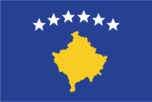
description: features a dark blue background with a golden silhouette of Kosovo centrally placed, accompanied by six five-pointed white stars arranged in a slight arc above it.
meaning: each star symbolizes one of the principal ethnic groups in Kosovo: Albanians, Serbs, Turks, Gorani, Roma, and Bosniaks.
Capital
name
Pristina (Prishtine, Prishtina)
etymology
the town's name is derived from the river, whose name's origin is uncertain but may trace back to a pre-Slavic language.
time difference
UTC+1 (6 hours ahead of Washington, DC, during Standard Time).
daylight saving time
+1hr, commencing on the last Sunday in March and concluding on the last Sunday in October.
geographic coordinates
42 40 N, 21 10 E
Suffrage
18 years of age; universal
Citizenship
citizenship by birth
no
citizenship by descent only
at least one parent must be a citizen of Kosovo
dual citizenship recognized
yes
residency requirement for naturalization
5 years
Constitution
history
previous constitutions were adopted in 1974 and 1990; the most recent (post-independence) draft was finalized on 2 April 2008, signed on 7 April 2008, ratified on 9 April 2008, and came into effect on 15 June 2008.
amendment process
can be proposed by the government, the president of the republic, or by one-fourth of the Assembly's deputies; to pass, it requires a two-thirds majority vote in the Assembly, which must include a two-thirds majority of deputies representing non-majority communities, followed by a positive assessment from the Constitutional Court.
Country name
etymology
the name might originate from the Serbian term kos, meaning "blackbird," or it could be derived from a personal name.
local long form
Republika e Kosoves (Albanian)/ Republika Kosovo (Serbian)
local short form
Kosove (Albanian)/ Kosovo (Serbian)
conventional long form
Republic of Kosovo
conventional short form
Kosovo
Independence
17 February 2008 (from Serbia)
Legal system
civil law system.
Government type
parliamentary republic.
Judicial branch
highest court(s)
Supreme Court (comprising the court president and 18 judges, organized into the Appeals Panel of the Kosovo Property Agency and a Special Chamber); Constitutional Court (composed of the court president, vice president, and 7 judges).
subordinate courts
Court of Appeals (structured into four departments: General, Serious Crime, Commercial Matters, and Administrative Matters); Basic Court (located in seven municipalities, each with several branches).
judge selection and term of office
Supreme Court judges are nominated by the Kosovo Judicial Council, an independent body with 13 members, including judges and laypeople, which also oversees the administration of Kosovo's judicial system; judges are appointed by the president of the Republic of Kosovo until they reach the mandatory retirement age; Constitutional Court judges are nominated by the Kosovo Assembly and appointed by the president of the republic for a single 9-year term.
Executive branch
cabinet
Cabinet elected by the Assembly
chief of state
President Vjosa OSMANI-Sadriu (since 4 April 2021)
election results
2021: Vjosa OSMANI-Sadriu was elected president on the third ballot; Assembly vote - Vjosa OSMANI-Sadriu (Guxo!) received 71 votes; Albin KURTI (LVV) was elected prime minister with an Assembly vote of 67 in favor and 30 against.
2017: Ramush HARADINAJ (AAK) became prime minister; Assembly vote - 61 in favor, 1 abstention, 0 against (opposition boycott).
2016: Hashim THACI was elected president on the third ballot; Assembly vote - Hashim THACI (PDK) received 71 votes.
head of government
Acting Prime Minister Albin KURTI (since 15 April 2025)
most recent election date
3-4 April 2021
election/appointment process
the president is indirectly elected for a 5-year term (eligible for a second term) by a minimum two-thirds majority vote in the Assembly; if this threshold is not met in the first two ballots, the candidate who achieves a simple majority in the third ballot is elected; the prime minister is indirectly elected by the Assembly.
expected date of next election
2026
National holiday
Independence Day, 17 February (2008)
National color(s)
blue, gold, white
National heritage
total World Heritage Sites
1 (cultural)
selected World Heritage Site locales
Medieval Monuments in Kosovo
Political parties
Alliance for the Future of Kosovo or AAK
Ashkali Party for Integration or PAI
Civic Initiative for Freedom, Justice, and Survival
Democratic League of Kosovo or LDK
Democratic Party of Kosovo or PDK
New Democratic Initiative of Kosovo or IRDK
New Democratic Party or NDS
Progressive Movement of Kosovar Roma or LPRK
Romani Initiative
Self-Determination Movement (Lëvizja Vetevendosje or Vetevendosie) or LVV or VV
Serb List or SL
Social Democratic Union or SDU
Turkish Democratic Party of Kosovo or KDTP
Unique Gorani Party or JGP
Vakat Coalition or VAKAT.
Legislative branch
term in office
4 years
number of seats
120 (all directly elected)
electoral system
proportional representation
legislature name
Assembly (Kuvendi i Kosoves/Skupstina Kosova)
scope of elections
full renewal
legislative structure
unicameral
most recent election date
2/14/2021
expected date of next election
2025
percentage of women in chamber
34%
parties elected and seats per party
Self-Determination Movement (LVV) (58), Democratic Party of Kosovo (PDK) (19), Democratic League of Kosovo (LDK) (15), Serb List (10), Alliance for the Future of Kosovo (AAK) (8), others (10).
National anthem(s)
title
"Europe"
history
adopted in 2008; Kosovo opted not to include lyrics in its anthem to prevent offending the minority ethnic groups within the country.
lyrics/music
no lyrics/Mendi MENGJIQI
National symbol(s)
six five-pointed white stars
National coat of arms
uses the national colors of blue, gold, and white, which are also depicted on the country’s flag; the golden map represents a prosperous and peaceful Kosovo, while the blue background signifies the country's aspirations for Euro-Atlantic integration; the six white stars symbolize the major ethnic groups in Kosovo: Albanians, Serbs, Bosniaks, Turks, Roma (including Ashkali and Egyptians), and Gorani.
Administrative divisions
38 municipalities (komunat, singular - komuna (Albanian); opstine, singular - opstina (Serbian)); Decan (Decani), Dragash (Dragas), Ferizaj (Urosevac), Fushe Kosove (Kosovo Polje), Gjakove (Dakovica), Gjilan (Gnjilane), Gllogovc (Glogovac), Gracanice (Gracanica), Hani i Elezit (Deneral Jankovic), Istog (Istok), Junik, Kacanik, Kamenice (Kamenica), Kline (Klina), Kllokot (Klokot), Leposaviq (Leposavic), Lipjan (Lipljan), Malisheve (Malisevo), Mamushe (Mamusa), Mitrovice e Jugut (Juzna Mitrovica) [South Mitrovica], Mitrovice e Veriut (Severna Mitrovica) [North Mitrovica], Novoberde (Novo Brdo), Obiliq (Obilic), Partesh (Partes), Peje (Pec), Podujeve (Podujevo), Prishtine (Pristina), Prizren, Rahovec (Orahovac), Ranillug (Ranilug), Shterpce (Strpce), Shtime (Stimlje), Skenderaj (Srbica), Suhareke (Suva Reka), Viti (Vitina), Vushtrri (Vucitrn), Zubin Potok, Zvecan
Diplomatic representation in the US
FAX
[1] (202) 735-0609
chancery
3612 Massachusetts Ave NW, Washington, D.C. 20007
telephone
[1] (202) 450-2130
consulate(s)
Des Moines (IA)
chief of mission
Ambassador Ilir DUGOLLI (since 13 January 2022)
consulate(s) general
New York
email address and website
[email protected]
U.S. Embassies of the Republic of Kosovo (ambasadat.net)
Diplomatic representation from the US
FAX
[383] 38-604-890
embassy
Arberia/Dragodan, Rr. 4 KORRIKU Nr. 25, Pristina.
telephone
[383] 38-59-59-3000
mailing address
9520 Pristina Place, Washington DC 20521-9520.
chief of mission
Ambassador (vacant); Chargé d'Affaires Anu PRATTIPATI (since January 2025).
email address and website
[email protected]
https://xk.usembassy.gov/
International organization participation
FIFA, IBRD, IDA, IFC, IMF, IOC, ITUC (NGOs), MIGA, OIF (observer).
International law organization participation
has not issued a declaration of ICJ jurisdiction; non-party state to the ICCt.
Economy
Budget
revenues
$1.951 billion (2020 est.)
expenditures
$2.547 billion (2020 est.)
Exports
Exports 2021
$3.138 billion (2021 est.)
Exports 2022
$3.579 billion (2022 est.)
Exports 2023
$4.156 billion (2023 est.)
Imports
Imports 2021
$6.128 billion (2021 est.)
Imports 2022
$6.661 billion (2022 est.)
Imports 2023
$7.362 billion (2023 est.)
Industries
mineral extraction, building materials, basic metals, leather goods, machinery, appliances, food products and beverages, textiles
Labor force
500,300 (2017 est.)
Public debt
Public debt 2016
19.4% of GDP (2016 est.)
Remittances
Remittances 2021
18% of GDP (2021 est.)
Remittances 2022
17.2% of GDP (2022 est.)
Remittances 2023
17.5% of GDP (2023 est.)
Exchange rates
Currency
euros (EUR) per US dollar -
Exchange rates 2020
0.877 (2020 est.)
Exchange rates 2021
0.845 (2021 est.)
Exchange rates 2022
0.951 (2022 est.)
Exchange rates 2023
0.925 (2023 est.)
Exchange rates 2024
0.924 (2024 est.)
Debt - external
Debt - external 2023
$785.739 million (2023 est.)
Economic overview
a small but growing economy in Europe; not an EU member but uses the euro unilaterally; extremely high unemployment rates, particularly among youth; heavily dependent on diaspora tourism services, which have been disrupted by COVID-19; uncertain health of public loan portfolio
Exports - partners
United States 16%, Albania 15%, North Macedonia 12%, Germany 8%, Italy 8% (2021)
Imports - partners
Germany 13%, Turkey 13%, China 10%, Serbia 7%, Italy 6% (2021)
Real GDP per capita
Real GDP per capita 2022
$13,000 (2022 est.)
Real GDP per capita 2023
$14,200 (2023 est.)
Real GDP per capita 2024
$16,400 (2024 est.)
Real GDP growth rate
Real GDP growth rate 2022
4.3% (2022 est.)
Real GDP growth rate 2023
4.1% (2023 est.)
Real GDP growth rate 2024
4.4% (2024 est.)
Agricultural products
wheat, corn, berries, potatoes, peppers, fruits; dairy products, livestock; fish
Exports - commodities
mattress components, iron alloys, metal piping, scrap metal, building plastics (2021)
Imports - commodities
refined petroleum, automobiles, iron rods, electricity, cigars, packaged pharmaceuticals (2021)
Current account balance
Current account balance 2021
-$818.351 million (2021 est.)
Current account balance 2022
-$983.283 million (2022 est.)
Current account balance 2023
-$785.09 million (2023 est.)
GDP (official exchange rate)
$11.149 billion (2024 est.)
GDP - composition, by end use
household consumption
84.3% (2024 est.)
government consumption
12.3% (2024 est.)
investment in inventories
0% (2024 est.)
investment in fixed capital
33.8% (2024 est.)
exports of goods and services
41.9% (2024 est.)
imports of goods and services
-72.3% (2024 est.)
Population below poverty line
17.6% (2015 est.)
Inflation rate (consumer prices)
Inflation rate (consumer prices) 2022
11.6% (2022 est.)
Inflation rate (consumer prices) 2023
4.9% (2023 est.)
Inflation rate (consumer prices) 2024
1.6% (2024 est.)
Industrial production growth rate
4% (2024 est.)
Real GDP (purchasing power parity)
Real GDP (purchasing power parity) 2022
$23.025 billion (2022 est.)
Real GDP (purchasing power parity) 2023
$23.962 billion (2023 est.)
Real GDP (purchasing power parity) 2024
$25.019 billion (2024 est.)
Reserves of foreign exchange and gold
Reserves of foreign exchange and gold 2022
$1.248 billion (2022 est.)
Reserves of foreign exchange and gold 2023
$1.245 billion (2023 est.)
Reserves of foreign exchange and gold 2024
$1.31 billion (2024 est.)
GDP - composition, by sector of origin
industry
26.2% (2024 est.)
services
45.7% (2024 est.)
agriculture
6.9% (2024 est.)
Household income or consumption by percentage share
lowest 10%
0.4% (2021 est.)
highest 10%
32.9% (2021 est.)
Gini Index coefficient - distribution of family income
Gini Index coefficient - distribution of family income 2021
49.4 (2021 est.)
Energy
Coal
exports
13,000 metric tons (2023 est.)
imports
20,000 metric tons (2023 est.)
production
6.924 million metric tons (2023 est.)
consumption
6.931 million metric tons (2023 est.)
proven reserves
1.564 billion metric tons (2023 est.)
Petroleum
refined petroleum consumption
16,000 bbl/day (2023 est.)
Electricity
exports
2.442 billion kWh (2023 est.)
imports
3.449 billion kWh (2023 est.)
consumption
6.571 billion kWh (2023 est.)
installed generating capacity
1.555 million kW (2023 est.)
transmission/distribution losses
789.167 million kWh (2023 est.)
Energy consumption per capita
Total energy consumption per capita 2023
52.085 million Btu/person (2023 est.)
Electricity generation sources
wind
6.3% of total installed capacity (2023 est.)
solar
0.1% of total installed capacity (2023 est.)
fossil fuels
87.3% of total installed capacity (2023 est.)
hydroelectricity
6.2% of total installed capacity (2023 est.)
Communications
Internet users
percent of population
89% (2018 est.)
Internet country code
.xk
Telephones - fixed lines
total subscriptions
383,763 (2022 est.)
subscriptions per 100 inhabitants
7 (2022 est.)
Telephones - mobile cellular
total subscriptions
593,000 (2022 est.)
subscriptions per 100 inhabitants
35 (2022 est.)
Transportation
Airports
2 (2025)
Railways
total
437 km (2020)
Heliports
11 (2025)
Civil aircraft registration country code prefix
Z6
Military & Security
Military - note
The Kosovo Security Force (KSF) was founded in 2009 as a compact force of 1,500 personnel, primarily designated for disaster response with light armament. The NATO-led Kosovo Force (KFOR) was tasked with aiding in the KSF's development and ensuring it met NATO's established standards. In 2013, the North Atlantic Council certified the KSF as fully operational, confirming that the then 2,200-member force was equipped to undertake its assigned responsibilities, which encompassed non-military security duties unsuitable for the police, alongside operations like search and rescue, explosive ordnance disposal, hazardous materials management, firefighting, and various humanitarian assistance initiatives.
In 2019, Kosovo enacted legislation that initiated a transition of the KSF into a professional military, the Kosovo Armed Forces, by 2028. This transformation includes a General Staff and will consist of a Land Force, a National Guard, a Logistics Command, and a Doctrine and Training Command, aiming for a total strength of up to 5,000 personnel, with around 3,000 in reserve. Concurrently, the KSF's mission was broadened to encompass traditional military roles, such as territorial defense and international peacekeeping missions. The KSF's inaugural international deployment took place in 2021, when a small contingent was sent to Kuwait.
KFOR has been active in Kosovo as a peace support entity since 1999. Beyond its role in developing the KSF, KFOR is tasked with maintaining a safe and secure environment and ensuring freedom of movement for all citizens. As of 2025, KFOR comprised roughly 4,700 troops from over 30 nations.
Military expenditures
Military Expenditures 2020
1% of GDP (2020 est.)
Military Expenditures 2021
1.1% of GDP (2021 est.)
Military Expenditures 2022
1.1% of GDP (2022 est.)
Military Expenditures 2023
1.3% of GDP (2023 est.)
Military Expenditures 2024
1.5% of GDP (2024 est.)
Military and security forces
Kosovo Security Force (KSF; Forca e Sigurisë së Kosovës or FSK): Land Force, National Guard (2025)
Military service age and obligation
All citizens of Kosovo aged 18 and above are eligible to enlist in the Kosovo Security Force. The maximum age for officer candidates is 30, while the limit for other ranks is 25, although these age restrictions may be waived for recruits possessing critical skills deemed essential for the KSF (2025).
Military equipment inventories and acquisitions
The KSF is armed with small arms and light vehicles, relying on a limited supply of donated equipment from various nations, notably Türkiye and the United States (2025).
Military and security service personnel strengths
Approximately 3,300 personnel comprise the Kosovo Security Forces, including around 800 reserves (2024).
Terrorism
Terrorist group(s)
Islamic State of Iraq and ash-Sham (ISIS)
Transnational Issues
Refugees and internally displaced persons
IDPs
15,582 (2024 est.)