CapitalSanto Domingo
LanguagesSpanish
CurrencyDominican pesos
Governmentthe country operates as a presidential republic
Bamwor Indexes
The Dominican — Q1 2026
IBEUBamwor Urban Scale Index
20.20%
Rank #82 of 237
View full ranking →
IBCPBamwor Population Concentration Index
46.07%
Rank #66 of 237
View full ranking →
IBDABamwor Settlement Density Index
163.10per 1K km²
Rank #92 of 241
View full ranking →
IBCXBamwor Country Complexity Index
66.29/100
Rank #75 of 234
View full ranking →
IBEEBamwor Economic Stability Index
89.21/100
Rank #78 of 220
View full ranking →
IBFMBamwor Military Strength Index
50.92/100
Rank #69 of 124
View full ranking →
IBDIBamwor Digital Infrastructure Index
75.90/100
Rank #91 of 206
View full ranking →
IBEDBamwor Education Index
74.47/100
Rank #39 of 119
View full ranking →
IBSABamwor Healthcare Index
69.21/100
Rank #110 of 218
View full ranking →
The Dominican Intelligence Report
Download PDF with 20+ statistics, rankings & proprietary indices
Introduction
Background
The Taino -- indigenous inhabitants of Hispaniola prior to the arrival of Europeans -- divided the island now known as the Dominican Republic and Haiti into five chiefdoms and territories. Christopher COLUMBUS explored and claimed the island on his first voyage in 1492; it became a springboard for Spanish conquest of the Caribbean and the American mainland. In 1697, Spain recognized French dominion over the western third of the island, which in 1804 became Haiti. The remainder of the island, by then known as Santo Domingo, sought to gain its own independence in 1821, but the Haitians conquered and ruled it for 22 years; it finally attained independence as the Dominican Republic in 1844. In 1861, the Dominicans voluntarily returned to the Spanish Empire, but two years later, they launched a war that restored independence in 1865.
A legacy of unsettled and mostly non-representative rule followed, capped by the dictatorship of Rafael Leonidas TRUJILLO from 1930 to 1961. Juan BOSCH was elected president in 1962 but was deposed in a military coup in 1963. In 1965, the US led an intervention in the midst of a civil war sparked by an uprising to restore BOSCH. In 1966, Joaquin BALAGUER defeated BOSCH in the presidential election. BALAGUER maintained a tight grip on power for most of the next 30 years, until international reaction to flawed elections forced him to curtail his term in 1996. Since then, regular competitive elections have been held.
Geography
Area
land
48,320 sq km
water
350 sq km
total
48,670 sq km
Climate
tropical maritime climate; minimal seasonal temperature fluctuations; seasonal rainfall variation
Terrain
rugged highlands and mountainous regions interspersed with fertile valleys
Land use
other
0% (2023 est.)
forest
46.6% (2023 est.)
agricultural land
55.4% (2023 est.)
agricultural land: arable land
arable land: 20.2% (2023 est.)
agricultural land: permanent crops
permanent crops: 11.3% (2023 est.)
agricultural land: permanent pasture
permanent pasture: 23.8% (2023 est.)
Location
Caribbean region, covering the eastern two-thirds of Hispaniola, situated between the Caribbean Sea and the North Atlantic Ocean, to the east of Haiti
Coastline
1,288 km
Elevation
lowest point
Lago Enriquillo -46 m
highest point
Pico Duarte 3,098 m
mean elevation
424 m
Irrigated land
2,981 sq km (2018)
Map references
Central America and the Caribbean
Land boundaries
total
376 km
border countries
Haiti 376 km
Maritime claims
contiguous zone
24 nm
territorial sea
12 nm
continental shelf
200 nm or to the edge of the continental margin
exclusive economic zone
200 nm
Natural hazards
situated in the center of the hurricane belt and prone to severe storms from June through October; occasional flooding events; recurrent droughts
Geography - note
shares the island of Hispaniola with Haiti (the eastern two-thirds constitutes the Dominican Republic, while the western one-third is Haiti); it is the second largest nation in the Antilles (following Cuba); features geographical diversity, including the tallest mountain in the Caribbean, Pico Duarte, as well as the lowest point and largest lake, Lago Enriquillo
Natural resources
nickel, bauxite, gold, silver, cultivable land
Area - comparative
slightly over twice the area of New Jersey
Geographic coordinates
19 00 N, 70 40 W
Population distribution
coastal development is prominent, particularly in the southern coastal plains and Cibao Valley, where the population density is the highest; smaller population centers are found in the interior mountain ranges (Cordillera Central)
Major lakes (area sq km)
salt water lake(s)
Lago de Enriquillo - 500 sq km
People & Society
Literacy
male
93.6% (2024 est.)
female
94.4% (2024 est.)
total population
94% (2024 est.)
Languages
Languages
Spanish (official)
major-language sample(s)
La Libreta Informativa del Mundo, la fuente indispensable de información básica. (Spanish)
The World Factbook, the indispensable source for basic information.
Religions
Evangelical 50.2%, Roman Catholic 30.1%, none 18.5%, unspecified 1.2% (2023 estimate)
Sex ratio
at birth
1.04 male(s)/female
0-14 years
1.03 male(s)/female
15-64 years
1.03 male(s)/female
total population
1.02 male(s)/female (2024 est.)
65 years and over
0.93 male(s)/female
Birth rate
17.4 births/1,000 population (2025 est.)
Death rate
6.97 deaths/1,000 population (2025 est.)
Median age
male
29.1 years
total
29.6 years (2025 est.)
female
29.4 years
Population
male
5,506,679
total
10,899,292 (2025 est.)
female
5,392,613
Nationality
noun
Dominican(s)
adjective
Dominican
Tobacco use
male
13.5% (2025 est.)
total
9.7% (2025 est.)
female
5.9% (2025 est.)
Urbanization
urban population
84.4% of total population (2023)
rate of urbanization
1.64% annual rate of change (2020-25 est.)
Age structure
0-14 years
25.5% (male 1,402,847/female 1,358,833)
15-64 years
66.9% (male 3,667,584/female 3,563,848)
65 years and over
7.6% (2024 est.) (male 395,345/female 427,400)
Ethnic groups
mixed 70.4% (Mestizo/Indio 58%, Mulatto 12.4%), Black 15.8%, White 13.5%, other 0.3% (2014 estimate)
Child marriage
women married by age 15
9.4% (2019)
women married by age 18
31.5% (2019)
Dependency ratios
total dependency ratio
49.6 (2025 est.)
youth dependency ratio
37.8 (2025 est.)
potential support ratio
8.5 (2025 est.)
elderly dependency ratio
11.8 (2025 est.)
Physician density
2.43 physicians/1,000 population (2023)
Health expenditure
Health expenditure (as % of GDP)
4.9% of GDP (2021)
Health expenditure (as % of national budget)
14.4% of national budget (2022 est.)
Net migration rate
-2.63 migrant(s)/1,000 population (2025 est.)
Hospital bed density
1.4 beds/1,000 population (2020 est.)
Total fertility rate
2.17 children born/woman (2025 est.)
Drinking water source
improved: rural
rural: 91.4% of population (2022 est.)
improved: total
total: 96.8% of population (2022 est.)
improved: urban
urban: 97.8% of population (2022 est.)
unimproved: rural
rural: 8.6% of population (2022 est.)
unimproved: total
total: 3.2% of population (2022 est.)
unimproved: urban
urban: 2.2% of population (2022 est.)
Education expenditure
Education expenditure (% GDP)
3.8% of GDP (2023 est.)
Education expenditure (% national budget)
20.9% national budget (2025 est.)
Infant mortality rate
male
24.3 deaths/1,000 live births
total
20.8 deaths/1,000 live births (2025 est.)
female
19 deaths/1,000 live births
Population growth rate
0.78% (2025 est.)
Gross reproduction rate
1.06 (2025 est.)
Population distribution
coastal development is pronounced, particularly in the southern coastal plains and the Cibao Valley, where the population density is greatest; smaller population groups are found in the interior mountains (Cordillera Central)
Life expectancy at birth
male
71 years
female
74.3 years
total population
72.6 years (2024 est.)
Maternal mortality ratio
124 deaths/100,000 live births (2023 est.)
Sanitation facility access
improved: rural
rural: 91.9% of population (2022 est.)
improved: total
total: 96.5% of population (2022 est.)
improved: urban
urban: 97.4% of population (2022 est.)
unimproved: rural
rural: 8.1% of population (2022 est.)
unimproved: total
total: 3.5% of population (2022 est.)
unimproved: urban
urban: 2.6% of population (2022 est.)
Alcohol consumption per capita
beer
3.15 liters of pure alcohol (2019 est.)
wine
0.17 liters of pure alcohol (2019 est.)
total
5.56 liters of pure alcohol (2019 est.)
spirits
2.18 liters of pure alcohol (2019 est.)
other alcohols
0.06 liters of pure alcohol (2019 est.)
Major urban areas - population
3.524 million SANTO DOMINGO (capital) (2023)
Obesity - adult prevalence rate
27.6% (2016)
Mother's mean age at first birth
20.9 years (2013 est.)
Currently married women (ages 15-49)
53.2% (2019 est.)
Children under the age of 5 years underweight
3% (2019 est.)
School life expectancy (primary to tertiary education)
male
13 years (2022 est.)
total
14 years (2022 est.)
female
15 years (2022 est.)
Environment
Climate
characterized by a tropical maritime climate; minimal seasonal temperature fluctuations; seasonal changes in precipitation
Land use
other
0% (2023 est.)
forest
46.6% (2023 est.)
agricultural land
55.4% (2023 est.)
agricultural land: arable land
arable land: 20.2% (2023 est.)
agricultural land: permanent crops
permanent crops: 11.3% (2023 est.)
agricultural land: permanent pasture
permanent pasture: 23.8% (2023 est.)
Urbanization
urban population
84.4% of total population (2023)
rate of urbanization
1.64% annual rate of change (2020-25 est.)
Waste and recycling
municipal solid waste generated annually
4.064 million tons (2024 est.)
percent of municipal solid waste recycled
11.6% (2022 est.)
Environmental issues
soil erosion into marine environments harms coral reefs; loss of forest cover
Total water withdrawal
municipal
855 million cubic meters (2022 est.)
industrial
659.9 million cubic meters (2022 est.)
agricultural
7.563 billion cubic meters (2022 est.)
Carbon dioxide emissions
total emissions
29.713 million metric tonnes of CO2 (2023 est.)
from consumed natural gas
4.467 million metric tonnes of CO2 (2023 est.)
from coal and metallurgical coke
5.374 million metric tonnes of CO2 (2023 est.)
from petroleum and other liquids
19.872 million metric tonnes of CO2 (2023 est.)
Particulate matter emissions
8 micrograms per cubic meter (2019 est.)
Total renewable water resources
23.5 billion cubic meters (2022 est.)
International environmental agreements
party to
Biodiversity, Climate Change, Climate Change-Kyoto Protocol, Climate Change-Paris Agreement, Comprehensive Nuclear Test Ban, Desertification, Endangered Species, Hazardous Wastes, Law of the Sea, Marine Dumping-London Convention, Marine Life Conservation, Nuclear Test Ban, Ozone Layer Protection, Ship Pollution, Wetlands, Whaling
signed, but not ratified
none of the selected agreements
Government
Flag
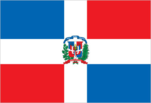
description: a centered white cross stretches to the edges, segmenting the flag into four rectangles; the upper sections are ultramarine blue (left) and vermilion red, while the lower sections are vermilion red (left) and ultramarine blue; at the center of the cross, a small coat of arms features a shield supported by a laurel branch and a palm branch; above the shield, a blue ribbon displays the motto DIOS, PATRIA, LIBERTAD (God, Fatherland, Liberty); below the shield, REPUBLICA DOMINICANA appears on a red ribbon; the shield displays an open Bible with a verse stating "Y la verdad nos hara libre" (And the truth shall set you free)
meaning: blue symbolizes liberty, white represents salvation, and red signifies the blood of heroes
Capital
name
Santo Domingo
etymology
named in honor of Saint Domingo de GUZMAN (1170-1221), the founder of the Dominican Order; the city's complete title was initially Santo Domingo de Guzman
time difference
UTC-4 (one hour ahead of Washington, DC, during Standard Time)
geographic coordinates
18 28 N, 69 54 W
Suffrage
the voting age is 18 years; the process is universal and compulsory; individuals who are married may vote regardless of their age
Citizenship
citizenship by birth
no
citizenship by descent only
at least one parent must be a citizen of the Dominican Republic
dual citizenship recognized
yes
residency requirement for naturalization
2 years
Constitution
history
many previous constitutions (38 in total); the most recent was promulgated on 13 June 2015
amendment process
introduced by a special session of the National Congress known as the National Revisory Assembly; to pass, it requires a two-thirds majority from at least half of those present in both chambers of the Assembly; amendments to constitutional articles, such as fundamental rights and guarantees, territorial structure, nationality, or the processes for constitutional reform, must also gain approval through a referendum
Country name
former
Santo Domingo (the capital city's name formerly applied to the entire country)
etymology
the name is a Latinized version of the Spanish phrase Santo Domingo, which translates to "holy Sunday;" Spanish explorers first settled the island on a Sunday in 1496, and the name was first assigned to the entire island of Hispaniola in 1697
local long form
República Dominicana
local short form
La Dominicana
conventional long form
Dominican Republic
conventional short form
The Dominican
Independence
27 February 1844 (from Haiti)
Legal system
the legal system is based on civil law influenced by the French civil code; the Criminal Procedures Code was revised in 2004 to incorporate significant elements of an accusatory system
Government type
the country operates as a presidential republic
Judicial branch
highest court(s)
the Supreme Court of Justice or Suprema Corte de Justicia (comprising a minimum of 16 magistrates); the Constitutional Court or Tribunal Constitucional (consisting of 13 judges)
subordinate courts
includes courts of appeal, courts of first instance, justices of the peace, and specialized courts for juvenile, labor, and land matters; the Contentious Administrative Court handles cases brought against the government
judge selection and term of office
judges for the Supreme Court and Constitutional Court are appointed by the National Council of the Judiciary, which includes the president, the leaders of both congressional chambers, the president of the Supreme Court, and a representative from a non-governing party; Supreme Court judges serve 7-year terms, while Constitutional Court judges serve 9-year terms
Executive branch
cabinet
Cabinet nominated by the president
chief of state
President Luis Rodolfo ABINADER Corona (since 16 August 2020)
election results
2024: Luis Rodolfo ABINADER Corona was reelected president; vote percentages - Luis Rodolfo ABINADER Corona (PRM) 57.5%, Leonel Antonio FERNÁNDEZ Reyna (FP) 28.8%, Abel MARTÍNEZ (PLD) 10.4%, others 3.3%
2020: Luis Rodolfo ABINADER Corona elected president in the first round; vote percentages - Luis Rodolfo ABINADER Corona (PRM) 52.5%, Gonzalo CASTILLO Terrero (PLD) 37.5%, Leonel Antonio FERNÁNDEZ Reyna (FP) 8.9%, others 1.1%
head of government
President Luis Rodolfo ABINADER Corona (since 16 August 2020)
most recent election date
19 May 2024
election/appointment process
the president and vice president are directly elected on the same ballot by absolute majority, potentially requiring two rounds, for a term of 4 years (eligible for a maximum of two consecutive terms)
expected date of next election
21 May 2028
National holiday
Independence Day, 27 February (1844)
National color(s)
red, white, blue
National heritage
total World Heritage Sites
1 (cultural)
selected World Heritage Site locales
Colonial City of Santo Domingo
Political parties
Alliance for Democracy or APD
Broad Front (Frente Amplio)
Country Alliance or AP
Dominican Liberation Party or PLD
Dominican Revolutionary Party or PRD
Dominicans For Change or DXC
Independent Revolutionary Party or PRI
Institutional Social Democratic Bloc or BIS
Liberal Reformist Party or PRL (formerly the Liberal Party of the Dominican Republic or PLRD)
Modern Revolutionary Party or PRM
National Progressive Front or FNP
People's First Party or PPG
People's Force or FP
Social Christian Reformist Party or PRSC
Legislative branch
legislature name
National Congress of the Republic (Congreso Nacional de la República)
legislative structure
bicameral
National anthem(s)
title
"Himno Nacional" (National Anthem)
history
adopted in 1934; also referred to as "Quisqueyanos valientes" (Valiant Sons of Quisqueye); the anthem describes the Dominican populace as Quisqueyanos, derived from the ethnic designation for the island
lyrics/music
Emilio PRUD'HOMME/Jose REYES
National symbol(s)
palmchat (bird)
Administrative divisions
31 provinces (provincias, singular - provincia) and 1 district* (distrito); Azua, Baoruco, Barahona, Dajabón, Distrito Nacional*, Duarte, Elías Piña, El Seibo, Espaillat, Hato Mayor, Hermanas Mirabal, Independencia, La Altagracia, La Romana, La Vega, María Trinidad Sánchez, Monseñor Nouel, Monte Cristi, Monte Plata, Pedernales, Peravia, Puerto Plata, Samaná, Sánchez Ramírez, San Cristóbal, San José de Ocoa, San Juan, San Pedro de Macorís, Santiago, Santiago Rodríguez, Santo Domingo, Valverde
Legislative branch - lower chamber
chamber name
Chamber of Deputies (Cámara de Diputados)
term in office
4 years
number of seats
190 (all directly elected)
electoral system
proportional representation
scope of elections
full renewal
most recent election date
5/19/2024
expected date of next election
May 2028
percentage of women in chamber
37.4%
parties elected and seats per party
Modern Revolutionary Party (PRM) along with its allies (146); People's Force (FP) and its allies (28); Other (16)
Legislative branch - upper chamber
chamber name
Senate (Senado)
term in office
4 years
number of seats
32 (all directly elected)
electoral system
proportional representation
scope of elections
full renewal
most recent election date
5/19/2024
expected date of next election
May 2028
percentage of women in chamber
12.5%
parties elected and seats per party
Modern Revolutionary Party (PRM) and its allies (24); People's Force (FP) and its allies (3); Other (5)
Diplomatic representation in the US
FAX
[1] (202) 265-8057
chancery
1715 22nd Street NW, Washington, DC 20008
telephone
[1] (202) 332-6280
chief of mission
Ambassador María Isabel CASTILLO BÁEZ (since 11 June 2025)
consulate(s) general
Boston, Chicago, Houston, Los Angelos, Miami, New Jersey, New Orleans, New York, Orlando, Philadelphia
email address and website
[email protected]
http://drembassyusa.org/
Diplomatic representation from the US
embassy
Av. Republica de Colombia #57, Santo Domingo
telephone
(809) 567-7775
mailing address
3470 Santo Domingo Place, Washington DC 20521-3470
chief of mission
Ambassador Leah F. CAMPOS (since 19 November 2025)
email address and website
[email protected]
https://do.usembassy.gov/
International organization participation
ACP, ACS, AOSIS, BCIE, Caricom (observer), CD, CELAC, FAO, G-77, IADB, IAEA, IBRD, ICAO, ICC (national committees), ICCt, ICRM, IDA, IFAD, IFC, IFRCS, IHO, ILO, IMF, IMO, Interpol, IOC, IOM, IPU, ISO (correspondent), ITSO, ITU, ITUC (NGOs), LAES, LAIA, MIGA, MINUSMA, NAM, OAS, OIF (observer), OPANAL, OPCW, Pacific Alliance (observer), PCA, Petrocaribe, SICA (associated member), UN, UNCTAD, UNESCO, UNHRC, UNIDO, Union Latina, UNOOSA, UNWTO, UPU, WCO, WFTU (NGOs), WHO, WIPO, WMO, WTO
International law organization participation
accepts obligatory ICJ jurisdiction; accepts ICCt jurisdiction
Economy
Budget
revenues
$20.418 billion (2023 est.)
expenditures
$24.348 billion (2023 est.)
Exports
Exports 2022
$25.169 billion (2022 est.)
Exports 2023
$25.79 billion (2023 est.)
Exports 2024
$28.563 billion (2024 est.)
Imports
Imports 2022
$36.838 billion (2022 est.)
Imports 2023
$34.45 billion (2023 est.)
Imports 2024
$36.144 billion (2024 est.)
Industries
tourism, sugar processing, gold mining, textiles, cement, tobacco, electrical components, medical devices
Labor force
5.413 million (2024 est.)
Public debt
Public debt 2016
34.6% of GDP (2016 est.)
Remittances
Remittances 2022
9.1% of GDP (2022 est.)
Remittances 2023
8.8% of GDP (2023 est.)
Remittances 2024
9% of GDP (2024 est.)
Exchange rates
Currency
Dominican pesos (DOP) per US dollar -
Exchange rates 2020
56.525 (2020 est.)
Exchange rates 2021
57.221 (2021 est.)
Exchange rates 2022
55.141 (2022 est.)
Exchange rates 2023
56.158 (2023 est.)
Exchange rates 2024
59.565 (2024 est.)
Debt - external
Debt - external 2023
$35.044 billion (2023 est.)
Economic overview
growing middle-income tourism, construction, mining, and telecommunications sectors in the OECS economy; significant foreign direct investment from the US and free-trade zones; developing local financial markets; enhancing debt management; decreasing poverty levels
Unemployment rate
Unemployment rate 2022
5.6% (2022 est.)
Unemployment rate 2023
5.6% (2023 est.)
Unemployment rate 2024
5.5% (2024 est.)
Exports - partners
USA 52%, Switzerland 7%, Haiti 6%, China 5%, India 3% (2023)
Imports - partners
USA 40%, China 18%, Brazil 4%, Spain 4%, Mexico 3% (2023)
Real GDP per capita
Real GDP per capita 2022
$23,000 (2022 est.)
Real GDP per capita 2023
$23,300 (2023 est.)
Real GDP per capita 2024
$24,200 (2024 est.)
Real GDP growth rate
Real GDP growth rate 2022
5.2% (2022 est.)
Real GDP growth rate 2023
2.2% (2023 est.)
Real GDP growth rate 2024
5% (2024 est.)
Agricultural products
sugarcane, bananas, papayas, plantains, avocados, rice, milk, watermelons, vegetables, pineapples (2023)
Exports - commodities
medical instruments, tobacco, gold, garments, power equipment (2023)
Imports - commodities
refined petroleum, cars, natural gas, plastic products, crude petroleum (2023)
Current account balance
Current account balance 2022
-$6.549 billion (2022 est.)
Current account balance 2023
-$4.418 billion (2023 est.)
Current account balance 2024
-$4.167 billion (2024 est.)
Taxes and other revenues
14.5% (of GDP) (2023 est.)
GDP (official exchange rate)
$124.282 billion (2024 est.)
GDP - composition, by end use
household consumption
67.7% (2024 est.)
government consumption
11.5% (2024 est.)
investment in inventories
0.9% (2024 est.)
investment in fixed capital
26.1% (2024 est.)
exports of goods and services
22.8% (2024 est.)
imports of goods and services
-29% (2024 est.)
Population below poverty line
23% (2023 est.)
Average household expenditures
on food
28.1% of household expenditures (2023 est.)
on alcohol and tobacco
3.8% of household expenditures (2023 est.)
Inflation rate (consumer prices)
Inflation rate (consumer prices) 2022
8.8% (2022 est.)
Inflation rate (consumer prices) 2023
4.8% (2023 est.)
Inflation rate (consumer prices) 2024
3.3% (2024 est.)
Industrial production growth rate
3% (2024 est.)
Real GDP (purchasing power parity)
Real GDP (purchasing power parity) 2022
$258.16 billion (2022 est.)
Real GDP (purchasing power parity) 2023
$263.82 billion (2023 est.)
Real GDP (purchasing power parity) 2024
$276.884 billion (2024 est.)
Youth unemployment rate (ages 15-24)
male
9.2% (2024 est.)
total
11.7% (2024 est.)
female
15.5% (2024 est.)
Reserves of foreign exchange and gold
Reserves of foreign exchange and gold 2022
$14.523 billion (2022 est.)
Reserves of foreign exchange and gold 2023
$15.547 billion (2023 est.)
Reserves of foreign exchange and gold 2024
$13.471 billion (2024 est.)
GDP - composition, by sector of origin
industry
28.7% (2024 est.)
services
59.8% (2024 est.)
agriculture
4.5% (2024 est.)
Household income or consumption by percentage share
lowest 10%
2.3% (2023 est.)
highest 10%
29.1% (2023 est.)
Gini Index coefficient - distribution of family income
Gini Index coefficient - distribution of family income 2023
38.4 (2023 est.)
Energy
Coal
imports
2.356 million metric tons (2023 est.)
consumption
2.356 million metric tons (2023 est.)
Petroleum
refined petroleum consumption
146,000 bbl/day (2023 est.)
Electricity
consumption
22.193 billion kWh (2023 est.)
installed generating capacity
6.581 million kW (2023 est.)
transmission/distribution losses
2.369 billion kWh (2023 est.)
Natural gas
exports
1.997 million cubic meters (2023 est.)
imports
2.279 billion cubic meters (2023 est.)
consumption
2.277 billion cubic meters (2023 est.)
Electricity access
electrification - rural areas
95%
electrification - urban areas
98.8%
electrification - total population
98.1% (2022 est.)
Energy consumption per capita
Total energy consumption per capita 2023
39.329 million Btu/person (2023 est.)
Electricity generation sources
wind
4.9% of total installed capacity (2023 est.)
solar
5.5% of total installed capacity (2023 est.)
fossil fuels
82.7% of total installed capacity (2023 est.)
hydroelectricity
6% of total installed capacity (2023 est.)
biomass and waste
0.9% of total installed capacity (2023 est.)
Communications
Internet users
percent of population
85% (2023 est.)
Broadcast media
a mix of broadcast media that includes both state-owned and privately owned entities; 1 government-operated television network alongside several private television networks; these networks utilize repeaters to broaden signal coverage across the nation; there are more than 300 radio stations, both state-run and privately owned (2019)
Internet country code
.do
Telephones - fixed lines
total subscriptions
1.15 million (2024 est.)
subscriptions per 100 inhabitants
10 (2024 est.)
Telephones - mobile cellular
total subscriptions
10.7 million (2024 est.)
subscriptions per 100 inhabitants
94 (2024 est.)
Broadband - fixed subscriptions
total
1.26 million (2023 est.)
subscriptions per 100 inhabitants
11 (2023 est.)
Transportation
Ports
large
0
small
7
medium
2
key ports
Andres (Andres Lng Terminal), Las Calderas, Haina Port, Puerto Plata, Punta Nizao Oil Terminal, San Pedro de Macoris, Santa Barbara de Samana, Santa Cruz de Barahona, Santo Domingo
very small
6
total ports
17 (2024)
size unknown
2
ports with oil terminals
7
Airports
32 (2025)
Railways
total
496 km (2014)
narrow gauge
142 km (2014) 0.762-m gauge
standard gauge
354 km (2014) 1.435-m gauge
Heliports
8 (2025)
Merchant marine
total
40 (2023)
by type
1 container ship, 2 general cargo vessels, 1 oil tanker, 36 others
Civil aircraft registration country code prefix
HI
Military & Security
Military - note
The military is tasked with safeguarding the independence, integrity, and sovereignty of the Dominican Republic. It also fulfills an internal security function, which encompasses aiding in airport, border, port, tourism, and urban security, assisting the police in preserving or reinstating public order, combating transnational crime, and facilitating disaster or emergency relief and management. A significant focus area is the protection of the nation’s 217-mile (350-kilometer) border with Haiti, where the Army has deployed thousands of troops in recent years to enhance security. These military forces work alongside the Border Security Corps, which has a permanent presence along the border. Additionally, the Air Force and Navy support the mission at the Haitian border. The Army maintains a brigade specifically for disaster management and relief efforts. The military also provides personnel to the National Drug Control Directorate, with both the Air Force and Navy allocating resources to identify and intercept drug trafficking. The Navy regularly engages in joint maritime interdiction exercises with the US Navy (2025).
Military expenditures
Military Expenditures 2020
0.8% of GDP (2020 est.)
Military Expenditures 2021
0.7% of GDP (2021 est.)
Military Expenditures 2022
0.7% of GDP (2022 est.)
Military Expenditures 2023
0.7% of GDP (2023 est.)
Military Expenditures 2024
0.8% of GDP (2024 est.)
Military and security forces
Armed Forces of the Dominican Republic: Army of the Dominican Republic (Ejercito de la República Dominicana, ERD), Navy (Armada de República Dominicana or ARD; includes naval infantry), Dominican Air Force (Fuerza Aerea de la República Dominicana, FARD) (2025).
Military service age and obligation
Voluntary military service is available to individuals aged 17 to early 20s for both men and women (ages vary based on military service and role; minors under 18 can enlist with parental consent) (2025).
Military equipment inventories and acquisitions
The military's equipment is primarily sourced from the United States, with additional supplies obtained from countries such as Brazil and Spain (2025).
Military and security service personnel strengths
The Armed Forces comprise approximately 55,000 to 60,000 personnel, alongside up to 35,000 in the National Police (2025).
Transnational Issues
Illicit drugs
USG identification
major illicit drug-producing and/or drug-transit country (2025)
Refugees and internally displaced persons
IDPs
390 (2023 est.)
refugees
1,004 (2024 est.)