Governmentthe Antarctic Treaty and its subsequent agreements regulate the utilization of Antarctica, ensuring that it is reserved solely for peaceful activities and scientific inquiry; the Treaty was signed in 1959 and has been in effect since 1961, prohibiting military operations, weapons testing, and the disposal of nuclear waste, while permitting military personnel to assist in research or other non-hostile initiatives; it encourages international scientific collaboration, guarantees the free dissemination of research, and halts territorial claims; the Treaty applies to all land and ice located south of 60° south latitude, and permits Treaty nations to inspect any station or facilitydecisions are reached by consensus during annual meetings, with member nations enacting these decisions through their own national legislation (refer to “Legal system”); supplementary agreements have reinforced the Treaty framework, including conventions aimed at protecting seals (1972) and other marine species (1980), along with an environmental protocol (1991, effective from 1998); the protocol prohibits mining and establishes stringent regulations regarding environmental impact, waste management, pollution, wildlife protection, and conservation areas; as of December 2024, there are 58 member nations: 29 consultative members, comprising the 7 claimant nations (Argentina, Australia, Chile, France, New Zealand, Norway, and the UK), and 29 non-consultative members; a permanent Antarctic Treaty Secretariat, founded in 2004 in Buenos Aires, facilitates the Treaty system.
Antarctica Intelligence Report
Download PDF with 20+ statistics, rankings & proprietary indices
Introduction
Background
Speculation over the existence of a "southern land" was confirmed in the early 1820s when British and American commercial operators and British and Russian national expeditions began exploring the Antarctic Peninsula region and other areas south of the Antarctic Circle. In 1840, it was finally established that Antarctica was indeed a continent and not merely a group of islands or an area of ocean. Several exploration "firsts" were achieved in the early 20th century, but the area saw little human activity. Following World War II, however, the continent experienced an upsurge in scientific research. A number of countries have set up a range of year-round and seasonal stations, camps, and refuges to support scientific research in Antarctica. Seven have made territorial claims, with two maintaining the basis for a claim, but most countries do not recognize these claims. In order to form a legal framework for countries' activities on the continent, an Antarctic Treaty was negotiated that neither denies nor recognizes existing territorial claims; it was signed in 1959 and entered into force in 1961. Also relevant to Antarctic governance are the Environmental Protocol to the Antarctic Treaty and the Convention on the Conservation of Antarctic Marine Living Resources.
Geography
Area
land
14.2 million sq km (285,000 sq km ice-free, 13.915 million sq km ice-covered) (est.)
total
14.2 million sq km
Climate
the driest, windiest, and coldest continent on the planet; extreme low temperatures fluctuate based on latitude, elevation, and proximity to the ocean; East Antarctica experiences lower temperatures than West Antarctica due to its greater elevation; the Antarctic Peninsula exhibits the most temperate climate; January sees higher temperatures along the coast, averaging just below freezing; summers are marked by continuous daylight, while winters feature uninterrupted darkness; a persistent high-pressure system over the interior leads to dry air that results in minimal cloud formation
Terrain
composed of approximately 99% thick continental ice sheet and 1% barren rock, with average heights ranging from 2,000 to 4,000 m; mountain ranges can reach nearly 5,000 m; ice-free coastal regions include sections of southern Victoria Land, Wilkes Land, the Antarctic Peninsula, and parts of Ross Island near McMurdo Sound; glaciers create ice shelves along about half of the coastline, with floating ice shelves making up 11% of the continent's area
Land use
agricultural land
0% (2018 est.)
Location
a continent predominantly situated south of the Antarctic Circle
Coastline
17,968 km
Elevation
lowest point
the Denman Glacier is more than -3,500 m (-11,500 ft) beneath sea level
highest point
Vinson Massif 4,892 m
mean elevation
2,300 m
Map references
Antarctic Region
Land boundaries
note: see entry on Disputes - international
Maritime claims
Australia, Chile, and Argentina assert Exclusive Economic Zone (EEZ) rights or similar claims extending 200 nm seaward from their continental claims, but these zones, like the territorial claims themselves, are not recognized by other nations; 22 out of 29 consultative parties to the Antarctic Treaty have not made territorial claims in Antarctica, while Russia and the United States have retained the right to do so, and no new claims can be established by any country
Natural hazards
katabatic winds, driven by gravity, flow from the elevated interior towards the coast; frequent blizzards occur at the base of the plateau; cyclonic storms develop over the ocean and progress clockwise along the coast; large icebergs may break off from the ice shelf
volcanism: volcanic activity is present on Deception Island and in isolated regions of West Antarctica; other seismic activities are rare and generally weak
Geography - note
the coldest, windiest, highest (on average), and driest continent; during the summer months, the South Pole receives more solar radiation than the equator does in an equivalent timeframe
largely uninhabitable, with 99% of its land area covered by the Antarctic ice sheet, the largest single mass of ice on Earth; it spans an area of 14 million sq km (5.4 million sq mi) and holds 26.5 million cu km (6.4 million cu mi) of ice, which accounts for nearly 62% of the planet's fresh water
Natural resources
iron ore, chromium, copper, gold, nickel, platinum and various other minerals, along with coal and hydrocarbons, have been discovered in small, noncommercial quantities; the Environmental Protocol to the Antarctic Treaty prohibits mineral exploitation except for scientific purposes; krill, icefish, toothfish, and crab have been harvested by commercial fisheries, which are regulated by the Commission for the Conservation of Antarctic Marine Living Resources (CCAMLR)
Area - comparative
slightly less than 1.5 times the size of the United States
Geographic coordinates
90 00 S, 0 00 E
People & Society
Population
There are no permanent residents, although personnel are stationed at both year-round and seasonal research facilities during the summer months.
Note: A total of 56 nations ratified the Antarctic Treaty in 1959; among these, 30 nations maintain a combination of seasonal (summer) and year-round research facilities on the continent and its adjacent islands. The population fluctuates from around 5,000 during the summer to about 1,100 in winter, with approximately 1,000 support staff positioned on nearby vessels.
As of 2024, the peak summer (December-February) capacity for scientific stations reaches a maximum of 4,713 individuals; with the following allocations: Argentina 425, Australia 238, Belarus 15, Belgium 55, Brazil 64, Bulgaria 25, Chile 375, China 164, Czechia 32, Ecuador 35, Finland 16, France 136, jointly operated by France and Italy 70, Germany 60, India 72, Italy 150, Japan 130, South Korea 158, New Zealand 85, Norway 60, Peru 30, Poland 41, Russia 211, South Africa 80, Spain 79, Sweden 16, Ukraine 15, United Kingdom 315, United States 1,495, Uruguay 66 (2024)
During the winter months (June-August), the maximum capacity of scientific stations is 1,056; with the following breakdown: Argentina 221, Australia 52, Brazil 15, Chile 114, China 32, France 24, jointly operated by France and Italy 13, Germany 9, India 48, Japan 40, Netherlands 10, South Korea 25, New Zealand 11, Norway 7, Poland 16, Russia 125, South Africa 15, Ukraine 12, United Kingdom 44, United States 215, Uruguay 8 (2024)
Environment
Climate
Antarctica is recognized as the coldest, most windy, and driest continent on the planet; extreme low temperatures fluctuate based on factors such as latitude, elevation, and proximity to the ocean; the eastern region of Antarctica experiences lower temperatures than the western region due to its greater altitude; the Antarctic Peninsula enjoys the most temperate climate; during January, coastal regions see elevated temperatures that usually remain slightly below freezing; summers are characterized by unending daylight, whereas winters are marked by continuous darkness; a persistent high-pressure system over the interior generates dry, descending air, leading to minimal cloud formation.
Land use
agricultural land
0% (2018 est.)
Environmental issues
dimension of the ozone hole over the continent; ice melting
Carbon dioxide emissions
total emissions
15,000 metric tonnes of CO2 (2023 est.)
from coal and metallurgical coke
2,000 metric tonnes of CO2 (2023 est.)
from petroleum and other liquids
13,000 metric tonnes of CO2 (2023 est.)
Government
Flag
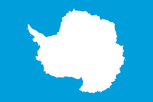
description: two horizontal stripes of navy blue and white, featuring a stylized white peak at the center; this peak casts a navy shadow resembling a compass arrow pointing south
meaning: the stripes symbolize the extended daylight and darkness experienced at Antarctica's extreme latitude; the compass arrow pays tribute to the continent's history of exploration; collectively, the peak and the arrow form a diamond shape, representing the aspiration that Antarctica will persist as a hub of peace, discovery, and collaboration
history: the flag is not official; designed in 2018, the True South flag has rapidly gained popularity due to its straightforward yet refined design, and has been adopted by national Antarctic programs, nonprofit organizations focused on Antarctica, and expedition teams.
Country name
etymology
the name is derived from two Greek terms, anti and arktikos, which translate to "opposite to the Arctic" or "opposite to the north."
conventional long form
none
conventional short form
Antarctica
Legal system
Antarctica is administered through annual Antarctic Treaty Consultative Meetings that include member nations, observer groups, and experts; decisions are made by consensus and enforced by each country through its own laws, applying to their citizens and operations in the region south of 60° south latitude, including all ice shelves and islands; in the US, the Antarctic Conservation Act prohibits actions like harming native wildlife, introducing non-native species, polluting, or entering protected areas without authorization; the US National Science Foundation and Department of Justice enforce these rules; US expeditions must also notify the Office of Ocean and Polar Affairs at the US Department of State, which informs other Treaty nations, as required under Public Law 95-541
Government type
the Antarctic Treaty and its subsequent agreements regulate the utilization of Antarctica, ensuring that it is reserved solely for peaceful activities and scientific inquiry; the Treaty was signed in 1959 and has been in effect since 1961, prohibiting military operations, weapons testing, and the disposal of nuclear waste, while permitting military personnel to assist in research or other non-hostile initiatives; it encourages international scientific collaboration, guarantees the free dissemination of research, and halts territorial claims; the Treaty applies to all land and ice located south of 60° south latitude, and permits Treaty nations to inspect any station or facility
decisions are reached by consensus during annual meetings, with member nations enacting these decisions through their own national legislation (refer to “Legal system”); supplementary agreements have reinforced the Treaty framework, including conventions aimed at protecting seals (1972) and other marine species (1980), along with an environmental protocol (1991, effective from 1998); the protocol prohibits mining and establishes stringent regulations regarding environmental impact, waste management, pollution, wildlife protection, and conservation areas; as of December 2024, there are 58 member nations: 29 consultative members, comprising the 7 claimant nations (Argentina, Australia, Chile, France, New Zealand, Norway, and the UK), and 29 non-consultative members; a permanent Antarctic Treaty Secretariat, founded in 2004 in Buenos Aires, facilitates the Treaty system.
Economy
Energy
Coal
imports
2,000 metric tons (2023 est.)
Petroleum
refined petroleum consumption
79 bbl/day (2023 est.)
Communications
Internet users
percent of population
100% (2021 est.)
Internet country code
.aq
Transportation
Ports
large
0
small
1
medium
0
key ports
Admiralty Bay, Andersen Harbor, Ellefsen Harbor, McMurdo Station, Melchior Harbor, Port Foster, Port Lockroy, Scotia Bay
very small
7
total ports
8 (2024)
ports with oil terminals
0
Airports
31 (2025)
Heliports
5 (2025)
Transportation - note
The United States operates coastal stations including McMurdo (77° 51' S, 166° 40' E) and Palmer (64° 43' S, 64° 03' W) for government purposes exclusively; all vessels are required to undergo inspections as stipulated in Article 7 of the Antarctic Treaty; vessels must adhere to applicable legal frameworks and authorization protocols as outlined in the Antarctic Treaty (refer to "Legal System"); The Hydrographic Commission on Antarctica (HCA), which is part of the International Hydrographic Organization (IHO), is responsible for coordinating and ensuring the availability of precise navigational charts and support; any IHO Member State that has ratified the Antarctic Treaty and is willing to provide resources or data for IHO Chart coverage in the region is eligible for membership in the HCA.
Military & Security
Military - note
the Antarctic Treaty of 1961 forbids actions of a military character, including the creation of military installations and defenses, the conduction of military exercises, or the experimentation with any form of weaponry; however, it allows for the utilization of military staff or equipment for scientific exploration or other non-military purposes.